
Translated material
Low start rates
Tariffs at a low start. Prices for gasoline and tariffs for natural monopolies frozen in the pre -election period will be increased in the very near future. The price race has already begun. What the consequences will be - the New Times found out in early April in the government, a meeting was held in the government dedicated to the upcoming change in tariffs for the services of natural monopolies. Their planned increase in 2012 was not scheduled for January 1, as usual, but on July 1. The official explanation of the change of dates - the heating season begins in the second half of the year. But in past years, this did not prevent the government from raising tariffs since the beginning of the year. Then, however, there were no March presidential elections, and even so nervous ... Now they are behind, and the natural monopolies, led by Gazprom, were engaged in the usual business: knocking out a new increase in tariffs from the government.
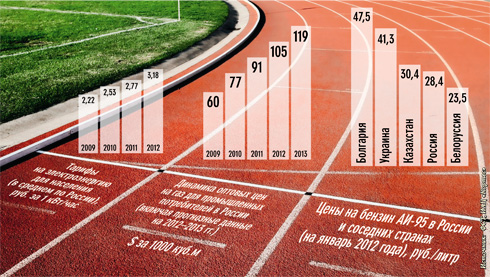
Click that Gazprom launched the first trial ball at the end of March, demanding to raise gas prices by 40%from the second half of the year at the end of March. And this despite the fact that at the end of 2011 the government decided that gas tariffs from July 1, 2012 should increase by 15%. On March 23, at a meeting in Kirishah, Vladimir Putin once again confirmed: only 15%. But Gazprom did not calm down. On April 6, it was announced that the company was advocating for an additional increase in prices in the domestic market. According to The New Times, Gazprom asks on October 1 to raise tariffs by another 11%. The expected position was called the position of Gazprom, the partner of the company Rusenergy Mikhail Krutikhin: “Yes, the monopoly insists on raising tariffs even after Putin’s shout. As many predicted, increasing the tax on mining (NPPs) will be forwarded to consumers. ”

Since the beginning of this year, NPI has been doubled for Gazprom. And Gazprom explains its desire to raise tariffs by the fact that the growth of payments to the treasury from the concern in 2012 will amount to 114 billion rubles, and the annual income from the planned increase in tariffs (by 15%) - only 50 billion. As a result, the losses will amount to over $ 2 billion per year, while the companies need to finance the investment program, update fixed assets, lay gas pipelines and master the gas pipelines and master New deposits
* * See the New Times No. 12 dated April 2, 2012.
Why did Gazprom first asked for an increase in tariffs by 40% and from July 1, and now it seems to be 26% and from October 1? “The company acts in strict accordance with the famous eastern proverb:“ Do you want to get a ram - ask for a camel, ”Krutikhin believes. Valery Nesterov, an analyst in the Troika Dialog Technical Council, agrees with him: “I do not think that the company really hoped that it would be able to achieve a 40 percent increase in tariffs at once. But, perhaps, I hoped that the government would still meet her and conduct additional indexing of gas prices-say, another 10-15%. ”
Gazprom’s claims for an additional increase in tariffs, the investkaf analyst Vitaly Mikhalchuk, consider the claims to be unreasonable. Even with increasing tax burden, the Gazprom refusal will not ruin, the expert is sure. The activities of the concern are profitable
* Gazprom’s net profit in 2011 amounted to about $ 40 billion-25% more than in 2010. . And the increase in tax rates for Gazprom, according to Mikhalchuk, was just undertaken with the aim of removing a part of the money “surplus” from him. Mikhail Krutikhin recalls: “In 2012, thanks to the active use of shale and liquefied gas, blue fuel prices in the United States were lower than prices for industrial enterprises in Russia. The increase in Gazprom, which was requested by Gazprom, would make Russian gas almost twice as much as American. ”
"
According to the results of the year, inflation will be at least 8–8.5%. That is, according to this parameter, the country will be discarded to the level of 2010
"
Manual prices for gasoline in Russia are not set: the market for oil products is considered competitive. But since only five oil companies rule the ball on it
* Rosneft, Gazprom Neft, Lukoila, TNK-BP, Surgutneftegaz accounts for over 75% of the domestic-Russian gasoline market. , he is quite amenable to manual management by the government. In January, the Ministry of Energy agreed with the largest players: until spring - that is, before the elections - not to increase retail prices at gas stations. The elections have passed, the moratorium on the increase in prices is over, and now the hands of the "gasoline kings" are untied.
The first began to increase the prices of Lukoil. Analysts of the Cortes center noted that at the company's gas stations, the increase in the cost of a liter of fuel over the past two weeks was 25 kopecks. The Director of Development and Marketing of the Cortes IAC Pavel Strokov believes that this is only the beginning: soon the price tags at gas stations will begin to actively rewrite all the companies. “If it weren’t for the moratorium, then the average price for Russia on AI-95 would be 30.5 rubles today,” Ranov calculated. “Now this indicator is 28.4 rubles.” The expert proceeds from the fact that since the beginning of the year the government raised excise taxes on gasoline, and in order to compensate for them, the average cost of a liter of gasoline should jump somewhere for two rubles.
Denis Borisov, an analyst in Nomos-bank, claims that in the first three months of the year, oil industry workers did not at all sell gasoline at all: “Thanks to a successful price situation at the end of the year, a significant supply of petroleum products (gasoline is more than 1 million tons), so refueling, despite the freezing of prices, had the opportunity to work with an average profitability of 10%-this is a good indicator for 10% industries ".
But now, analysts surveyed by The New Times recognize, the cost of gasoline will begin to grow, and by no means a penny. Oleg Ashshin, the president of the St. Petersburg oil club, expects that in July-August, in the midst of agricultural work and transport activity, prices will jump by about 12-15%. Vitaly Mikhalchuk from Investkafa also calls the same numbers. He explains this by the fact that the global price of oil affects the cost of gasoline: “Given the rise in oil quotes, the increase in prices at gas stations looks inevitable.”
“In my opinion, the level of 30 rubles for AI-95 will be overcome before May. And by the end of the summer season, in order to exclude fuel deficiency, oil industry workers will allow you to raise the bar to 33-34 rubles, ”said Vitaly Gromadin, analyst with Arbat Capital.
In spite of the records of gas and gasoline prices, as you know, are laid down in the cost of literally all goods and services, and therefore most significantly affect the overall level of inflation in the country. At the beginning of April, with frozen gas tariffs and gas prices, inflation has already amounted to 3.7%in Russia. Meanwhile, the monetary authorities, at the request of the first deputy chairman of the Central Bank Alexei Ulyukaev, intend to maintain annual inflation within 6–6.5%
* According to the results of 2011, inflation in Russia was a record low - 6.9%. “Our calculations show: with an increase in gas tariffs for“ planned ”15%, while an increase in gas prices by 12-15%, it is almost impossible to meet the annual 6% inflation,” says Igor Nikolaev, head of the Department of Strategic Analysis of the FBC. According to his forecasts, according to the results of the year, inflation will be at least 8–8.5%. That is, according to this parameter, the country will be discarded to the level of 2010.
The head of the Duma Energy Committee, a member of Fair Russia, Ivan Grachev, believes that in the conditions of legally (as in the gas industry) and in fact (as an oil) monopolized market to contain energy tariffs and prices, a political will is required: “It would be enough to introduce a moratorium on the growth of tariffs higher than the planned level of inflation, that is, this year, the increase in gas tariffs would follow To limit 6%, since the government has planned such inflation. ” However, the deputy draws attention, the government plans does not have a hint of restraint of energy prices: “None of the seven published articles of the future president of low fuel prices were promised to the population.”