
Translated material
Consensus for the opposition
While missiles with an unpredictable trajectory plow the vastness of the virtual universe of one of the presidential candidates, the opposition must find a consensus. Different movements and parties should begin to speak with each other in order to develop a common point of view on the main issues tearing down society. Alexey Mazur tells how to take the first step.
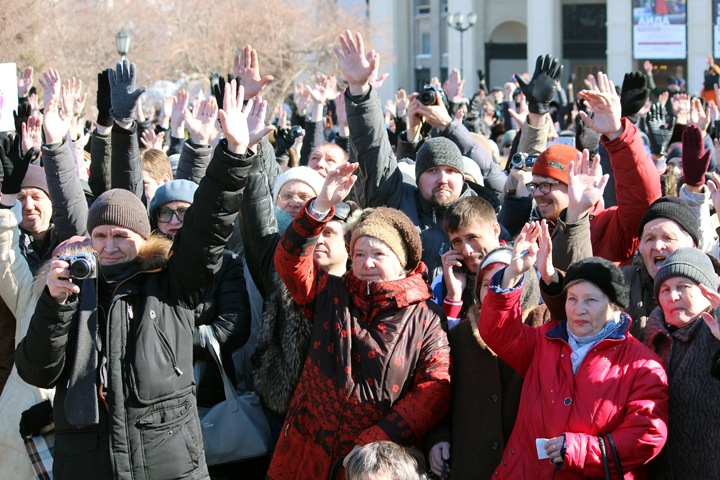
The ex-deputy of the State Duma Arkady Yankovsky invited me as an expert to meet with Leonid Gozman, who will be held in the Novosibirsk Loft Potemka on March 14. The topic is "what we can do today, in the current conditions." “We” apparently mean those who believe that the country is in the wrong direction, and “current conditions” are the upcoming presidential elections, whose practical outcome is predetermined, and “controlled democracy” as a whole.
The question is important, because the opposition thought jumps between the two poles, one of which "does not depend on us and the time to blame", and the other "is impossible in Russia in a peaceful and painless way." That is, it is implied, although it is not pronounced aloud, one or another variation of the “Maidan” or “velvet revolution”. Or not velvet.
I will make a Falstart and in advance I will publish an opinion on the stated topic. Against the background of how our missiles with an unpredictable trajectory plow the expanses of the world space, the atmosphere and the underwater world, the discussion of some small problems looks inappropriate, but still. Life continues. And we need to give her, if not meaning, then at least his illusion-until someone pressed the red button.
I see three important directions that the Russian opposition does not work on, or does not work enough:
The first is the development of the "constructive program". The Russian opposition is often reproached that it does not have a clear program. In a significant extent, these reproaches are fair.
The second is the self -organization of society. The opposition reproaches power for the opacity of the decisions made, in the absence of democratic institutions and in unwillingness to listen to public opinion. But the democratic opposition has not created a single mass party or movement in twenty years, in which there would be internal democracy. Unfortunately, the so -capable form of the organization is the scheme of “Leader and its supporters” so far.
The third is the search for public consensus. The society today is split on many questions, starting from the attitude to Stalin, ending with the issue of Crimea. But, as practice shows, activists of different views may well cooperate and interact on specific real problems. If the consensus on the issue of the past looks completely unattainable, then on the issue of the future this is not so.
Nobody likes corruption, nobody likes social injustice, nobody likes the bias of the courts and the irresponsibility of large officials. Nobody likes the transformation of Russia into a raw materials appendage of Europe and China and the loss of advanced positions in the astronautics and the sphere of high technologies.
Nobody likes the organization of large business (mainly banking and construction) on the principle of "our profit, and losses are state -owned."
It is quite possible to agree on all these issues. Now we can distinguish several already formed “positive” points of “opposition consensus”:
The fight against corruption. Officials must declare not only income, but also expenses, as well as explain where they got the property. There must be independent special services and prosecutors investigating corruption crimes. Different special services must have the right to provoke a bribe. On the other hand, officials should be able to protect their honest name in a fair court.
The court must be fair.
Elections should be honest at all stages. The right to extend should not be significantly limited. The abolition of the municipal filter. Return of registration of pledge candidates. Signatures for candidates must be collected either in electronic form, or through the election (the voter leaves the signature in the election commission, the signature is automatically recognized as reliable, the number of signatures is significantly reduced). Mandatory debate. The return of the second round for the elections of all levels. Additional Voice Counting Systems.
Creation of real local self -government. I will add from myself - where people want it.
More fair tax legislation. The rich should pay more (as a percentage of income) than the poor. Today in fact - on the contrary.
Deburocracy. Reducing the number of procedures, approvals, officials.
The return of the right to peaceful meetings and processions.
Responsibility of managers for the results of their activities.
Social security.
Good and free medicine and education.
The development of science and technology, aspiration to the future.
And now more controversial moments with which not everyone will agree among the opposition:
Revision of privatization results. Either the nationalization of resource assets, or the taxation of the oligarchs with a “privatization tax” (pay a significant part of the difference between the market value of the assets and the one that was paid for several years). Problems and objections are clear.
Lustration - is it needed or not needed? Is the restriction of rights only on the basis of belonging to a certain group or organization, or everyone should be responsible only for their misconduct?
Presidential or parliamentary Republic. What is the election system, to change the constitution completely or to make amendments to the current?
Migration policy.
Juvenile justice, demographic policy.
Drugs and the fight against them.
Questions of the urbanist, the division of urban space between pedestrians and motorists.
Different parts of the opposition have their answers to these questions, which they consider "of the very granted." However, no one considers them so important as to discuss with each other.
And finally, the main question. What to do with problems that split our civil society sometimes on irreconcilable sides? I will list what I remember, excluding importance.
The attitude towards Stalin and his heritage.
Molotov-Ribbentrop Pact.
Attitude to Lenin, the 1917 revolution, to numerous monuments and communist toponymy.
Crimea.
Ukraine and Donbass.
Syria (and in general - participation in foreign wars).
Relations with the West, with China and generally the place and role of Russia in the world.
The role of the Russian Orthodox Church in the state and society.
Attitude to sexual freedom.
Attitude to sexual minorities.
I will venture to offer how the “opposition consensus” could look like some of these issues. Since it is impossible to achieve a common point of view, you must either agree on how to achieve it, or how to coexist with different points of view. For example, in the book “Third Empire”, Mikhail Yuryev proposes a very reasonable way to study the Stalin era - through the creation of a commission that all parties trust, and collecting facts that are not in doubt. Being a Stalinist (judging by the text), he offers what many anti -Stalinists call for. Although this path will not lead to the end of disagreement, it can somehow move the position of the parties.
Another way is to agree that everyone can be with their opinion on how much Stalin was a tyrant and how an effective manager. But at the same time, admit that there is no need to shoot people (and each other) only because they have a different point of view.
In the Crimea, it seems to me that the opposition could agree on the following formula: “The accession of Crimea to Russia (apparently) corresponded to the desire of the population of both Crimea and Russia. But it occurred in violation of a number of international norms and led to the complication of the international situation. The situation should be tried to return to the legal field, but in no case contrary to the will of the people of Crimea. It is advisable to achieve an acceptable agreement on the issue of Crimea with Ukraine, while we are ready to hold as many referenda in Crimea with the participation of international observers as it will be needed to convince the international community and Ukraine. ”
I anticipate a lot of screaming on both sides about the proposed formula, but it is similar to a possible compromise. If not similar, offer your option.
In Ukraine and Donbass - normalization, negotiation process, and cessation of violence are required. And many other correct, but, alas, meaningless words, because we will be honest, nothing depends on the opposition in this matter. Both from that and from another.
Relations with the West, China and others. I think that the stage of “getting up from the knees” and the search for international recognition by swinging a nuclear baton will soon be tired of everyone. On the other hand, the proposal to “blindly follow the West” will also not receive the approval of the majority. Perhaps the example of China will come in handy - soft power instead of rough, China does not climb anywhere, where its interests are not directly involved, but at the same time does not allow itself to infringe. The main thing is the development of their own economy and their own people.
As for the relationship to sexual minorities, it seems to me that for an “opposition consensus” a formula that acted until recently in the US Army would have been awarded - “do not speak and do not ask”. Your personal business, but do not go through the streets with posters about how, in what way and with whom you do this.
The proposals are probably imperfect, and perhaps completely no suitable. But let's at least start discussing them. After all, we can.
Alexey Mazur