
Translated material
Memory ailments
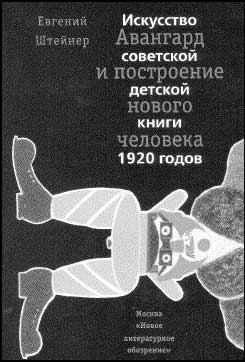
Evgeny Steiner. Vanguard and the construction of a new person. The art of the children's book of the 1920s. M.: New Literary Review, 2002. 262 p.
 Evgeny Steiner is a graduate of Moscow State University, art critic, author of the book about Japanese medieval art. He left Russia in the late 80s; He lived in Israel, taught at the universities of Japan and the USA, settled in New York.
The reviewed book, as the author writes in one of the preface, was mainly written in Moscow, in 1989, but for various reasons was postponed. Then the author adapted the manuscript to the requests of the Western reader, so the book was first published in Seattle and London.
The structure of the book is as follows. The brief introduction devoted to the fate of the Russian avant -garde is followed by three chapters. The first (“The arrangement of the milestone: the main authors of the constructivist project”) tells of some of the largest artists using the example of their work in the children's book; The second (“elements of the constructivist project”) and the third (“Production Book: Steam and Others”) combine an overview of the fine series with the analysis of the theme and pathos of the Soviet children's book of the 20s. At the end of the book, brief, but very sensible information about many artists mentioned by the author and pointers - nominal and objective.
In general, the book that is now in front of me is not a translation from English, but, minus the title, is by no means “source”, but the text, once again redesigned by the author, as he himself recognizes, taking into account the fact that much that was new in 1989, today is not such.
The mother of Eugene Steiner, whose memory is dedicated to the book, read to him "some of these books." Which is understandable-Soviet children's books in the 1920s could well have been preserved at the home library. (I also keep the “Fedorino Woe” I wasolated in the infancy in quite avant -garde design. However, I never loved pictures in Fedorin Gorus, and I don’t like the avant -garde font culture now.) However, from how the author describes these children's books, it is clear that he has not grown up, that the whole culture of the early -Soviet book is not just psychologically Alien, but the straightforwardness is incompatible with its nature.
This, in a certain sense, is often for the better: the author could ensure the objectivity of the conversation. Could - but not provided. Unlike the author, I cannot boast of “immovableness”, because, having no specific artistic abilities, the child accurately distinguished the illustrations of Konashevich (whom she did not love) from the works of Lebedev, Deineki and Tyrsa (whom I loved). Of course, neither I nor other children never saw not only “about two squares” by El Lisitsky, but also other small or completely unique author's books of the era of constructivism.
Have these books were children at least by intention? Or did the artists of that era primarily solved their artistic problems in them? I think that the second is more likely. It seems to me, Tatlin in rather terrible illustrations for Harms, and Petrovovodkin in illustrations for the “riddles” of Marshak, Boris Grigoryev, and the early Nathan Altman, and even the earliest swans of the times of “Chuch-La” (1921) were not concerned about the specific features of children's perception of their work. In Russian art of their era, they were innovators, and most importantly - fantastically gifted people. Is this fireworks that so tragically reflected the spirit of the time of the first post -revolutionary years in itself?
Illustrations for children's books - it was a source of honest earnings in very difficult times, but at the same time a paid platform for experimenting with new forms, new ways of building art space. I don’t know what they paid for illustrations in 1921 - perhaps with firewood. Or herring. But if we turn to the easel works of prominent avant -garde artists of those years, we will see that in their art they were at least honest: they did not bifurcated their art world on “custom” and “genuine”. “Children's” Petrov-Vodkin is faithful to the same artistic principles as the “adult”, and therefore fundamentally recognizable. Of course, this does not mean that we must love his work: everyone is free in his artistic addictions. In addition, addictions are changing: in my youth, “bathing the red horse” was a discovery for someone, and I always preferred a still still life.
But Steiner writes about the famous illustrations of Vladimir Lebedev to Kipling's Elephant. Having mentioned that these illustrations made both then and then the strongest aesthetic impression on artists and critics, Steiner, not without sympathy, cites the statements of children for whom these illustrations were incomprehensible. But what is surprising? Psychologists will confirm that children of preschool and primary school age - namely, books are made for them, where the role of the picture is comparable or even more important than words - they best perceive illustrations that are as close as possible to a specifically field image. From this point of view, the illustrations of Beatrice Potter, the late Vladimir Lebedev, as well as Alexei Pakhomov (the time of the ABC of Marshak), children will always be preferred to the exquisite works of the Trongott brothers or Viktor Pivovarov, whose children's books have already bought my generations primarily for themselves.
However, is it possible to say that children's pictures like the Lebedevsky “Elephant,“ introduced a sense of the torn of being into the viewer’s subconscious ”(p. 70, isolated by the author of the book)? It sounds anecdotically. However, Evgeny Shteiner is much so serious: on p. 78 We read about the well -known lines from the “baggage” of Marshak “sofa, suitcase, bag, basket, picture ...” , that this listing itself is “mockery over old -regime private ownerships”.
And this is written by a former Muscovite with a university education ... Why? No, the question would be worth it differently: for whom? .. Next will get to everyone - the remarkable font master of Solomon Telingater; Mikhail Zaskhanovsky, who created the famous "mail" (1927) together with Marshak; The amazing drawer Nikolai Kupreyanova, Galina and Olga Chichagov ...
Gradually, less and less attention will be paid to the “ art of a children's book” (pictures, a layout, fonts) and more and more - “building a new person” (texts and the alleged intentions of their authors). However, artists could illustrate only those books that were published, and books were published with a certain ideological load, expressed, alas, in the pathos of the construction of the “brave new world”. And here, in the analysis of illustrations, Steiner constantly reminds us how disgusting this world and this pathos are to him. The texts addressed to children are really primitive to stupidity (by the way, today these nonsense are no less than 80 years ago - they are just different). Nevertheless, the assertion is that the “lyrical hero of the new type in the literature of the winning class” is a steam locomotive (p. 150), it just replaces one ideological roll to another.
No, not without reason on the cover of the book, the artist Yevgeny Polikashin imprinted the subtitle inwards inside the heading, so if the child had read these lines, this would come out: the art avant -garde of the Soviet and the construction of the new book of the 1920 man.
And then I could not stand it and took out from the shelf the only book that I had survived (the rest was distributed) from the series “Selected Children's Books of Soviet Artists”: they were published by the “Soviet artist” with a circulation of 50 thousand copies (!). This series in due time (apparently in the late 70s) was invented by the famous art critic Yuri Yakovlevich Gerchuk. The model of the series suggested complete - up to the format - reproducing the original of the children's book that was described. But the publication did not come down to this.
In my case, on the serial cover of the book (this is 1982) it is written: the artist A. Deinek makes a book. Below, in a slightly reduced form, the book of the book, which Deineka made, was reproduced - this is the “Kuterom” by Nikolai Aseev, published in 1930. The original with a volume of one printed sheet is reproduced inside, starting from the 15th band of the publication. He is preceded by an introductory article by Yu. Ya. Gerchuk and his essay on the children's books of the participants of the famous Association of Ost ("Society of Manufacturingists"). The biography of Deineki and excerpts from critical responses to his work as an artist of the children's book.
In the introductory article “White in Black” illustrations of Deineki, “Kuterma” are analyzed and compared with a similar drawing by Vladimir Konashevich and similar in technology (white in black) drawing of Ivan Leonidov (yes, that very!). To show the work of Deineki as an illustrator of a children's book in a wider context, Yu. Ya. Gerchuk offered the reader a capacious review of the works of the “strokes” in a children's illustration; As examples, the works of David Sternberg, Nisson Shifrin and Nikolai Kupyanov are reproduced; All of them date back to the 1920s.
When you involuntarily compare the calm, moderately academic analysis of Gerchuk and the tense, as if the sniffing intonation of Steiner, which for some reason, for some reason, is just now the Soviet ideology of industrialization and skewing of a person causes such hatred, you suddenly realize that either Steiner at the stage of the plan succumbed to this unproductive emotion, or-which seems to me more likely-he originally wrote for the Western reader. I can’t explain such a pathos (in the sense of Belinsky): the title that gave its review of the book by Steiner Sergey Khachaturov (“Another victim of the agitprop” - “News Time”. No. 135. July 30, 2002), hits the target precisely because the latter that can be suspected of Steiner is simple -minded.
In short, the irony of the English title of the book - “Stories for Little Comrades”, which belongs, as said in one of the preface, the American publisher (as an approximate semantic equivalent, I would offer “Stories for the children of the Youth”), is quite appropriate; But - alas! - It is addressed primarily against the author of the book.
By the way, about the preface - there are three of them, and they leave the reader not even a dual, but a triple impression: 1) pity for the author who does not know what to insert and what to cross out, in order to publish in their native Palestins, and not “sort out”; 2) sympathy for the reader, whose hopes to read something sensible about the subject will be deceived; 3) a feeling of unsatisfactory need for a truly modern story about the art of our children's book.
So far, the gaps in our knowledge will be replenished with the texts of other authors - Yuri Gerchuk, Yuri Milk, Elena Gerchuk; And the curious reader is not too lazy to flip through the once popular non -periodic publication “The Art of the Book”.
PS In the “New Literary Review” No. 51 (2001), Russian writer Alexander Goldstein, who was in Israel, praised the “Letters from the space” by Evgeny Steiner - the confessional prose of the intellectual, according to Goldstein, “nowhere is there either at home, nor cultural refuge” (p. 286) - neither in Israel, nor in Japan, nor in Japan America. On the Internet, on the website of the magazine "Mirror" [1] , I found a fairly representative passage from this essay.
Good prose. The homelessness of the soul. The impossibility of love. Life from Grant to Grant. A wonderful description of the Russian cemetery in Iokogam.
Deeply Reasonable Evgeny Semenovich! When you publish “letters from space” (from the heart I wish you this), do not write preface.
[1] See [ http://members.tripod.com/~barashw/zerkalo/13#14/steiner.html ].