
Translated material
Deep into the dark centuries
The dark centuries in the history of the Universe is the time after the era of recombination, which in itself is very clearly visible in the cosmic microwave (relict) radiation until the appearance of a large number of galaxies and quasars - from 380 thousand to about 500 million years. The first 100 million years after recombination in the universe there was simply nothing to see - all of it was almost evenly filled with neutral gas. After 100 million years, the first stars and their accumulations appeared, then small, then larger galaxies: the growth of heterogeneities and the formation of structures came from small to large scale.
Candidates for a new record
The most distant quasar found with a red displacement of 7.54, which corresponds to the age of the universe of 650 million years. The galaxies are visible significantly further, up to red displacements Z = 11 (such a red displacement was reliably detected by the spectroscopic method, there were weak instructions on the Z ~ 12 galaxies). Moreover, the recordly distant galaxy was unusually bright in the ultraviolet (in its own reference system) - several times brighter than the Andromeda galaxy in the entire range. This record lasted quite a long time, but on February 12, 2022, Preprint was published [ 1 ], which reports the discovery of two galaxies with red displacements of 12–13. Then, with a more than monthly delay, this stirred the interest of the media of a wide profile.
The study was not in new observations, but in archival excavations - a significant part of the discoveries is currently being done that way. The authors of the Preprint used archive databases of Cosmos reviews (Cosmological Evolution Survey) and SDXS. In these reviews, the same parts of the sky were carefully studied by different tools. Observations are a series of “deep punctures” - personnel with a very large exposition. In the infrared range, the basis of the review was given by space telescopes (“Hubble”, “Spitzer”) and ground (“Subaru”, “Kek”). In addition, these sites were studied in radio and X-ray ranges, but this study was based only on the near infrared range. Thus, it is very difficult to explore the wide area of the sky: the field of view of powerful telescopes is quite narrow, the time for each frame is large. As a result, the contents of both databases cover a little less than one ten thousandth of the sky, about fifteen lunar disks (2.3 and 1.2 square degrees).
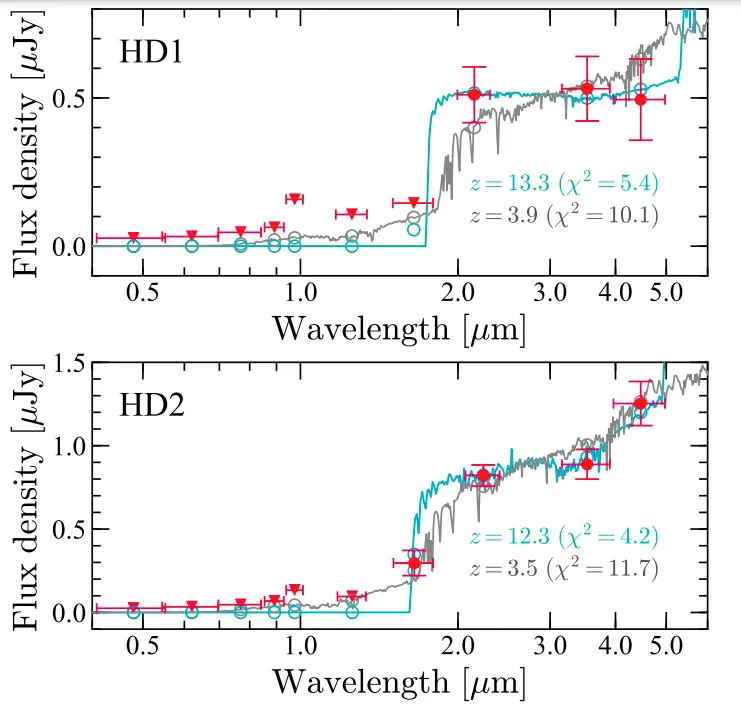
In deep reviews there is no spectrometric data according to which the red displacement is determined - only photometric data: the flow of light energy in several wide spectral stripes. Nevertheless, according to photometric data, you can approximately evaluate the red displacement. You can catch on the so-called lime-hare-the failure of the spectrum due to the absorption of photons with neutral hydrogen. In its own reference system of the object, this failure is in a hard ultraviolet, and due to red shift moves to the near infrared range.
The authors of the work [ 1 ] searched in the archival data of the galaxy with the most distant Lyman-Rum. Farmers using data on closer galaxies indicated that in these existing reviews there should be from one to several galaxies with Z> 12. Having set as simple quantitative criteria (in the so -called spectral strip to brightness is quite large, and in a shorter wave lane n - at least two and a half times less), they selected two objects, naming them HD1 and naming their HD1 and naming their HD1 and HD2. The method of maximum credibility gave for these objects a red displacement from about 12 to 16.5 (the best - 15.2) for HD1 and from 12 to 13 (the best value is 12.3) for HD2. As can be seen from errors, the photometric method gives only a very approximate assessment of the red displacement.
Clue in a millimeter range
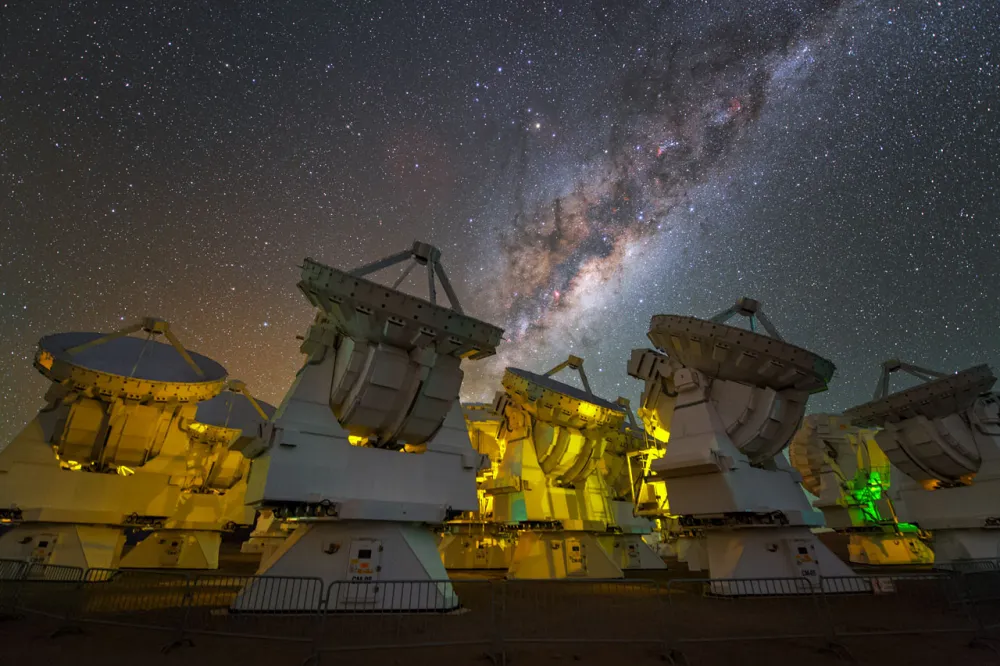
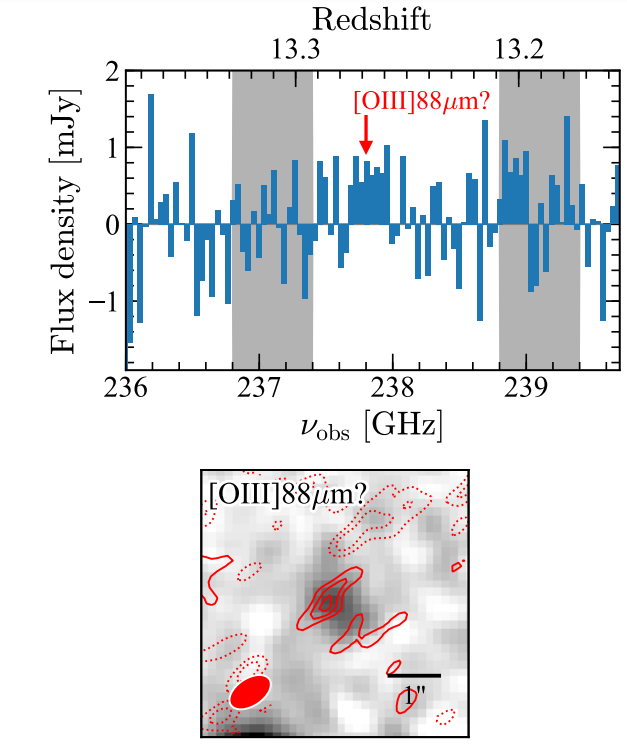
For a more accurate definition of red displacement, there is a clue in a completely different range - on millimeter waves. Previously, for this, the line of twice ionized oxygen O III with a wavelength of 88.4 microns (in its own system) was successfully used. This line moves due to the red displacement in the millimeter range, where it can successfully detect. The most powerful millimeter tool tool is Alma (Atacama Large Millimeter Array), it already has a lot of bright results. Of these, pictures of protoplanetary discs and the image of the surroundings of a super-massive black hole in the M87-Galaxy M87-Alma were a central knot in a global experiment that gave this image were published. Due to the large total area of many parabolic plates operating in the interferometer mode, with good angular resolution (about a second), there is great sensitivity and excellent spectral resolution.
The authors of the work [ 1 ] ordered Alma observations for the HD1 and HD2 objects and for the brightest of them, HD1, found a feature in the spectrum, which can be interpreted as the same line of twice ionized oxygen, along which a red displacement of several distant galaxies had already been measured. If this is true, then the red displacement of HD1 Z = 13.27. The statistical significance of the line, 4σ, is not high enough to solemnly announce the opening. The authors carefully talk about the "Candidate Galaxy" to a record red displacement. But given the fact that the line is about the expected place of the spectrum and “flies” from the right place in the sky, which coincides with the optical image of the Galaxy, this candidate can be called very strong.
In Preprint, the authors mention another HD3 object, which did not pass their quantitative criteria, but remains a real candidate. For him, the best rating (Best Fit) of red displacement Z = 14.6.
The first swallows?
Both HD1 and HD2 objects are extremely bright in ultravioletus - ten times brighter than our galaxy in the entire range, while their mass is most likely small - it is hardly more than a few billion solar masses. In those days, all the galaxies were small: the formation of structures in the universe came from smaller to large ones. There are more bright galaxies in ultravioletus, but they are visible with red shift Z ~ 4, that is, they are much later (from 1.5 to 2 billion years) and probably much more massive - in those days there was an active unification of small galaxies into large ones with concomitant violent starship. However, two galaxies-kandidata in a record red displacement are only slightly inferior in ultraviolet brightness to the absolute champions, while probably much inferior in mass. That is, most likely, they are record holders for luminosity per unit mass, although there are no masses of their mass, this conclusion is based on general considerations about the evolution of galaxies.
In [1], the distribution of galaxies in luminosity for different red displacements is also given. HD1 and HD2 are located at the brightest end of the distribution for Z> 10. With lower red dispersed Z ~ 4 per unit of the accompanying volume, almost as many brightest galaxies as with Z> 10. However, there are two orders of magnitude larger than the z ~ 4 galaxies, and generally a unit of concomitant volume at 2-4 billion years radiates the order two more ultraviolet radiation than in the first hundreds of millions of years. And the brightest galaxies, it turns out, approximately coincide in brightness.
The brightness of the galaxies in the ultraviolet is traditionally associated with the current pace of star formation. Indeed, the main part of the ultraviolet radiation is radiated by massive short -lived stars, the number of which is proportional to the total mass of the born stars - on this subject there is a generally accepted well -proven formula. For our galaxy, the pace of star formation is about 2 mʘ per year, for HD1 - 110 mʘ, for HD2 - 180 mʘ per year. This is despite the fact that the mass of those galaxies is much (possibly two orders of magnitude) less than our mass. That is, if their ultraviolet linen is associated with the pace of star formation by a known ratio, then the galaxies found are unique in the specific (per unit mass) the pace of star formation. This is all the more surprising that in those days the full pace of starship in a unit volume was small. What is the reason for the uniqueness of these galaxies?
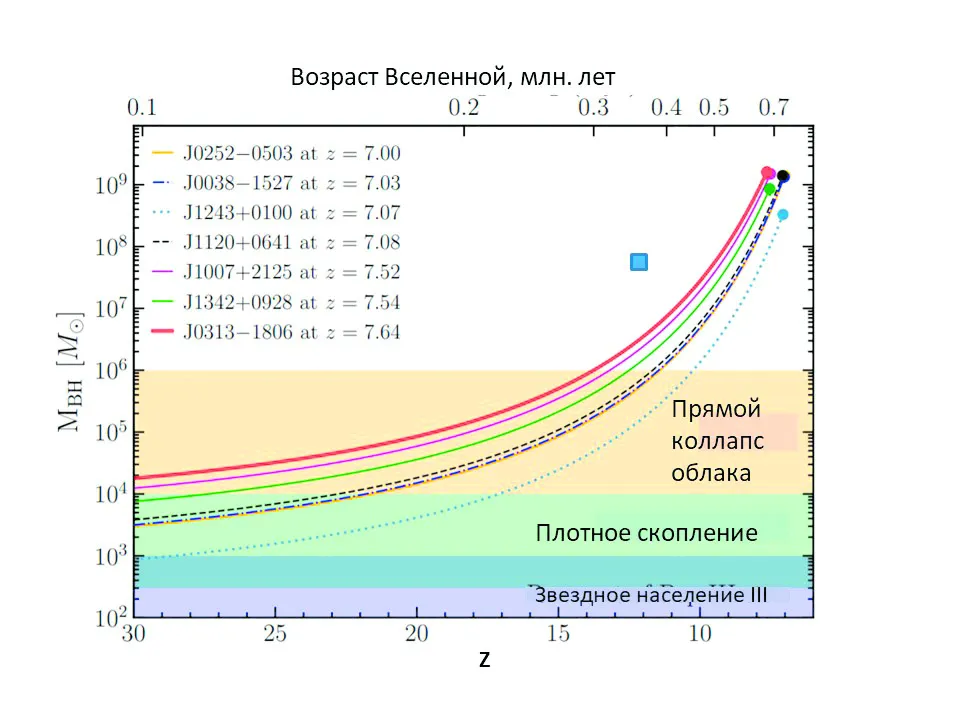
One of the possible reasons is discussed in the article: this is not the stars of the galaxy shine, but a quasar in its center. In order for Quasar to provide such a luminosity, the corresponding black hole must have a mass of 108 mʘ. And immediately a very tough problem arises: over 300 million years, black holes of such a mass could not appear: there was not enough time to grow (see [ 2 ]). This is not a new problem: a kvazar with a mass of a billion sunny with a red shift of 7.64 has recently been found, which corresponds to the age of the universe of 650 million years. In theory, that such a quasar appears, he should begin to grow from a black hole not less than 20,000 mʘ - to explain the origin of such a seed black hole is very difficult. Explain the appearance of a black hole 108 m of the time of 330 million years is even more difficult, see Fig. 3. In the comments, the assumptions are made that such luminosity is provided by the stars of the so -called population of the III - the earliest stars without impurities of heavy elements that could be extremely massive and bright. However, this does not solve the problem - the ratio between the mass and the highlighted energy for these stars is hardly much more than the same for ordinary massive stars illuminating galaxies with a high pace of starship.
Boris Stern
1. Arxiv.org/pdf/2112.09141.pdf
2. TRV-SCIENCE.ru/2021/02/OTKUDA-VZYALIS-MOSHHNYE-RANNIE-KVAZARY