
Translated material
Bamboo plates age 2000
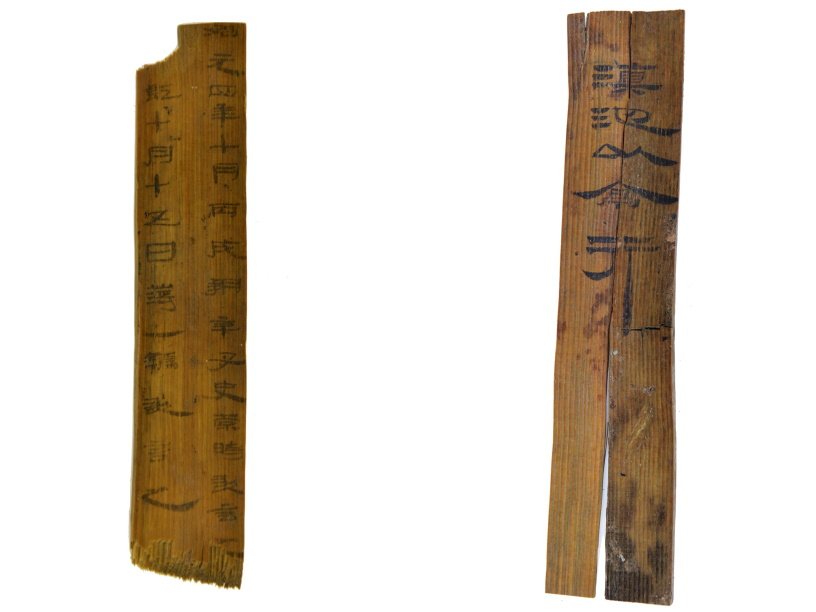
Thousands of bamboo plates with texts found on archaeological excavations in Habosuo, in the province of Yunnan in the south-west of China, will help to shed a new light on the reign of the West Han dynasty (202 BC-25 g.
Such records are known in the Chinese tradition called Jian. The ranks of thin plates were fastened into a single canvas with twine from above and below, and a peculiar “book” (jyandu) was obtained. On each of these records, only one column of text fit. They wrote on the plates with a brush, if necessary to fix the error, scraped a tree with a special knife. The material in the southern regions of the Han empire served Bamboo, in the north, where they did not grow bamboo, thin plates of poplar wood, pine, willow or Chinese Tamarisk were used.
The earliest preserved samples of wooden and bamboo plates date back to the 5th century BC ( the period of the fighting kingdoms). However, references in earlier texts, preserved on other media, clearly show that bamboo plates were used already in the late period of Shan (from about 1250 BC). The stain records served as the main material for recording texts in China until the widespread of paper in the first two centuries of our era. For this purpose, silk also served, but for most documents it was an excessively expensive material. The plate-stroke has gone out of use by the 4th century of our era. Archaeologists have discovered many samples of records thanks to the custom to place books made of these records into the tombs of the rulers.
Since the start of excavations in Habosuo in 2021, more than 10,000 bamboo plates were discovered. Of these, about 2000 dates from the Han dynasty (202 BC - 220 BC), 1300 contain written signs, 837 - prints of seals. Bamboo records found in the tombs of the Western Han often represent fiction and books on medicine and agriculture, but in the current find, records of an administrative nature prevail.
Proceedings of seals deserve special attention, because there are official seals of 20 of 24 districts, under the rule of the ancient state of the Dan , non -Khan's culture of agricultural settlements and exclusively experienced metal craftsmen, on the territory of modern Yunnan. The state was captured by the Khan emperor U-di in 109 BC. e. On some slats, the names of 12 counties are recorded, such as the “Uyan Chi County” and “Jian Lin County”, which were part of the Izhou district, founded by the emperor U-di after the annexation of the Diana state. Other terms, such as the “county judge” and “Dan Chen” (First Minister of Dyan Office), were found on the planks. According to the historian Tao Zhunjun, the inscriptions demonstrate a “well-developed” socio-administrative system that was used to manage the southwestern border area. “Titles such as“ Dyan Cheng ”indicate that the Han government established special political roles in the southwestern region,” says Jiang Zhilun, the leading archaeologist of the Hebosuo project.