Date
Author
Фонд «Общественное мнение
Source

Preserved copy
Translated material
The limits of the permissible
The limits of the permissible
In your opinion, is it permissible or unacceptable when young people seek to avoid military service?
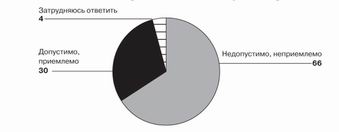
In the summer of 2013, FOM asked respondents by phone a number of questions, asking to evaluate some social practices. The set of these practices-if you abstract from hypotheses checked in the framework of the study-may seem random (and to some extent is really that). But one way or another, the survey results are quite eloquent.
As you can see, evasion in the army is considered permissible less than a third of Russians (30 %), while leaving for permanent residence abroad is recognized as acceptable two -thirds (65 %). With this ratio of opinions, by the way, it would be curious to find out how to perceive the departing abroad if he goes to this with the aim of evading the army service.
The distribution of answers to these questions varies noticeably depending on the age of the respondents. It is easy to guess that the younger the surveyed, the more willing they recognize the permissible evasion: 42 % of those who are younger than 30 years old, and 38 % - from 30 to 45 years old, but only 20 % - from 46 to 60 years old, and 17 % - those who are older. The same dependence is traced in judgments regarding the admissibility of leaving abroad to permanent residence. Moreover, if in the younger age cohort those who consider such a departure is permissible almost four times more than those who consider it unacceptable (78 and 21 %), among citizens of the “first average” age - about three times (72 and 23 %), and the “second average” - almost double (60 and 33 %), then in the older age cohort, the former are in a clear minority (40 versus 56 %).
Increased tolerance in relation to both the “deviations” and those who leave are shown by the owners of higher education (they evaluate these practices as permissible 38 and 72 % of respondents with university diplomas, respectively), as well as even more Muscovites (49 and 81 %).
In your opinion, is it permissible or unacceptable when the spouses get divorced, officially stops their marriage?
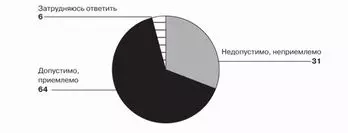
If our fellow citizens are about twice as often as a tolerant attitude to divorces than intolerant (and they perceive civil marriages even more favorable), then abortions are more often - and also approximately twice - they are recognized as unacceptable. Here, too, very significant age -related differences are found in approaches, but much less predictable (and, accordingly, deserve greater attention) than in the above cases (Table 1).
Table 1
Data in % of groups
The population as a whole | 18-30 years | 31-45 years | 46-60 years | Over 60 years old | |
In your opinion, is it permissible or unacceptable when the spouses get divorced, officially stops their marriage? | |||||
Unacceptable, unacceptable | 31 | 30 | 22 | 33 | 40 |
It is permissible, acceptable | 64 | 65 | 72 | 61 | 54 |
I find it difficult to answer | 6 | 5 | 6 | 5 | 6 |
In your opinion, is it permissible or unacceptable when a man and a woman live together, but do not formally formalize the relationship? | |||||
Unacceptable, unacceptable | 29 | 23 | 18 | 32 | 47 |
It is permissible, acceptable | 70 | 76 | 81 | 67 | 48 |
I find it difficult to answer | 2 | 1 | 1 | 1 | 5 |
In your opinion, is it permissible or unacceptable when a woman does an abortion? | |||||
Unacceptable, unacceptable | 62 | 75 | 58 | 52 | 60 |
It is permissible, acceptable | 32 | 20 | 35 | 40 | 36 |
I find it difficult to answer | 6 | 5 | 7 | 7 | 5 |
As you can see, among citizens of the “first middle” age of those who consider both divorce and civil marriage acceptable, much more than among representatives of the older and more younger age cohort, not to mention the oldest. It turns out that the notorious conflict of “fathers and children” in such fundamental issues of family life does not unfold between the current youth and its “ancestors” (here the positions are very close), but between no longer the youngest (31–45 years) people and their parents who have reached respectable ages. Here the contrast is really striking. Most likely, it is related to the differences in the conditions of the socialization of these generations: the “fathers” entered adulthood long before the end of the Soviet era-at a time when the instructions of the “communist morality” also had a noticeable influence on the value-abstract system of society, while the “children” graduated from school and stood on their feet during the time of perestroika and in the period of “collapse of the foundations” and radical and radical individualization, which affected the sphere of normative ideas about the family.
As for the attitude to abortion, the situation is different here: young respondents more often consider them unacceptable, and the contrast between them and all other age cohorts is very impressive. Presumably, two very different factors are synchronously and unidirectional. On the one hand, the socialization of the younger generation falls on the period of updating traditional values, and in this context, abortion appears as a morally unacceptable act equated with murder. On the other hand, this generation is most competent in matters of contraception, and a negative attitude to abortion as a manifestation of savagery, unacceptable and unacceptable irresponsibility of a woman in relation to her own health, also, apparently, is more common among young people than elders.
It is worth noting - although there is nothing to be surprised here - that men are much more often than women, consider civil marriage (75 and 65 %, respectively), and much less abortion (25 and 38 %). And, of course, Muscovites demonstrate increased tolerance to divorces (78 % consider them acceptable, 19 % - unacceptable), and to civil marriages (76 and 20 %), and for abortion (47 and 49 %, respectively).
In your opinion, is it permissible or unacceptable when a person does suicide?
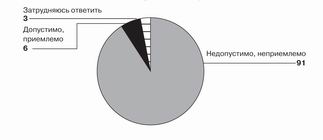
Suicide is considered “acceptable, acceptable” 6 % of Russians (in Moscow - 11 %), but what is behind this answer, what meanings respondents put into it is not too clear. This more than a sensitive topic requires, apparently, a special study. And as we see, more than half of the respondents refers to euthanasia, and only a third - as unacceptable. It should be noted that among representatives of the older generation, the voice on this issue was divided equally (45 and 45 %).
The survey showed, among other things, that if people consider any of the listed social practices acceptable, then they often often agree to recognize others and others. And vice versa (Table 2)
Table 2
Data in % of groups
The population as a whole | In your opinion, is it permissible or unacceptable when the spouses get divorced, officially stops their marriage? | ||
Unacceptable, unacceptable | It is permissible, acceptable | ||
31 | 64 | ||
In your opinion, is it permissible or unacceptable when young people seek to avoid military service? | |||
Unacceptable, unacceptable | 66 | 79 | 59 |
It is permissible, acceptable | 30 | 20 | 36 |
In your opinion, this is acceptable or unacceptable when Russian citizens are leaving for a permanent place residence abroad? | |||
Unacceptable, unacceptable | 31 | 53 | 19 |
It is permissible, acceptable | 65 | 42 | 78 |
In your opinion, is it permissible or unacceptable when a man and a woman live together, but do not formally formalize the relationship? | |||
Unacceptable, unacceptable | 29 | 50 | 18 |
It is permissible, acceptable | 70 | 48 | 81 |
In your opinion, is it permissible or unacceptable when a woman does an abortion? | |||
Unacceptable, unacceptable | 62 | 77 | 55 |
It is permissible, acceptable | 32 | 17 | 40 |
In your opinion, is it permissible or unacceptable when an inconspicuously sick person experiencing unbearable suffering voluntarily passes away with the assistance of doctors? | |||
Unacceptable, unacceptable | 34 | 50 | 28 |
It is permissible, acceptable | 54 | 38 | 62 |
Moreover, as we see, this dependence applies not only to positions on issues located in the same problem plane. Of course, it would be strange if people who were tolerant of divorces did not demonstrate increased tolerance and in relation to civil marriages, as well as abortion: there is a substantial relationship of judgments more or less obvious. But people who consider divorce unacceptable more often than their opponents are recognized as unacceptable and attempts to evade army service (79 versus 59 %), and departure to permanent residence abroad (53 versus 19 %), and euthanasia (50 and 28 %). In other words, the views of citizens regarding the admissibility of a particular controversial social practice affects, in addition to their views regarding this particular practice and some more general attitude. Some tend to authorize the free choice of the individual - and this factor somehow affects their judgments about any practices, others, on the contrary, prefer the inviolability of the traditional moral order - and this also affects their opinions on all issues.
All -Russian telephone survey on June 22-23, 2013, 1000repenters
© Fund "Public Opinion"