
Translated material
Invisible parties
In the opposition
 Invisible parties
June 28, 2012 Alexey Makarkin
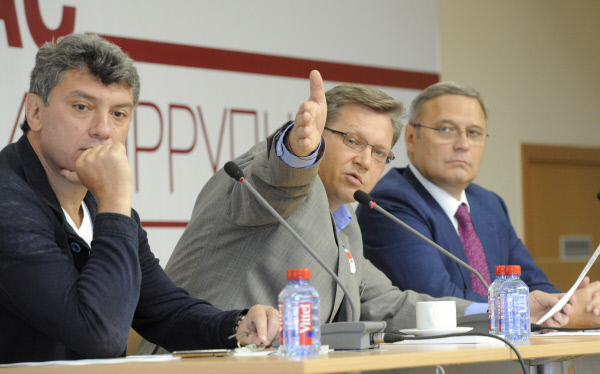
In the spring of this year, legislation was adopted on the liberalization of the party system. The actually acting taboo was removed to create new parties. The result is a violent part -time, however, which remained almost invisible in public space.
As of June 22, the Ministry of Justice registered a 21 new party-in addition to the seven RPR-Parnas that existed earlier, which restored its registration after the decision of the Strasbourg Court. Next in line is 176 organizing committees, of which, however, far from everyone will be able to get party status. For example, someone Oleg Balakirev announced the creation of as many six organizing committees, including with the names “Other Russia” and “Left Front” - now Eduard Limonov and Sergey Udaltsov will be in line for Balakirev O.I. And the party with the name “Plant your tree” is created by a certain Medvedev Dmitry Anatolyevich.
Four groups
Both registered and in the process of registration of the party can be divided into several groups.
Some parties are simulackers hastily created for different purposes. In order to act spoilers of really opposition parties (for example, the Communist Party of the Communist Party can be opposed to the Communist Party of Social Justice - the CPSU). Or for the insurance of United Russia: if the United Russia rating will go very much in any region, then you can allow some little-known pro-government party to participate in the campaign, which protrudes for all the good and against all the bad (and in the future of the regional parliament, the rivals form a coalition). Or in order to intercept the “brand” from the opposition - see the story about the “Left Front” and “Other Russia” above. For example, Mikhail Gorbachev will not be able to register a social-democratic party-such an organization already exists.
Other parties are formed by figures, as a whole, loyal authorities, but with their own interests and priorities, which do not always coincide with power. For example, Oleg Mitvol, as expected, headed and quickly registered the Green Alliance - the People's Party - he has long been known for the active pedaling of the environmental topic in public space. Or the owner of Rostselmash, Konstantin Babkin, who is still a unregistered party of the case - he actively opposes Russia's entry into the WTO and tried to initiate a referendum on this issue. Supporters of the Party of Case can be found both at opposition and loyist rallies. Or Viktor Aksyuchits, the former people's deputy of the RSFSR, the creator of the Christian Democratic movement in the early 90s, is now going to register the Orthodox People's Party of the majority.
The third type of parties is opposition. They are characterized by a traditional problem for Russian parties - crushing, and in all ideological segments. So far, in the queue for registration is the left batch of "Rot Front". One of its leaders is the former head of the dissolved Russian communist working party Viktor Tulkin, who, among the few leaders, tried to fight for maintaining registration. His associates in the RKRP also entered the party. But a number of prominent party members are activists of the new labor movement, including the Chairman of the Protector Trade Union Stepan Malentsov and Pyotr Zanev, deputy chairman of the Novoprof inter -regional trade union (including migrants working) and one of the leaders of the workers' mutual assistance center. However, the left -winged working party turned out to be narrower in composition than previously expected. It did not include the “Left Front” of Sergei Udaltsov (announced the accession to the “company front” of only a number of its regional organizations). Thus, “orgoviks” from the RKRP and trade unions who work directly with the working class entered the “Front”, but there are no charismatic leaders among them.
There is no unity among nationalists either. The first - and so far the only one - the registration among them was received by the experienced party -industry Sergey Baburin, who reanimated his Russian nationwide union (Ros), seeking to unite nationalist and imperial ideas. One of Baburin's deputy was Ivan Mironov, an justified accused of attempted attempt on Anatoly Chubais. In line-closer to its end-stands the National Democratic Party, created by Konstantin Krylov, Vladimir Thor and their associates. “National Demins” are opposed to the feeding of the Caucasus, for the creation of the Russian state and for situational interaction with other opposition forces. More radical nationalists Alexander Belov and Dmitry Demushkin have not yet submitted an application for registration (even before party liberalization, they formed an association of “Russians”).
On the liberal flank, there is a mentioned RPR-Parnas mentioned above, as well as the good old, but pretty worn “apple”. But some of the liberals from Solidarity created the organizing committee on registration of the “Party December 5”. So far, the unregistered “civilian platform” Mikhail Prokhorov is also counting on the liberal electorate.
Finally, the fourth type of parties are little-known projects that are not related to the authorities or the opposition and are not represented by any serious interests. These are either the fruits of the work of political strategists or a meeting of extravagant figures. Some of these parties in the future can be put up for sale - for example, for ambitious businessmen who want to try their hand at politics.
Objective limiters
For the functioning of new parties, there are several objective limiters.
To begin with, the public request for the creation of parties is relatively small. According to the December survey of the Levada Center, 56% of respondents to one degree or another opposed the creation of new parties (26%-“for”). This is the position of people who do not see any advantages for themselves in the development of the party system. Parties are perceived by them as meetings of “parasites” that do not bring benefits to society, but tearing from the general “pie” part of the funds (which could be directed to more useful ones - for example, social - needs). A parallel suggests itself with a famous Soviet joke that a second batch should not be created in the USSR, since its people will not feed.
New parties are not very welcome on television playing a huge role in electoral processes. If their representatives are allowed to participate in television programs, then often in an unfavorable environment for them. In the early 90s, the meaning of this factor was much smaller than now-society became much more skeptical and incredulous in relation to party politicians.
A certain limiter for the creation of new parties are strict rules for existing deputies elected on party lists. The deputy can be a member of only the party in the faction of which he is included, and has no right to voluntarily get out of this faction. Thus, he has three options: wait until he is excluded, hand over the mandate or join the new batch, not officially entering it. However, exceptions may not occur (it all depends on the leadership of the party or faction), to take the mandate means depriving yourself of important resources (immunity, the possibility of performances in the official media, etc.). There remains an option with a “attachment”, but it is clearly ambiguous in nature and, in any case, makes it difficult to become a public leader in the party. This option, in particular, was used by Alexei Etmanov, a well -known trade union leader, elected according to the "Socialist -Revolutionary" list in the ZAS of the Leningrad Region. He became the honorary secretary of the Central Committee of the Party "Rot Front".
There is also a problem of nomination of election candidates. Parliamentary parties have references - their nominees do not need to collect voter signatures. New parties will have to be much more difficult - they will have to submit autographs to the election commission, the authenticity of which can be challenged (there are many similar examples in Russian political practice). Therefore, many politicians are much more reliable to stay in the parliamentary “backwaters” without exposing themselves to additional risks.
All these factors initially weaken new parties. It is not surprising that a number of politicians are trying to distance themselves from party construction, the success of which is not guaranteed, while supporters push them to active actions. This applies to Prokhorov, who did not enter his own party. And to Alexei Navalny, who can repeat his experience. And to Alexei Kudrin, who has serious doubts about the need to create a party on the basis of the Committee of Civil Initiatives. None of them want to spoil their reputation, heading the Autsider party (we recall that the unsuccessful party and in the second half of the 90s did not benefit such a promising policy as Alexander Lebed). However, if new parties will strengthen their positions and achieve success in the elections in the regions, then interest in them can grow - both among the country's population as a whole (and not just specific subjects of the Federation), and among popular leaders.
Author - First Vice President of the Center for Political Technology
Photos of RIA Novosti