
Translated material
Sa Yerevanna!
In order to understand something in today's (last seventy years) Armenia, it is necessary to understand Yerevan. Many Armenians will not agree with such a formulation of the issue, do not recognize the unconditional dominance of the city over Armenian life, but it will be more likely a protest against the “injustice” of such a situation, and not against the fact itself. In order to understand something in Yerevan, it is necessary to understand once and for all-it is a fantasy city, a city-myth, a sand fortress, placed by a barrier from the winds of history.
Speaking in a more familiar metalaily - the creation of modern Yerevan was a rather pretentious reaction of the Armenian national unconscious to a whole string of disasters, experienced by the people at the turn of the year before and last centuries. As a result of these disasters, Armenia ended, there was a small fragment of it, on which the Armenian population survived - this fragment was incomparable with a large Armenia, divided between the Ottoman and Russian Empire, and was much smaller than Russian Armenia within the borders of 1913. Among all Russian writers who gave tribute to the fashion to write something excited about Armenia, this non-existence felt, it seems, only to Mandelstam:
It is painted with hoarse ocher, you are all far behind the mountain, and here only the picture is scorched from a tea saucer with water.
The “adhering picture” was supposed to, however, to become a miracle mirror, in which not so much even the previously existing Armenia would affect as one that existed only in countless historical legends-free, happy, not knowing anxieties. This never existing Armenia was measured, and the dream turned out to be brighter than “reality”.
Remember the small episode from the Pokrovsky Gate, where Kostya parted with sidelines, inventing a variety of business trips? Among the fictional trips are “a business trip to Armenia, where the remnants of Noev Ark were found on Mount Ararat.” Neither Kostya nor millions of Soviet people had any doubt that Ararat is in Armenia. This did not require any geographical map. In all schools of the country there were collections of emblems of the Union republics, and among the emblems, Armenian, created by Saryan, immediately caught my eye. Ararat occupied the central place on the coat of arms. Ararat flaunted on hundreds of Cards of Yerevan and its environs, against his background everything was photographed that could only be photographed. So, under Turkey, the shrine was symbolically annexed, even the NATO military base located on Mount did not protect it.
Yerevan was also estimated by one person - Alexander Tamanyan, a brilliant architect, who had almost drawn the plan of a huge city on the stars (suggesting an increase in the population ten times at once, in fact, Yerevan grew fifty). The plan was implemented only partly - one of the two huge avenues was built, the medieval castles of the complex of government buildings on Lenin Square (now the Republic), the plan of the informal center of the city - opera, were built only in partial accordance with the Tamanyanovsky project. However, the perfect Tamanyan turned out to be enough for the city to get the taste of construction in accordance with the dream, and the Armenians are builders from God. New avenues, parks, all kinds of unique structures appeared - from the classic Mattearan to the constructivist museum of contemporary art or a house of chess. All Yerevan was covered with architectural monuments, which were fifteen to twenty years old from the family. Little where there are cities on the planet with such a “density” of culture, and not accumulated for centuries, but suddenly grown.
The “large cascade”-“Babylonian tower”, as with sad sarcasm, is a peculiar final chord of construction and creative boards was a “Babylonian Tower”. It is not easy to determine the genre belonging of the structure - it is a huge staircase connecting the city center and a mountain residential massif located in the basin, this is a cascade of fountains, these are several museums located on the venues. At the foot of the cascade there is a monument to Tamanyan, leaning over his master plan, on top of the staircase was supposed to rest on the observation deck of a huge Victory Park. It should, but does not rest. As befits a “Babylonian tower”, the cascade is unfinished - it is not enough for twenty meters. First, the Karabakh war, the blockade, the full decay of everything is not up to the ambitious construction, but now ... Now in Yerevan they continue to actively build. They build a temple for the 1700th anniversary of Christianity in Armenia. But one of the symbols of the previous era - a cascade - no one is going to complete, they say, the escalators leading up, three times will reduce the income of minibuses that pursuate between the "floors" of the city ...
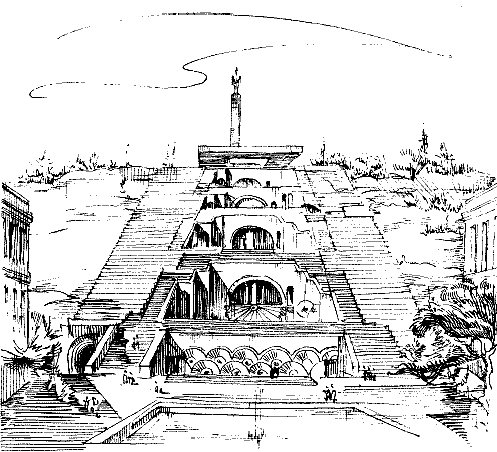
Big cascade
So, Yerevan today. Most of all, it resembles a beauty that fell into the clutches of a vampire and slowly, day after day of depriving blood. This blood leaves every day along with Armenian Airlines and Aeroflot aircraft flying to Moscow, Petersburg, Krasnodar, Stavropol. Considering my neighbors on the Yerevan - Moscow flight, I thought that I would return to this city rather than they. They may never return at all. Not only the city, but also the country bleeding, and no one can point out the “vampire”. There is no war, the war ended in victory, and Azerbaijanis or Turks are not to blame for today's troubles. The insidious and not very beloved West seems to send humanitarian help, the poor helps the poor (on this subject there is a special program of the World Bank).
It would be best for the role of the “vampire” that Russia would have come up - it was a million people who actually contribute to migrations, providing the Armenians with the clearly more preferential conditions of stay compared to the beneficial former “brothers” (extremely weak customs control, the complete absence of visas, freedom of stay and employment almost throughout the country). However, no one dares to blame Russia. And in fact - what to blame the Russians for? For being protected? For the fact that they give you the opportunity to work? Or for the fact that they did not transfer to the account of Armenia a amount equal to the Armenians to their homeland? Russia makes for Armenia the maximum within the framework of a possible selfish policy for it - makes it possible to earn money, receiving working hands in exchange (qualified, by the way). The alternative would only be an annexation and the inclusion of Armenia with a separate line in the budget.
But, apparently, any policy, even the most favorable possible, will not help Armenia anyway. The country is clearly devastated from the inside, tired of itself. The most striking are the constant complaints of the Yerevan people about a reduced tone, about despair. This can be heard even from people who are clearly in a much better mood than you yourself. You hear this in the city in which the dividing strip of the central avenue (Mesrop Mashtots Avenue) was laid out with small lanterns. Looking at the flashlights, sprinkled with asphalt, you are imbued with emotion and even admiration for these people and you understand that all the conversations about despair are nonsense. In desperation, it would not be up to flashlights. But the next day you hear all the same conversations again. The psychological state of Armenia and Yerevan is worse than objectively poor health. This is tightly jamming the conviction of his poor health, in the fact that there is no way out.
In order to understand this hopelessness, we must recall its origins - the terrible winters of 1991/92 and 1992/93. For almost two decades, flooded with fun and happiness, then for two years pushed by political passions, Yerevan suddenly found himself in a dark raw pit, like the one in which St. Grigory Enlightener.
The effect of the dark pit created two factors. The first is objective, geopolitical. Armenia, who did not plan to leave the USSR at all (the entire strategy of the struggle for Karabakh was built on retraining it within the Union and the authority of the Union to guarantee new borders), suddenly turned out to be not only “independent”, but also surrounded from all sides, squeezed between Turkey and Azerbaijan, as well as a chaotic, incomprehensible Georgia cut from the “large land” - Russia. The geopolitical position was inspired by the idea of “blockade”, and fears, as previously dreams, became a reality of someone's stupidity, greed or meanness.
What happened - no one really knows. It’s just that from some moment the lights went out throughout the country, gas and heating were turned off and it was announced that the country was in the energy blockade. Light in Yerevan was tentatively at the most inappropriate time like four o'clock in the morning. All benches in the city went to heating. People went crazy, hung, in horror tried to flee the country. The joke of what evil genius was the “blockade” - and today it is not quite clear. It is only known that the “blockade” factor was not objective, but subjective. Transport flows were not interrupted. People with their own eyes saw trains, including with fuel, quite safely passing through the territory of Azerbaijan. When people began to connect the “left” light to the houses, it soon became clear that it was enough for everyone. The Blockade was a fantasy. In the almost generally accepted interpretation, which took place in 1992–94 is called the “energy terror of the fascist Aodov regime” (who would have thought that the Western-based movement, headed by the intelligent Levon Ter-Petrosyan, will fall into the “fascists”?).
Whether the energy terror was an ordinary theft or the manifestation of devilish treachery, the result was constant fright and bloom, accompanying Armenian life all the years of “independence”. This fear has not passed to this day. As soon as he began to weaken - there was an absurd and mysterious tragedy of 1999, when two undoubted national leader were killed by terrorists - the prime minister and leader of the military Vazgen Sargsyan and the speaker of the Parliament, the first secretary of the Central Committee in the best years of Yerevan Karen Demircheyan. It is interesting that with rather conflicting assessments of the figures of Sargsyan and Demirchyan from those who are involved in the “political process”, their official and unofficial cult is supported quite diligently, especially in Yerevan. Indeed, for Yerevan, this murder turned out to be a pure tragedy - the “master” of the country remained the driver of the Karabakh Robert Kocharyan, an unloved, unsuccessful, first secretly, and now obviously hated.
From the AD-fascism ending in 1998, Yerevan fell into the “occupation” of Karabakha, people of a completely different culture, self-awareness, another “code of honor”, active and assertive, sometimes cynical. The confrontation of the “Yerevan against Stepanakert” deserves a special conversation, but it is enough to say that people who, a decade ago screaming a millions -haired chorus: “Artsakh, artzach!”, Today, they do not use a Turkic “Karabakh”, or even, having removed the mask of national political correctness, will explain to you that these highlanders are a completely different people (as soon as possible, many Karabakhtsy (as well, many Karabakhians They think the same). The bleeding city is experiencing its decline even more painful due to the fact that the places of the Yerewans who have left are not always empty-the Karabakh residents are replacing them. And the city, accustomed to the complex, strongly ritualized culture of relations, absorbed by the skin, transmitted in mild changes in the intonation of the voice, suddenly feels how the threads binding it burst one after another, the element incomprehensible and arranged according to some laws bursts. Modern Yerevan arose as the city of emigrants who came from around the world (this, by the way, explains the exceptional delicacy and preventiveness inherent in most “old Yerevan”), but once it arose, it is closed in its exceptional originality; Whether he will be able to transform visitors into the "new" Yerevan or decay - a big question.
However, in New Yerevan there is one strange trait that was absent in the old one, although it was in the old one that would be more logical. Today's Yerevan is the city with almost no crime. Criminal reporters are carried out mainly by stories about rare drunken brawls and anxious reports on the development of prostitution. It is paradoxical that the city owes this natural, but belated crowning of the “Yerevan path” to the most hated by the “Aodovic fascists”, the former Minister of the Interior, writer Vano Siradeegean. Having arrived, Vano proclaimed the thesis: “The Republic will not feed the two thieves,” and the Ministry of Internal Affairs began a merciless terror - first against the old criminal world (in the illness of the cases of caught with red -handed killed on the spot), and then against everyone who did not like it (the most soft measure was a proposal to turn things out for several days, sell that you will have time and get out into Russia). The crime, especially organized crime, was perceived as an attempt on the monopoly of the police and mercilessly suppressed. The policeman began to scare not only children, but also adults.
Three years have already passed since Vano was not in power, a year has passed since they tried to plant him for some of the murders committed by his order (he disappeared Vitoga), and in Yerevan you can still walk along the night streets and even parks in Yerevan, and the waiters of numerous cafes return home alone in their sometimes sufficiently frivolous uniforms. One friend of mine went to his acquaintance-jeweler, he began to show new products laid out on the balcony on the ground floor. "Isn't it dangerous?" - asked a friend, pointing to the balcony, thin glasses, rather flimsy frames. "Of course not. I recently knocked the roof. Does not proceed. " - “I'm not talking about that. What if anyone will take? " - "How will it take?" - "He will break the glass, climb onto the balcony and take it." “Well then, I’ll catch up with him and so I will cut him.” The dense environment of Yerevan in the village waited and waited for the moment when the crime was uprooted, and conveniently accepted a new, much more natural life system for itself without murders, rape and pocket theft.
By the way, Yerevan owes the “National Allergen” by another good deed: he retained the love of his childhood intact - a children's railway laid along the Razdansky gorge of a narrow -column with a half -kilometer long. It would seem doomed to die in a blockade, she worked for the joy of children all these years. The intermediate “stations” closed it, but a new attraction appeared-a “black house” hanging over the gorge-a mansion built by Tamanyan once, in which Levon Ter-Petrosyan has now lives in a shutter, or under house arrest. They are not trying to judge him, but they are not released for people or abroad. From the railway, the mansion is best visible, and it looks with a kind of gloomy romance.
Vano's monster, saving the children's railway, the hated levon, turning into a romantic prisoner, two fortresses, meeting the guest entering Yerevan from the side of the guest and in fact that they turn out to be wine and cognac factories, bored with flashlights, countless cafes, the number of which was multiplied every year, as if the Yerevans decided to lower all the remaining money On the fun ... Laying out of such fragments (and there are hundreds and hundreds) the picture speaks of one thing. And today, the bleeding Yerevan has retained its main property - the ability to accept everything, comprehend everything, to redo everything in a slightly playful spirit inherent in him. In the most terrible years, Yerevan finally found his song, which immediately became the anthem of the “building joking” of the city. The song is called: "Sa Yerevanna!" (“This is Yerevan”), and the legendary bard Ruben Akhverdyan created it.
The Yerevan myth is not going to die.