Date
Author
Фонд «Общественное мнение
Source

Preserved copy
Translated material
Apology of the peasantry
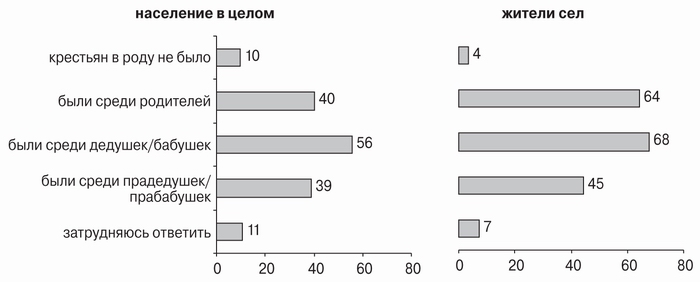
In your family, among your ancestors over the past hundred years, there were no peasants or peasants? And if they were, then among your parents, grandfathers/grandmothers or among great -grandfathers/great -grandmothers?
(any number of answers)
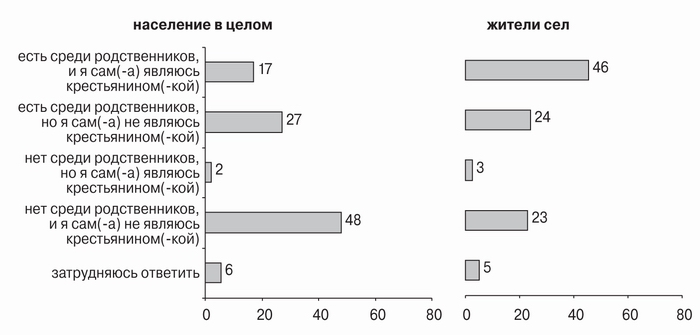
And now there are peasants among your relatives or not? Or maybe you yourself (-a) are a peasant (s)?
(card - one answer)
The survey data very vividly demonstrate that Russia has recently been a peasant country. Only 10 % of our fellow citizens are confident that over the past hundred years, peasants have not been in their family. 40 % of peasants surveyed had parents (or one of them), and even in Moscow and other megacities there are quite a lot: 21 and 22 %, respectively. And already most of the capital's residents (57 %) report the belonging of at least one (one) of their grandfathers or grandmothers to the peasantry. In other megacities, this indicator, by the way, is noticeably lower: 44 %.
The distribution of answers eloquently speaks of the pace of urbanization of Russia in the last century: the peasants were among parents for 56 % of elderly respondents (over 55 years old), in 46 % of middle -aged respondents (36-54) and only 23 % of young (18–35 years).
But even now, almost half of the Russians either attribute themselves to the peasants (19 %) or have relatives of the peasants (27 %). Moreover, such relatives, we note, have a third of Muscovites (31 %) and a quarter of residents of other megacities (25 %).
As the table below, most Russians are inclined to recognize the peasantry sociocultural originality, the community of mental and/or behavioral characteristics. Moreover, it is interesting that confidence in such a peculiarity is the higher, the further the respondent from the natural “habitat” of the peasants: if in the village dividing this point of view about one and a half times more than those who are not consistent with it, then in Moscow - almost all the same.
The population as a whole | Type of settlement | |||||
Moscow | Megapolis | Big City Small City | village | |||
It seems to you, do the peasants have any common character traits, behavior that distinguish them from most other people, or such special character traits, do the peasants have no behavior? | ||||||
Eat | 56 | 73 | 65 | 57 | 53 | 50 |
No | 29 | 13 | 24 | 34 | 27 | 35 |
I find it difficult to answer | 15 | 14 | 10 | 10 | 20 | 15 |
All participants in the survey, consistent with the fact that the peasants have common, distinguishing them from other features (that is, 71 % of respondents) asked these features, and describe features. The collective image of the peasant, drawn by respondents, turned out to be very positive, in many ways idyllic. Exactly half of those who answered the question (28 % of respondents) spoke of hard work, the zeal of peasants (“love to work”, “zeal, hard work”, “workaholics”, “always work, workers”). The virtues, especially often attributed to the peasantry, include love for the earth (“devotion to the earth”, “craving for the earth”, “earthliness”) - 6 %, kindness and responsiveness (“sincere people in the village”, “kinder”, “more responsive than other residents”) - 6 %, simplicity, modesty (“without ambition, ordinary people”, “modesty”) - 5 %, as well as practicality), as well as practicality), as well as practicality). (“Householdness”, “frugality and prudence”, “economicity, practicality”), thoroughness (“they do everything for conscience”, “they are more fundamental!”, “Responsibility”) and friendliness, cordiality (“benevolent, open”, “sociable”, “friendly”, “hospitality”) - 3 %each. The picture is complemented by such features as determination (“perseverance”, “grasping dead”), balance (“calm, humble people”, “not so twitchy as the townspeople, more balanced”), simple -mindedness (“selflessness”, “they cannot lie”, “trusting”), endurance (“more patient”, “we can transfer any difficulties”) - 2 % each, as well as wisdom (“very smart”, “unusual wisdom for the townspeople”), decency (“justice”, “honest”, “their conscience has not yet been lost”), God -fearing (“Christian holidays”, “more religious”) - 1 %, etc.
At the same time, there are very few critical statements: 2 % of the respondents mentioned laziness and drunkenness (“they drink a lot”, “laziness”, “drunkards and loafers in the villages are now left”), 1 % did not respond low about the cultural level of the peasantry (“less civilized people”, “grayness”, “illiteracy, oak”).
In general, as we see, Russian citizens are inclined to treat the peasantry with the deepest reverence-most likely, however, not quite identifying this socio-historical community with the real rural population today. Moreover, a fair amount of sympathy is mixed with this reverence: belonging to the peasantry is firmly associated with poverty.
In your opinion, in our country, most peasants live richer than people like you, poorer or the same?
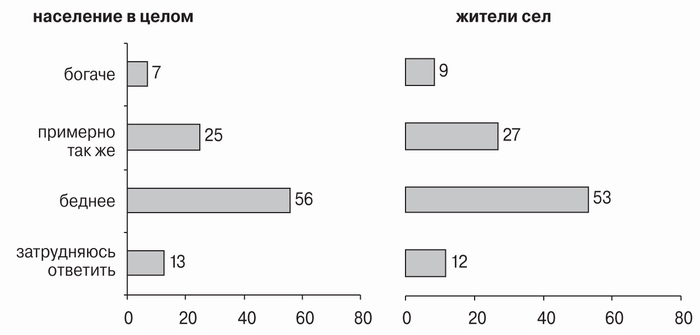
It is very significant that even in the village (and half of the rural residents, as we saw earlier, consider themselves peasants), 53 % of respondents are sure that most peasants live poorer than they are, and only 9 % are richer. This clearly indicates that poverty is perceived by very many as a stable characterological feature of the peasantry, as one of the species -forming signs of this community.
This, of course, does not at all prevent our fellow citizens from recognizing today's peasantry as a “guardian of national traditions”. Moreover, it is significant that in the village this opinion is widespread in almost the same extent as in cities.
Some believe that today in Russia the peasantry as a whole is the guardian of national traditions. Others believe that the peasantry in Russia is not today the keeper of national traditions. With which point of view - the first or second - do you agree?
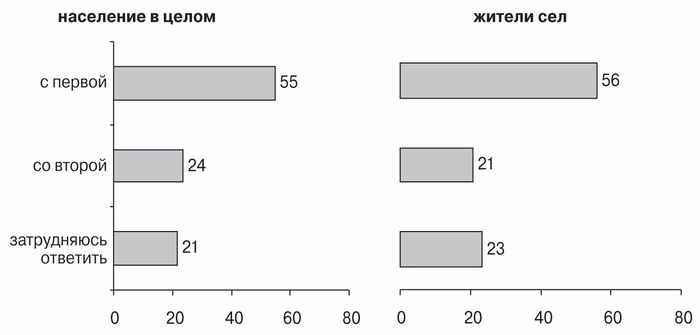
And be sure to pay attention to the fact that representatives of different generations are inclined to recognize the peasantry as a bearer of national traditions equally: among relative to the elderly, this point of view is shared by 57 %of respondents, among middle -aged people - 55 %, among young people - 53 %. But, as we could see, the elders are much closer to the peasantry than young people. Consequently, the stereotype of the special sociocultural role of the peasantry is quite successfully reproduced as new age cohors socialize. And if the peasantry is recognized by the youth of the bearer of national traditions, this means that the actual image of this social group somehow “works” in the hidden mechanisms of the formation and reproduction of national identity. And if so, then talking about Russia as a peasant country in the past tense is not entirely correct.