
Translated material
History with history
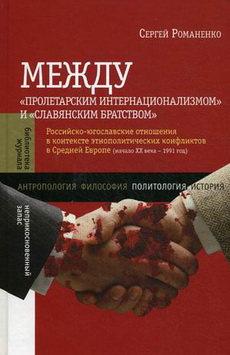 Recently, a presentation of the book of historian Sergei Romanenko was held “between Proletarian Internationalism” and “Slavic Brotherhood”. Russian-Yugoslav relations in the context of ethnopolitical conflicts in Central Europe. ” Behind the heavy name is a serious scientific work on the problems that still evoke strong emotions in Russia. About how pragmatic foreign policy interests were covered with bright and attractive slogans for their time. Moreover, when even the interests changed, the slogans remained, as they have already turned into stable stereotypes, continuing to influence the consciousness of both elites and society as a whole.
Such phenomena have to deal with far from only professional historians specializing on this topic. About ten years ago, the journalist called me and excitedly asked me to comment on the expulsion of the Serbs from Kosovo after the de facto separation of the region from Serbia. She quite reasonably called these events ethnic cleaning. The girl also suggested a recipe for the fight against this sad phenomenon - to evict all ethnic Albanians (that is, to fulfill the dream of Milosevich, who did not have time to make her into life for reasons beyond his mind). Moreover, the interlocutor sincerely did not understand that she was offering to commit ethnic cleaning, and more radical than the militants of Hashim Tachi did. For her, the expulsion of the Serbs by Albanians is ethnic cleaning. But on the contrary, the restoration of historical justice, the protection of the civilian population, etc. In general, a somewhat modified Chapek story about enemy anti -aircraft artillery, which insidiously attacked our planes, peacefully bombing cities of the enemy.
There was nothing strange in this position - if the media translate the same point of view for years, in the end, the media people themselves begin to believe. Moreover, this is not only about the media. It is worth going to any large bookstore, and we will see a lot of books rehabilitating Stalin, glorifying Beria, condemning democracy. Most of their authors are not professional historians, but amateur lovers injured by the events of the last two decades. In their former life, they were physicists or chemists, engineers or scouts, but now they have turned into propagandists that they were expensive. They cultivate in the mass historical consciousness the “conspiracy theory”, relying not on facts, but on emotions, or even such fakes as the “plan of Dulles”.
But the point is not only in the writings of amateurs, more or less popular (it seems that the market is already sharpened by them). The situation in professional Russian historiography looks very contradictory. On the one hand, there are a lot of high -quality historical works based on archival sources in small circulations. Romanenko’s book - from their number; The author worked on it, studying historical documents in Russia, Hungary, Croatia, Bosnia and Herzegovina, Slovenia. On the other hand, stereotypes were widespread here, not only Soviet, but also pre -Soviet ones. Often Marxist dogmas are replaced by imperial myths borrowed from the experience of “Russia that we have lost” (especially since this process began to occur long before the collapse of the CPSU and the collapse of the USSR). Historians are also people, and, therefore, are often subject to the same problems as society as a whole.
Sergei Romanenko draws attention to this in his monograph. I quote: “Modern Russian scientific thought in a large part does not ahead of the massive ordinary consciousness, but focuses on it and reproduces it after political leaders, who for the sake of popularity play on common and distant stereotypes, phobias and prejudices. A vicious circle arises, traveling along which both society and the state lose orientations in both time and space, as an obsolete and distant ideas and models from modernity. ” But the fact that excusable amateurs (although there are things that, in principle, are impossible for any author, with a diploma of the historian or without it - for example, conscious use of fakes), represents a much more serious problem when it comes to the works of professionals.
Romanenko’s book shows that it is necessary to study the past, but it is impossible to constantly live - otherwise stereotypes can lead to the fact that the “overwhelming” intensity of passions will entail dramatic consequences. An example of the subject of the study of Romanenko - the decayed Yugoslavia, where each side of the conflict has cultivated its historical myth - is the sad proof of this thesis. However, stereotypes are dangerous not only for the collapse of empires (or mini-imperials)-they are no less significant even after, when the former parts of one whole become neighbors. And for the relationship between them, the Russian imperial myth plays an equally destructive role than the Ukrainian national.
However, our society seems to be gradually becoming more resistant to historical propaganda. It would seem that the results of voting in the Svanidze-Kurginyan program contradict this-the obvious majority speaks out for the aggressively nostalgic Soviet patriot, refusing the support of a liberal journalist defending modern European values. However, in October, the Levada Center conducted a curious survey, finding out which of the two participants in the television sciences are more supported by the audience. And the result turned out to be unexpected: 33% expressed the sympathies of Svanidze and only 22% - Kurginyan. 20% said they support both, and 14% - neither one nor the other.
It seems that on the “nostalgic” results of television voting, a higher degree of mobilization of the emotional sympathizers of Kurginyan has a decisive effect. As well as the general intensity of passions during the program. When it comes to a sociological study in a calm environment, the results become more adequate real social moods - and inspire hope for the best. Of course, in the event that in Russia it will go as many serious historical works based on archival sources and not subject to stereotypical perception of the past and present.
Author-First Vice President of the Center for Political Technology