
Translated material
Sinusoid straightening
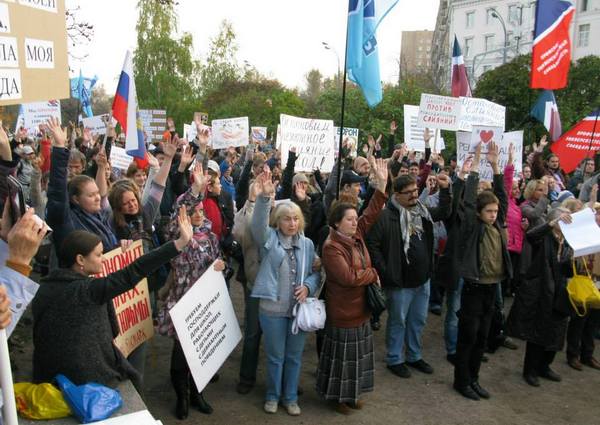
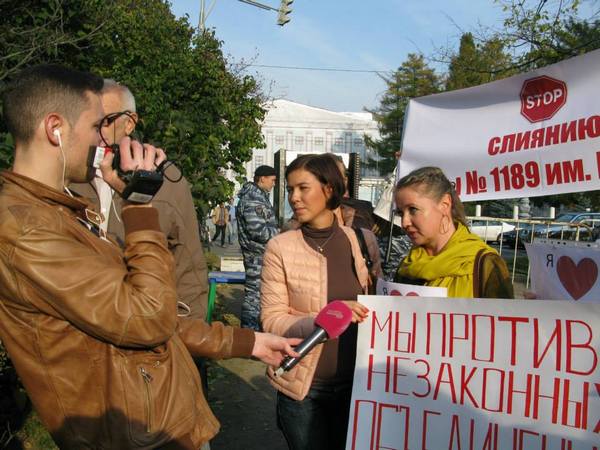
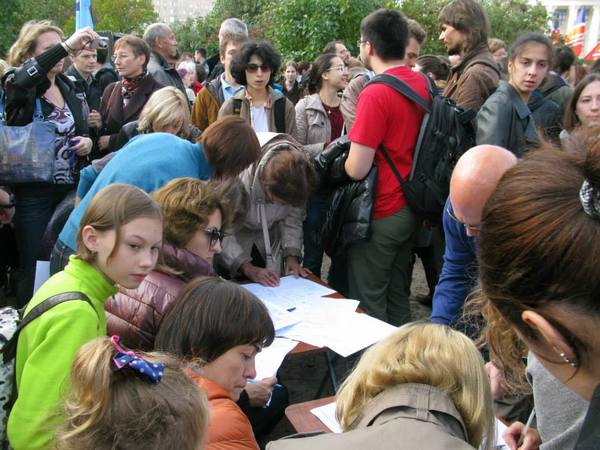
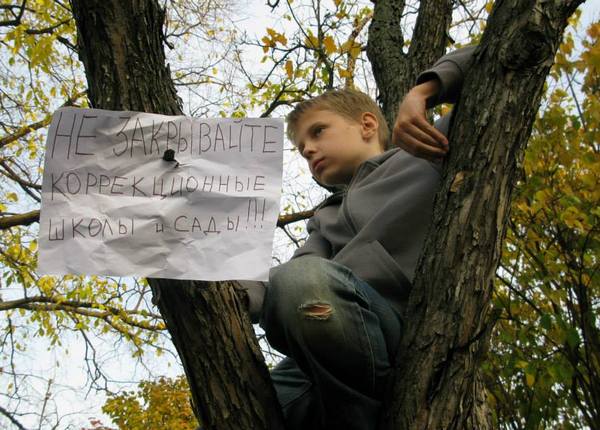
Passions, boiling around the protest of teachers, students and their parents against the merger of the intellectual school with a gymnasium 1588 more than a month ago, do not subside. Participants in the process and the interested public discuss various administrative and financial aspects, argue about what happened and what was not violated, the “intellectual” give advice, sympathize, support, criticize, send curses, gloating. In other words, as the king said in a similar occasion in Schwartz’s fairy tale: “Behind the wall, people press each other, cut their native brothers, sisters shout ... In a word, everyday, everyday life is going on.”
Not the last is the question of "why?" Why is it all started? Of course, the version of the targeted and malicious “strangulation” of schools for gifted children is widely discussed in order to bring the younger electorate to the common denominator. "Smarts are not necessary for us, the right ones are needed." We take a chance to assume that this is not the point. The case in the management system built in recent years; In particular, education.
Education can be approached in two fundamentally different ways. It can be regarded as a conveyor system, the task of which is to produce a product with some characteristics specified by the state and society. This approach was implemented with might and main in the industrial era, the British private schools of the 19th century were based on it - “Gentlemen factories”, and Russian pre -revolutionary gymnasiums, “sculpting” officials, and Soviet schools with a “young builder of communism” at the exit. The post -industrial society proclaimed a different goal - the most complete disclosure of the personality of each student, that is, the emphasis on the state interest on the humanistic principle. Such a model is based on a variety of educational institutions, specializations, training courses, teaching methods. Only with all this can we hope that each child will find his own educational “niche”, in which his personality, inclinations, family requests will receive the most adequate expression.
Let us ask ourselves: what is the place in that and other system plays educational bureaucracy? The answer is obvious. In the first option, its role is great: it leads the process from the first to the last stage, sets tasks, controls and adjusts their implementation. It is a representative of the customer, and the managerial headquarters, and the "State acceptance". This allows him to be numerous and talk with the schools menacingly and arrogantly. But in the second option, which involves a thin individual work, it remains a secondary role of the “rear service”, designed to ensure, in the military language, “the actions of military units”, that is, schools. And the rear - he is the rear, no matter how he call him.
It is not difficult to measure the results of the aforementioned subtle individual work to schools themselves: they manifest themselves in the desire of children not to scatter after a call from the last lesson, in graduates regularly coming to school, in grateful reviews of parents, in a well -visible teacher of the student’s personal growth. However, this is arithmetic not to express this. The bureaucratism is just a numerical indicator, because it can already be raised, and this is essentially the only thing they can do. And such indicators are announced by the results of the exam with the Olympiads and the average salary of the school.
For all its apparent meaningfulness, the results of the exam are actually not so much reporting about the school work. Firstly, many children are preparing for an exam with a tutor or in university courses. Secondly, a lot depends on the motivation of the child and his family, to which the school can influence very limited. Thirdly, as the last two years were especially clearly shown, these results are also not least dependent on the installation from above: the USE-2013 abounded with the “drains” of materials, and the average points were high; The USE-2014 was carried out relatively correctly, and the results decreased markedly. With the Olympiads, not everything is smooth, and the number of children who become winners and prize -winners of the regional and all -Russian tour (which take into account the ratings) is small enough.
Meanwhile, the merger of schools according to the “Strong+Middle+weak” scheme allows the statistics to improve without changing anything as work. The number of “high-point” USEs and winners-prizes of the Olympiads remains approximately the same, but they are now distributed according to three times the smaller number of schools, the percentage is growing, the absolute numbers are growing, there are no more outsiders with zero indicators, the head of the district “twists a hole” in the Latskan of the jacket.
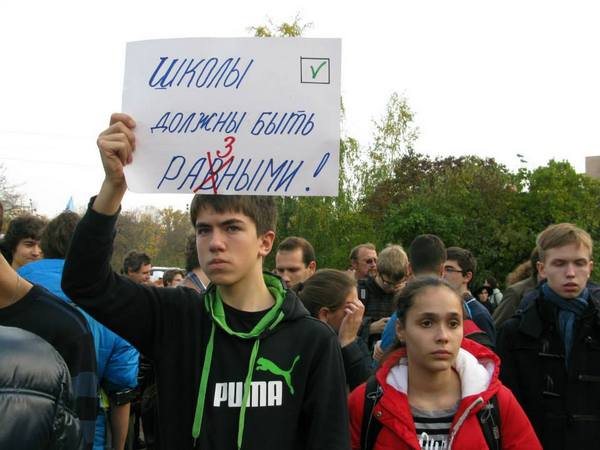
Even more clearly allows you to “increase the indicator” the notorious average salary. The merger of schools allows us to intensify the work of the teacher. For example, in a small school for 600 people (two classes in parallels), the chemist has a slightly larger bet, and nothing more, besides the class leadership, can not be hung on it. We drain three such schools, we fire one chemist (one of three will be a pensioner, so you can not even pay two salaries upon dismissal!), And the two remaining have already one and a half rates. The salary growth is obvious, and the fact that any teacher will tell you that from one and a half rates (i.e. 27 lessons per week), hacks begin even with a bona fide teacher-so this is not enough for an official, he needs to give a result now, after three or four years he will optimize something else in another chair ... and the increasing salary of the administration, primarily the director, also increases its controllability, and also increases its controllability, which also also increases it. It is important.

Of course, such a resource will be exhausted quite quickly, and the growth will stop. Then something else will come up with, and the successor of the current head of the regional education department will be equally assertively to implement some other reform. It is possible that the disaggregation of schools. And then we did not observe this with winter time!
So there is no conspiratorology! The “intellectual” is designed to become a tugboat that will significantly raise the indicators of a completely ordinary gymnasium 1588. And the fact that the school with a unique atmosphere, methods, a complex of extracurricular work and a carefully chosen pedagogical collection will most likely exist, from the point of view of the official - a side effect, nothing more.
We thank Natalia Demin for the photos provided.