
Translated material
June Lee in the Electrotheater

Colta.ru, together with the International Association of Writers, Poets and Journalists, Pen America presents the project “Written in the USA / written in America”.
For the first time, the Russian public will have the opportunity to get acquainted with American writers earlier than with their books. Four author, well -known to the American reader, but not yet translated into Russian, will come to Moscow to tell about their work and present a new view of modern America to the Russian audience.
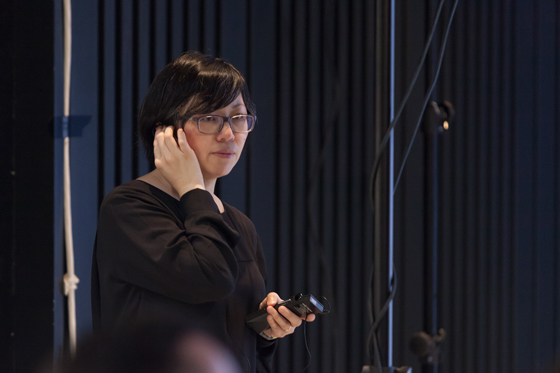
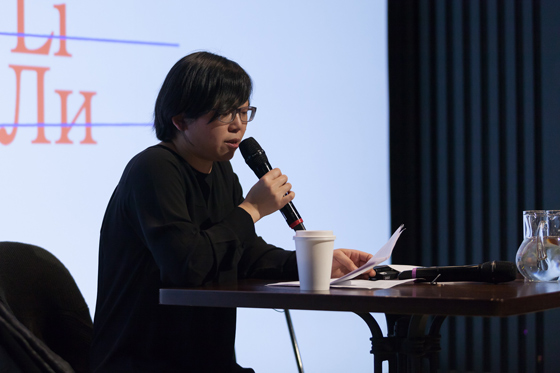
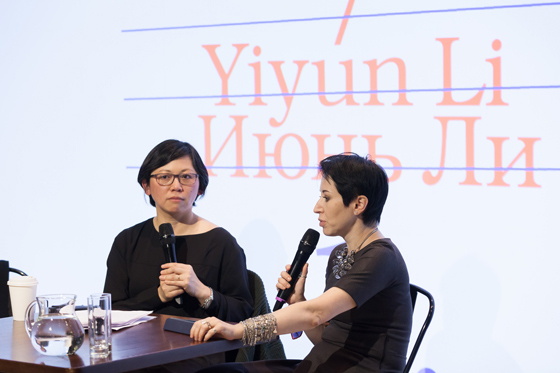
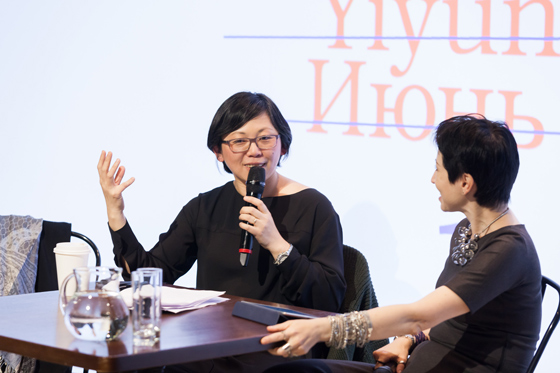
On April 22, with the help of our general partner - the Stanislavsky electricheater in Moscow, a public lecture of the writer June Lee, the first author of our program, was held. Happy we publish its full text.
June Lee was born in Beijing, in 1996 moved to the United States. The debut collection “A Thousand Years of Good Prayers” received the Frank O'Connor International Prize for the best short story, the PEN New English Award named after Hemingway, the prize of The Guardian for the best book. Her novel “The Loggrants” (“The Vagrants”) received a gold medal of the California Book Prize. The books were translated into more than twenty languages. In 2010, The New Yorker called her among the 20 best writers under the age of 40. In the same year, she received a prestigious MacArthur scholarship. The invited editor in the literary journal "Public Space" based in Brooklyn. He teaches at the University of California.
 © Stas Shakarvis
In a sense, my early literary education began with the illustrated autobiography of Maxim Gorky. Three books - “Childhood”, “In People” and “My Universities” - were reduced and supplemented by bright ink drawings. The size of the palm, these illustrated publications at that time were called books for little people , despite the fact that they were not children's literature. This was the literary format, because of which Shen Tsungven, one of my favorite Chinese writers, mourned the loss of literature in communist China-even an illiterate person could leaf through these books, as I did before I learned my first Chinese hieroglyph. Already as a young girl, I enjoyed these three books - they were my property, and besides them I did not own many. There was not a single boring page: either Gorky’s grandfather beat his grandmother, then his adoptive father beat his mother, then his uncle persuaded the good -hearted young man to drag a heavy cross in the cemetery and looked at him, crushed to death, without any regret, then Gorky during his studies colon with a club with a club. Every couple of pages, someone was dying: his father, his brother, his mother, a young man with a consumption, humming sad melodies, friends, neighbors and strangers. Important topics of these books - deprivation, inequality, political awakening of Gorky - passed me. I especially liked the range of characters: junk, rich relatives, beggars, one -armed man, a blind man, a chef crying over the beauty of poetry, a beautiful woman who borrowed a bitter book, a despicable bakery owner, mourning the piglets that his employee poisoned.
Not so long ago, I re -read this autobiography. (A rather strange acquaintance with Russian literature: start it with Gorky - as if climbing the roof of the house, not noticing a great Chinese wall nearby.) The book has preserved a lot of my memories, although this time the author dramatizes his own image, it seemed to me unpretentious and youthful. Is it beautiful - you want to remove Gorky from his own autobiography? And yet I felt how these books attract children: an orphan seems to be able to live a life that cripples and defeats others, but he always puts him in the center, making him more noble, more heroic and charismatic. Time from drama to drama can be considered wasted; In fact, there is no between dramas and life.
But this cannot be the fault of Gorky. Each era gives people its own language and its own ways to use this language. When I was small, my parents and people of their generations often sang songs of their youth: “Katyusha”, “Moscow Regions”, “Thin Rowal”, “Kalinka”. Someone sang in Russian, someone in Chinese translation. Oddly enough, one of my early children's memories is all these uncles and aunts, singing in chorus to the accompaniment of a frantic accordionist.
Of course, now I understand their enthusiasm. In the 50s and 60s, any Chinese song that has at least a drop of lyrical emotion, beauty was called bourgeois or even poisonous. Songs that ideological cleaning did not affect were Russian, and the generation of my parents sang through them about what it could not sing in Chinese.
The language theme occupied my thoughts as a writer and writer in a foreign language. I want to present you with an excerpt from my new book, where I studied the relationship between the languages of the public and personal, my native and acquired, as well as the relationship between language and history - social and personal.
 © Stas Shakarvis
Speaking means to make mistakes, but I will risk
One night I dreamed that I was again in Beijing, at the entrance to our apartment complex, in which a public telephone, a black disk apparatus, once guarded older women from the Association of Residents. They listened, without hiding neglect or curiosity, as I spoke on the phone with friends; When I finished, they began to complain that I was saying too long, and then made an entry in a special journal and calculated the cost. In those days, I had to plan a lot of things before using the phone, so that my parents did not notice my long absence. My pocket money - that is, that I could scrape and save from my lunch budget - I spent on phone calls and brands with envelopes. Like a Victorian heroine, I checked our mail before my parents did it, and chose from there the letters addressed to me.
I dreamed that I was asking for permission to use the phone. Two women left the office. I recognized them: in reality, there are no more. No, they said, this service does not work anymore, since now everyone has mobile phones. There was nothing special in this dream - it is impossible to prevent such a melancholy visit to the past - besides the fact that these women spoke to me in English.
Many years ago, when I began to write in English, my husband asked if I understood the subtext of this decision. He had in mind not practical problems, although there were plenty of them: foggy hopes for publication; the lack of a clear career path that I would have awaited in the field of science, my first specialization in graduate school in America; More stringent immigration rules awaiting me as a fiction writer. Many of my fellow students in China received green cards as NIW scientists (rejection of national interest). A creative person is of little interest for a nation.
My husband, writing codes for computer programs, asked about the language. Did I understand what it means to renounce my native language?
Once, Nabokov answered a question that he is probably tired of hearing: "My personal tragedy, which cannot and, in fact, should not touch anyone-that I had to abandon my native language." However, if something is characterized as a tragedy, this can no longer be a personal business. You can cry from your inner pain, but it is worth the public to dudge around, filling you with understanding and sympathy - and your pain becomes a tragedy. Woe belongs to man; The tragedy is those who surround him.
 © Stas Shakarvis
I often feel guilty, thinking about Mount Nabokov. As all the personal, deep connection between a person and his native language can be comforting and indispensable, but can also demand more than a person wants to give, or more than he is able to give. If I allow myself to be frank, my personal salvation, which cannot and should not touch anyone, is that I renounced my native language.
In the summer and autumn of 2012, I was hospitalized in California and New York after suicide attempts. At that time, I often returned to Beijing in my dreams. In them I stood on the roof of the building - one of those gray blocks of the Soviet type - or felt that she was lost by passing by bus through an unfamiliar area. Waking up after those dreams, I wrote down images that did not enter them in my diary - a nest of swallows under the balcony, barbed wire on the roof, a kindergarten with gossiping older people, mailboxes on the corners of the streets, round, green, with a hand -written schedule of letters in a square window behind translucent plastic.
But I never dreamed of Aiv-City, where I landed upon arrival in America. When they ask me about the first impression of this place, I can’t get a meaningful answer in my memory. During a recent trip there from my house in California, I visited the area through which I once went every day. One-story houses, painted in pleasantly pronounced tones, with their front gardens surrounded by white fences, have not changed at all. I realized that I had never described them to others or to myself in Chinese, and when English became my main language, they became everyday life. What happened during the transition from one language to another did not remain in memory.
People often ask about my decision to write in English. The change of one language seems to me natural, I answer, although this is not a lot of clarification: after all, to answer this question-as if trying to give a convincing explanation that someone is getting gray on this day, and not in another. But I understand that this is a stupid analogy, because I just do not want to delve deeply in this matter. Yes, there is something unnatural in this, and I refused to admit it. The point is not that I am writing in a foreign language - it can always be brought as an example of Nabokov, Konrad and many of my contemporaries - and not that I impulsively abandoned a reliable career for literary activity. The fact is how finally I abandoned Chinese, and did it with such determination that this decision became a kind of suicide.
The tragedy of Nabokov is that his failure was easy to explain by public history. His life path-an irreversible exile due to the revolution-became the property of the people. My decision to write in English was also explained by a shoot from the history of my country. But, unlike Nabokov, who was a Russian writer, I never wrote in Chinese. Nevertheless, it is impossible to avoid turning a personal decision into a metaphor, it is worthwhile to go through the prism of public vision. Once I and the poet of Eastern European origin - we both lived in America for many years and both write in English - asked to read our work in our native languages at the reception. But I explained that I was not writing in Chinese, and the organizer apologized for misunderstanding. I suggested reading whether BO, Du Fu or any of the classic poets, whose poems I taught from an early age, but instead I was asked to read poems by a political prisoner.
 © Stas Shakarvis
The desire of metaphors to develop limits reduces any human history; In the thirst to illuminate the surrounding, they blind their creators. In my distrust of metaphors, I feel a kinship with George Eliot: "We are all gloomy or bright, we are confused by thoughts in metaphors and inevitably act depending on their strength." And I know what my husband asked about this many years ago. But my rejection of my native language is deeply personal, so personal that I do not succumb to any interpretations - neither political, nor historical, nor ethnographic.
The Chinese immigrants of my generation in America criticize my English because it is not native enough. One compatriot, having read my work, wrote me an email in which he noted that my language is not a flowering or lyrical, unlike the language of true writers. “You write about simple things in simple English, you should be ashamed of yourself,” he wrote in a rage. One professor, an American writer who taught me in graduate school, said that I need to throw literary activity, because English will always be a foreign language for me. Their ideas about language knowledge did not make me impatient, like Nabokov, but rather forced to laugh secretly. The English language was a random choice for me, and any other could be in its place. What we strive for is not much speaks of us as what we are running from.
Before leaving China, I destroyed the diary that led for many years, and most of the letters addressed to me, the very letters that I was once afraid to skip and that hid from my mother. Those that I could not force myself to destroy, I sealed and took with me to America, even though I will never revere them again. I would destroy my letters to other people if I had them. I understand that this is a constant frantic desire to erase a life living in a native language - simply accepting the desired for real. Our relationship with the native language is similar to relations with our past. Very rarely the story begins and ends where we would like it.
A person crosses the border to become different. A person finishes the manuscript and breaks off the characters' stories. A person is borrowering a foreign language. All these are false and forced frames that give the appearance of freedom, just as time gives the appearance of softness, while we, suffering, allow him to flow monotonously by. Killing time is an English phraseology that still scares me: time can be killed, but only frivolous acts and aimless actions. Suicide does not occur to anyone as a bold attempt to kill time.
 © Stas Shakarvis
During my second stay in the New York Hospital, a group of medical students came to play Bingo one evening. A young woman, also a patient, asked if I wanted to join her. I said that I had never played Bingo in my life. She thought for a moment and said that she played Bingo only in the hospital. When we met, it was already her eighth hospitalization; For some time she studied in the hospital in her school years, and once even showed me a small fenced kindergarten, where she and other children were released for a warm-up. Her father often visited her at lunchtime, and I watched how they sat together and played the game, not even trying to start a conversation. At that time, no words would make sense, the language could not help the mind to survive this time.
At the same time, the tongue can flood the mind. Our thoughts, like slaves, depend on the language. I used to think that the abyss is a moment when despair stretches to eternity, but even the worst moment once ends. What really looks like an abyss is how a random tongue surrounds us like a bitter sand. We can kill time, but the tongue kills us.
“The patient claimed to feel like a burden for my beloved” - already much later I read the conclusion in the reception of rest. I did not remember this conversation at all. The burden for my loved ones: these words were probably attributed to me. I would never use such a phrasing in thoughts or in writing. But I resist not because I want to avoid banalities. To call yourself a "burden" means to give yourself weight in the lives of other people; To call them “loved ones” - to falsify the ability to love. We do not always want to be an object of self -examination imposed by stamps.
When Katherine Mansfield was still a teenager in New Zealand, she wrote in her diary about a man living in the neighborhood who had played the song “Suanni River” for weeks. “I wake up with SuANNI RIVER, eat it with every food and go to bed with the words“ The whole world is tired and sad ”as a lullaby.” I read the notes of Mansfield and letters to Marianne Moore at about one period when I returned home from New York. In one of the letters, Moore describes an event to raise funds at the Brin-Mor College. The girls in swimsuits and with green mermaid tails on the ferry: "It was very realistic ... down the Suannie River."
I noted these notes because they reminded me of one forgotten moment. I was nine, my sister was thirteen. One Saturday I sat in our apartment, and she was on the balcony. My sister began to go to the classes of a school choral mug that year, and in the rays of the autumn sun she sang in a voice, which was already beginning to acquire an adult sound: “down the Suannie River. Far, far. There my heart always beats. The old people live there. "
 © Stas Shakarvis
The words were in Chinese. The memory should also be in Chinese. But I will not see our tiny kindergarten with the vine that our dad raised and which was later uprooted by an angry mother, or a bamboo hedge decorated with a mortgage, or junk, which occupied half of the balcony, - annual accumulations delayed by dad - if I do not name all these things for myself in English. I cannot see my sister, but I hear her singing a song in English. Я могу попытаться понять мамину ранимость и жестокость в клинической терминологии психиатрического руководства DSM -5, но язык — это тот барьер, который я сама выбрала. От непереведенных воспоминаний можно отказаться; непереводимые воспоминания могут стать чужой историей.
На протяжении многих лет мой мозг прогонял китайский язык. Мне снятся сны на английском. Я говорю с собой на английском. И воспоминания — не только об Америке, но и о Китае; не только те, что я ношу с собой, но и те, что я отложила подальше, желая поскорее забыть о них, — сохраняются на английском. Разорвать связь с моим родным языком казалось — и до сих пор кажется — ключевым решением.
Когда мы входим в новый мир — в новую страну, в новую школу, на вечеринку, на встречу семьи или одноклассников, в военный лагерь, в больницу, — мы говорим на том языке, которого требуют обстоятельства. Навык приспособления — это навык владения двумя языками: один — для общения с окружающими, второй — для общения с собой. Мы совершенствуем публичный язык почти так же, как совершенствуем иностранный: нужно произвести оценку ситуации, построить предложения с верными словами и синтаксисом, избежать определенных ошибок либо извиниться за них и вынести для себя урок на будущее. Беглости в общественном языке, как и беглости в иностранном, можно достичь постоянной практикой.
Возможно, грань, которая существует между этими понятиями, не совсем четкая, и это правильно; для меня это не так. Когда я пишу, я часто забываю, что английским пользуются и другие люди. Английский — мой личный язык. Каждое слово должно быть обдумано, прежде чем оно станет словом. Я не сомневаюсь (может, это иллюзия?), что разговор, который я веду с собой, пусть он лингвистически не идеален, — это разговор, который я всегда хотела вести, и я делаю это именно так, как мне хочется.
 © Cтас Шакарвис
В моих взаимоотношениях с английским языком, в этих отношениях со свойственной им дистанцией между тем, кто не является носителем, и иностранным языком, из-за чего окружающие кидают косые взгляды, я чувствую себя невидимой, но не отчужденной. И это та позиция, которую я всегда хочу занимать в жизни. Но в каждом стремлении есть опасность пересечь грань между невидимостью и исчезновением.
Было время, когда я хорошо писала на китайском. В школе мои эссе были примерами для подражания; в армии, где я провела год нежеланной службы между моими восемнадцатью и девятнадцатью годами, командир нашего отряда давала мне выбор между сочинением черновиков для ее речи и уборкой туалетов или свинарников — и я всегда выбирала первое. Однажды в старшей школе я приняла участие в конкурсе ораторов. Стоя на сцене, я увидела, как многие зрители плакали, потому что были тронуты возвышенным лицемерным враньем, которое я написала; даже я сама была тронута до слез. Мне пришла в голову мысль, что я могу стать успешным писателем-пропагандистом. Меня это встревожило. В молодости человек должен хотеть быть верным себе и окружающему миру. Но что не пришло мне тогда в голову, так это задать вопрос: может ли интеллект человека полностью полагаться на общественный язык; может ли человек сформировать четкую мысль, воскресить точное воспоминание или просто почувствовать что-то искреннее, говоря только общественным языком?
Моя мама, обожающая петь, часто поет песни своих детства и юности, во многих из них — пропагандистские слова 50-х и 60-х годов. Но есть одна песня, которую она вспоминала всю жизнь, потому что она не знает, как ее петь. Она учила ее в детском саду в год, когда коммунизм захватил ее родной город; теперь она помнит только первую строчку.
В больнице была пожилая женщина, сидевшая в коридоре в блестящих красных туфлях. Я чувствую себя Дороти, говорила она, показывая мне туфли, которые она выбрала из пожертвований для больных. Были дни, когда ее ум прояснялся и она говорила о том, как красные туфли натирают ей ноги, но расстаться с ними она не может, или о том, как лекарства заставляют ее чувствовать, словно ее мозг умирает, и от них болит все тело. Но были и дни, когда она говорила в пустоту, вела бесконечные беседы с чем-то невидимым. Люди, которые бросили ее или умерли, возвращались и заставляли ее рыдать.
Я часто сидела рядом с этой одинокой Дороти. Я подслушивала? Возможно, но ее разговоры были за пределами вторжения. То, что возможно достигнуть точки, в которой граница между общественным и личным языком не имеет силы, пугает. Многое из того, что мы делаем — чтобы избежать страданий, найти счастье, сохранить здоровье, — это сохранение неприкосновенного пространства для нашего личного языка. И у тех, кто потерял это пространство, остался только один язык. Моя бабушка, по словам мамы и ее родственников, превратилась в женщину, говорящую с кем-то невидимым, перед тем как ее забрали в психиатрическую клинику, где она скончалась. Есть столько всего, чего можно лишиться: надежды, свободы, достоинства. Личный язык, однако, не поддается заключению. Только смерть может его отобрать.
 © Cтас Шакарвис
Мэнсфилд описывала свою привычку вести дневник как «говорливость… Должна сказать, ничто другое не дает мне подобного облегчения». Несколько раз она напрямую обращается к читателям — последующим поколениям — в насмешливой манере. Я бы предпочла не доверять ей. Но было бы нечестным не признать, как утешительны ее записи. Шли первые недели моей второй госпитализации. Моя жизнь была приостановлена. Были диагнозы, с которыми нужно было бороться, лекарства и протоколы, которых следовало придерживаться, работники больницы, перед которыми нужно было отчитываться, но все это было направлено только на исключение варианта. Я не видела, чем можно его заменить, но знала, что никто не мог дать ответы. Не имея никакого языка, чтобы описать безрадостность, которую я ощущала, я поглощала слова Мэнсфилд, словно утоляющее жажду снадобье. Возможно ли быть заложником чьих-то слов? То, что я подчеркивала и перечитывала, — были то ее слова или мои?
Не оставалось ничего, кроме как РАБОТАТЬ, но как я могла работать, когда эта ужасающая слабость даже ручку превращала в трость.
Есть нечто проникновенное и страшное в этом бесконечном желании установить контакт.
Поразительно, как сильно трясется большая ветвь, когда с нее улетает маленькая глупая птичка. Полагаю, птичка знает об этом и чувствует жуткое высокомерие.
Нам просто нужно быть уверенными в других. That's all.
Я осознаю свои недостатки лучше, чем кто-либо другой. Я точно знаю, когда ошибаюсь.
А существовали ли вообще для меня люди, не считая совсем далеких от меня людей? Или же они всегда подводили меня, а потом пропадали, потому что я отказывала им в действительности? Допустим, если бы я умерла, сидя за этим столом, играя со своим индийским ножом для бумаги, — в чем была бы разница? Не было бы разницы. Тогда почему я не совершаю самоубийство?
Когда мы думаем на приобретенном языке, мы расставляем и перестраиваем нейтральные, даже незначительные, слова. Когда мы что-то вспоминаем на приобретенном языке, в этих воспоминаниях есть разделяющая черта. То, что было раньше, может быть чьей-то чужой жизнью; может даже быть вымыслом.
Мне интересно, какой язык мы используем, чтобы чувствовать; а нужен ли для этого язык? В больнице Нью-Йорка я сходила на занятие студентов, изучающих разум и мозг. После беседы врач, который вел занятие, спросил о чувствах. Я ответила, что не в моих силах описывать то, что, вероятно, неописуемо. «Если можно перевести в слова свои мысли, почему нельзя сделать это с чувствами?» — спросил врач. Мне потребовался год, чтобы найти ответ. Сложно чувствовать на приобретенном языке, но делать это на родном языке вообще невозможно.
 © Cтас Шакарвис
Я часто думаю, что писательство — тщетная попытка; как и чтение; как и жизнь. Одиночество — это невозможность поговорить с кем-то на своем личном языке. Эта пустота наполнена общественным языком или романтизированными связями.
После того сна об общественном телефоне я вспомнила один момент в армии. Был канун Нового года, и нам приказали смотреть официальное празднование по кабельному телевидению. Во время трансляции ко мне подошла дежурная и сказала, что мне звонят по междугородней линии.
Это был такой же черный дисковый аппарат, какой был в моем доме; оказалось, звонила сестра. Это был первый междугородний звонок в моей жизни, а следующий случился четыре года спустя в Пекине, когда американский профессор звонил, чтобы провести со мной собеседование. Я до сих пор помню женщину, звонившую мне из медицинского комплекса Маунт-Синай в Нью-Йорке, задающую вопросы о моей заинтересованности в иммунологии, рассказывающую о своих исследовательских проектах и жизни в Америке. Мой английский был достаточно хорош, чтобы понимать половину сказанного, а скрипящие звуки на фоне разговора заставляли меня потеть, думая об упущенной второй половине.
Так о чем же я говорила с сестрой в канун Нового года? Отказавшись от родного языка, я вычеркнула себя из этого воспоминания. Но я поняла, что вычеркивание не прекращается и с новым языком, и это, друг мой, мое горе и мой эгоизм. Начав говорить и писать на иностранном языке, я не прекратила вычеркивать. Я также переступила грань от вычеркивания себя до вычеркивания остальных. Я — не единственная жертва в этой войне против самой себя.
В идеальном мире я бы предпочла сохранить свой разум для мыслей — и только для них. Я страшусь момента, когда мысль отступит и освободит место чувству, момента, когда мы встаем перед вечной проблемой избежания пустоты, для описания которой у нас не находится слов. Говорить, когда не можешь, — это грубая ошибка. Я высказалась тем, что написала — эту работу или любую другую — ради себя и против себя. Язык, который я выбрала, — мое утешение. То, что я вообще заговорила, — мое горе.