
Translated material
"The search for the ark continues to this day"
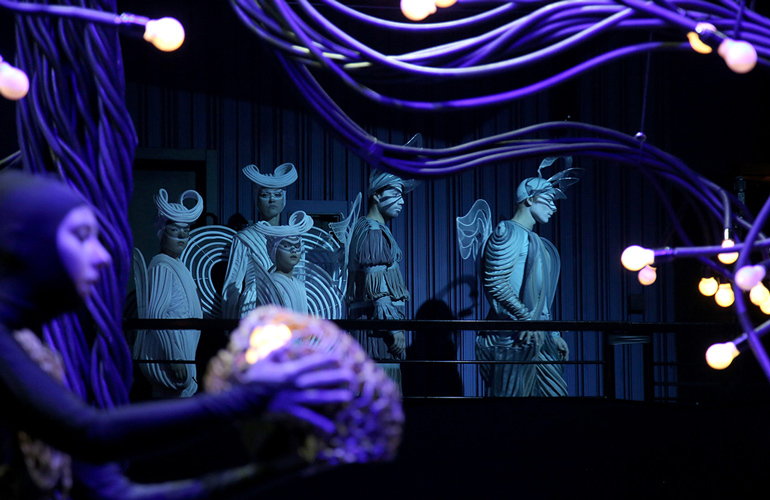
Maria Litvinova and Vyacheslav Ignatov (directors and artists), Olga and Elena Bekritsky (costume artists) are a team of storytellers, who received the Golden Mask for the Perm Opera Peter Pospelov last season “Traveling to the Country of Dzhambla” and now released a new work on the small scene of the Satz Theater. This is noev ark Britten. The Opera-Orator is based on the texts of the H vita-terrible miracle of the 16th century, interpreting the Old Testament plot of the World Flood. For the first time, it sounded in 1958 in the Church of Orford as part of a festival in Oldborough. Britten initially intended it for children in the church, but soon the “Noah's Ark” sailed into secular territory. In the new production, the text sounds in Russian, it was specially translated by Alexei Parin. Musical director - Sergey Mikheev. Ekaterina Biryukova talked about a play with two of his young directors.
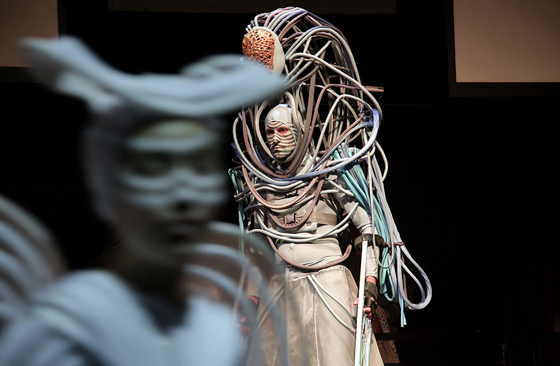
- You have a very, let’s say, material production, that is, all kinds of amazing objects play an important role in it. How do singers get along with them?
Vyacheslav Ignatov: At first they told us: “Oh, we are not working like that, we all teach in the class at first, and the scenery is preparing on the stage at this time, but in principle we can play everything without scenery.” But we can’t do it like that. At first we set the proposed circumstances - the scenery, props - and we put the heroes in them, and they act based on the proposed. And then you often come to the performance and see: the artists separately, the scenery separately.
Maria Litvinova: We generally always work according to the principle that fame now describes. Since we came from the puppet theater and for us objects and some material texture on the stage are extremely important. In Perm, the soloists told us: “No, friends, we are singing refrigerators, where we put it, and there we sing, what do you want from us? So that we play the dolls here? "
Ignatov: But then everything changed, the artists understood why all this was needed, and, moreover, they began to enjoy.
Litvinova: And when the artists of the Perm Puppet Theater came to them ...
- As spectators?
Ignatov: Well, yes. They came up and said: “Guys, well, we ourselves do not work with dolls, how you work!” So they just blossomed! And when they still got a “golden mask” - just a favorite performance has become!
We also have dolls in the Noah's Ark. But they are easier in puppetery than in Perm.
 © Elena Lapina
- And how do children cope with this story?
Ignatov: The children are amazing. How they want to work, how they are torn! They only tell them what needs to be done - they have already done it! In our play, the children's opera studio of the theater is involved in our play. Children from 7 to 14 years old.
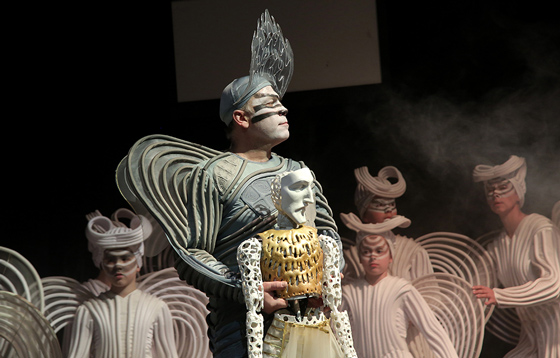
Litvinova: Britten generally wrote this opera for children to perform in the church. And if you look at the original score, then adult soloists are only Noah and his wife, and all other parties are performed by children. We have a little different way, since the soloists have a lot of work with the material part, with scenery, with dolls. So we did that we have all solo parties, adults sing, and children play angels, this is a choir, and he also has a rather large load.
- What other liberties did you allow yourself?
Ignatov: In our performance there is Adam and Eve, Cain and Abel. These are two main biblical events preceding the flood. And we have a giant in our play. He is not in the canonical Bible. Although there is a mention of giants as such in the Bible. But in the canonical text there is no giant about Noah's noe. But he is in apocrypha.
Litvinova: And in the Islamic version of the flood.
- So you studied all this?
Ignatov: Of course. We wanted to plunge into the material. This story is even interpreted in different ways. There are apocryphs that tell literally by the hour - what happened inside the ark, how it was arranged, what was on which floors. On the lower floor there are creeping bastards, on the second - animals, on the third - birds and in the fourth - noah with their family, eight people were of them.
 © Elena Lapina
Litvinova: And there is such a detail that the fourth tier was divided into a female half and male. And it was divided by the remains of Adam, which Noah also took with him to the ark and then buried it on Calvary. Actually, what we see on the icons is a crucified Christ, and under the crucifixion of the bone is just the bones of Adam, which Noah buried on Calvary. So everything is interconnected and mixed.
Ignatov: This is all exciting the minds so far. The search for the ark continues to this day. Expeditions are collected, go to Ararat, to other mountains, documentaries are shot, find it in the ice. There is an ark museum on Ararat, but it is located on the territory border with Armenia, and you can’t get there without a special pass. You can only see the binoculars, see the allegedly petrified skeleton of the ship.
A lot of questions. How did the ark look? How could all these animals be placed there? Despite the fact that the ark was much smaller than the Titanic. And there were much more animals on the ark than people on the Titanic. The Bible says that the water rose above the highest mountains by several elbows. And the highest mountain is Everest. Where it is impossible to be without an oxygen cylinder - the air is too sparse. And how did they breathe there? This is if you relate to this story as a real one.
- How do you feel about her?
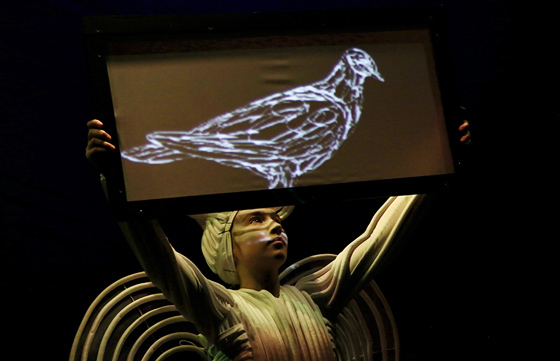
Ignatov: Personally, we treat her as a philosophical parable. What does it all mean to humanity? The story itself was reflected in almost our entire culture. Starting with the fact that in everyday life we often talk about "antediluvian times." The dove of the world with an olive branch, which is portrayed on different emblems, is the same dove from the story about the ark, a sign of what the land seemed. I remember my Soviet past when we painted pigeons with a twig - “peace”, May 9. This is all in everyday life. We just stopped associated these signs with the World Flood. This is the story of the long -lasting days, but we must draw our conclusions from it.
In our performance, we tell the story of the work and rallying of the family around the same business. When Noah received the news of the flood, he needed to convince the whole family that the work that they would do now is worthy of performance and that all this is true. After all, only he alone heard God. They built the ark for 100 years. But at the moment when he ascended the ark, it was 600 years old. They swam for a year, in the 601st year he left the ark. We thought: the wives of Noah and his three sons who were saved with him - they came from other families. Who stayed there, died. That is, family members also suffered a loss.
Litvinova: In one of the apocrypha there is a story that Noah had a fourth son, he refused to swim in the ark and died in the waves.
 © Elena Lapina
Ignatov: Children's books simplify this story, and it turns simply into a cheerful cruise with animals. But then all its content is lost. Then why tell her? We talk about how much the family had to work. First during the construction of the ark. Then swimming. Despite the fact that they were saved, for them it was a tremendous test. They worked all the year all the way. As written in the sources, each animal required feeding at one time. Some in the morning, some in the daytime, evening and even night. Noah did not close his eye throughout the year. 8 people had to serve all these animals. Someone had to prepare, someone to clean up after them. Some apocrypha says that God plunged animals into hibernation. And some interpreters explain that the temperature decreased greatly, and at low temperatures, animals fall into hibernation. But still this is a whole year of hard work in a closed space. And all this and his family survived. And when they went to the surface and stood on the solid ground, they pray - so that nothing like this would happen again! This is a story about how one family managed to bring the light of life from the old world to the new one. Save this barely warming light, which at any second could go out.