
Translated material
Cloud-RAI | Colta.ru
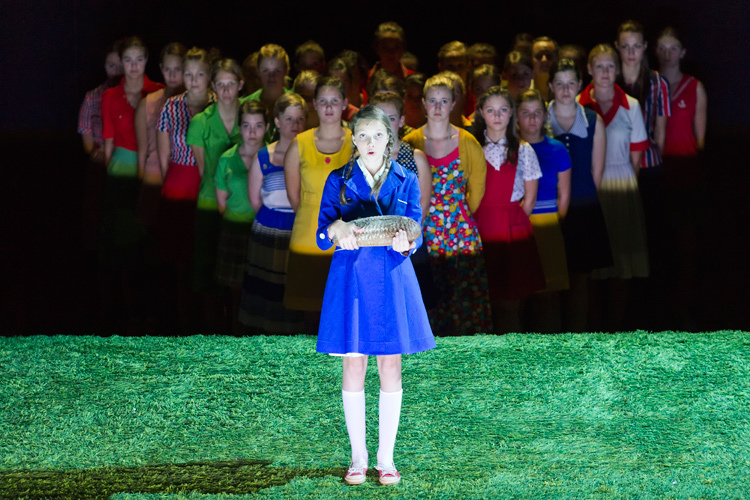
In the traditional genres of the musical theater of directing (or, we put it, choreography) and the composition are separate disciplines: someone writes music, someone puts a performance on it. Heiner Göbbels is completely different: he is a composer who uses the expressing means of the theater in his scores (actor, scam, light, color). For him, the composition includes directing - or vice versa: it depends on whether we are considering Göbbels's work in the context of a modern theater or modern academic music.
Accepting the proposal of the Carmina Slovenica vocal theater, Goobbels devoted the play “When the mountain changed its outfit” (in the original - “When the Mountain Changed Its Clothing” ), the chorist themselves - girls and girls, in which he saw not only young professionals, but also - first of all - teenagers. However, this is the usual practice for contemporary art - when the hero of the performance becomes a performer, which goes on stage in the role of himself.
Göbbels works with a chorus of 36 people, which gives him the opportunity to instantly change the character of the stage space: it is enough to build a new mise -en -scene. The choines are unciting around the perimeter of the scene, then they line up in the line; Either they rashly scatter around the site, then they gather in one polyphonic body.
 © "Golden Mask" "When the mountain changed its outfit"
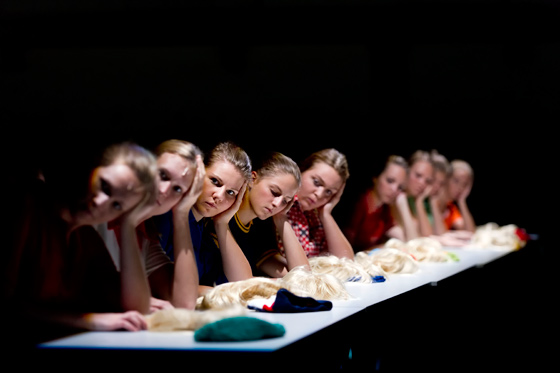
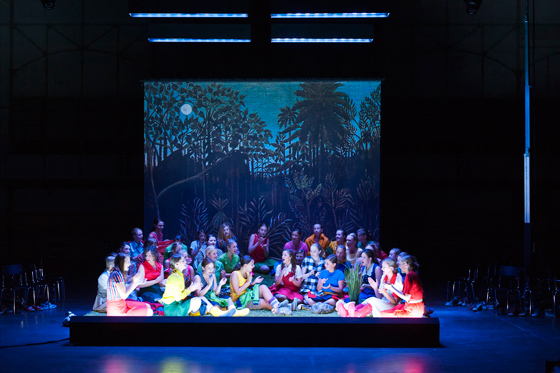
Swift spatial metamorphoses masterfully support the artist Klaus Grunberg: his scenography-with a mobile platform decorated with a green lawn, soft toys-living and a few written asses in the style of Henri Russo (it is amazing how easily the artist and director return this archaic, it would seem, element of stage design)-beats the image of children Like a lost paradise. In the final of the play, the artists carefully ripen toys, pull out cotton, bandage with threads-and cotton wool turns into clouds-fools of the inhabitants of paradise heaps.
But this paradise is by no means Christian, rather this place, not yet touched by culture, civilization. Göbbels presents to the public “another” - but not with us to sympathize with him: rather, so that we can feel his pressure, his superiority; Make sure our own beliefs and values are vulnerable. "Why can't I lie?" “This is not good.” - "Why?" “They punish it.” - "And if I lie down again to avoid punishment?" - And so on and the like: is it profitable to be honest, is it necessary to be afraid of a nuclear threat, do I know that I will die? In one of the long pauses with which the performance of Göbbels is sewn, the girls move the chairs to the advance line and silently, with a smile, look at the auditorium. A minute later, friendly faces are elusively changing, becoming unfriendly, aggressive.
For Göbbels, the composition includes directing - or vice versa: it depends on whether we are considering his work in the context of a modern theater or modern academic music.
Why the “mountain” is played in English, and not in the words, the question is far from idle, although, at first glance, as if not the most significant.
Firstly, the director is thus easier to achieve a neutral attitude to the text (the literary basis of the performance is quotes from Jean-Jacques Rousseau, Adalbert Stifter, Marina Abramovich and other authors-as always with Göbbels, is complicated and whimsical). Such removal allows you to withstand the balance between the layers of theatrical fabric, without attracting excess attention to recitation - and at the same time protect the artist from possible falsehood.
Secondly, Göbbels puts a performance on socialization (which the school is engaged in) and the first impressions of modern society (forming in the same place). A foreign language in the modern world is the number one school discipline. Musical overture, opening the “mountain”, is nothing more than a familiar cramming from childhood: “ Listen to Me , EVERYTHING IS Gonna to Be all Right , ” the choir pulls again and again.
 © "Golden Mask" "When the mountain changed its outfit"
In the “Shtifter’s things” , the hit of the foreign program “Golden Mask” - 2013, Heiner Göbbels expelled from the scene of the artist, focusing on visual and sound effects. The idea of the new performance of one of the main characters of the modern European scene is not just based on a person - he was born from a meeting with specific people, with the troupe of the Carmina Slovenica vocal theater. Göbbels borrowed the name of the production from the Slovenian folk song about how "in the spring Mount Kanin changed her outfit: / She put on a white shirt and green pants." In this quote, Göbbels heard a metaphor for growing up, determining the intonation of the entire production. And although the so -called transitional age is a very traumatic period of human life, the form created by the director, it is impossible to describe in other words except “absolute harmony”.