
Translated material
Imaginary values
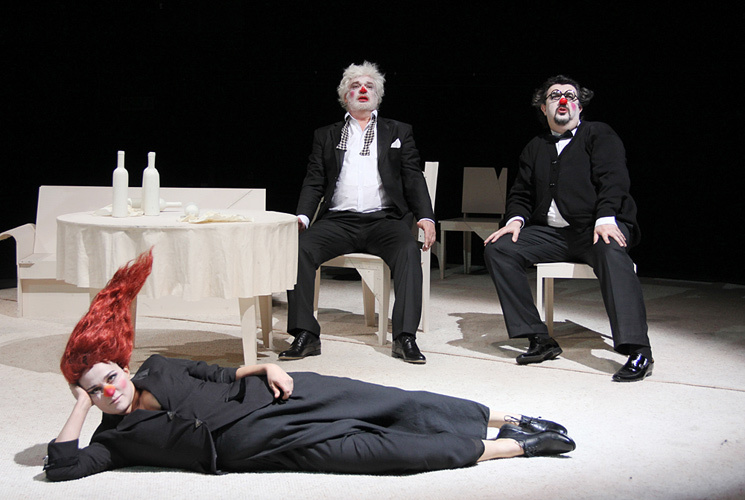
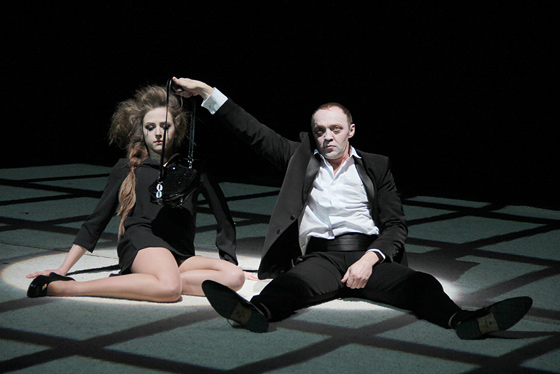
The premiere of “drunk” - a performance in which almost all roles are played by the Moscow Artists, ”played on the stage of the Meyerhold Center, Black The Box of which, like a glove, the inclined plane of the artists of Maria and Alexei Tregubovs drawn by black and white squares. There is no doubt that the “drunk” will also fit into the poster consistently withstanding the course for the experiment and the innovation of Qima, where the Moscow Art Theater has much more chances to find their audience than in the Kamerger Lane. This repertoirs of an assembly generally look like a potential spectator hit: the fans of Ivan Vyrypaev and the fans of the Moscow Art Theater, like Igor Zolotovitsky and Dmitry Brusnikin, will go to the “drunk” - all the more in the play of Viktor Ryzhakov, they reach a fundamentally new artistic territory for themselves.
The “drunk” create an entertaining precedent: despite the fact that Ivan Vyrypaev has not been one of the main figures of the modern Russian theater for several years, and the drama of the author of “oxygen” and “Delhi Dance” is quite deservedly one of the most successful positions of domestic theatrical exports, in the homeland of his plays they still go mainly in chamber spaces-on large stages They are extremely rare. It is logical that it was Viktor Ryzhakov who decided to bring the drama of Vyrypaev to a large scene - the director, who made the name formalist the elegant productions of “oxygen”, “Genesis No. 2” and “July” in the “Theater.doc” and “Practice”. Once upon a time, he gave us the music, hiding behind the brutality of the early texts of the playwright, Ryzhakov and “drunk”-written, in essence, already completely different Vyrypaev-decides to theatrically, Grotretovo, demanding ideal musicality, intonational and plastic accuracy from artists.
 © Ekaterina Tsvetkova
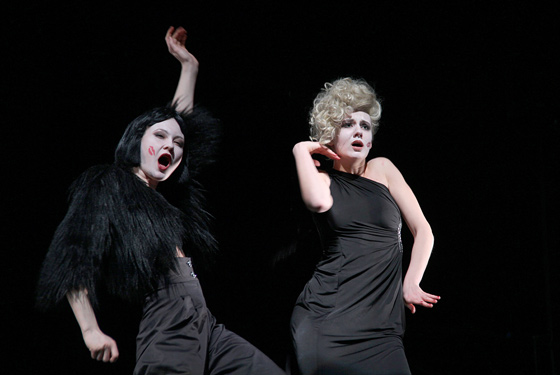
The new play of Vyrypaeva was created by order of Dusseldorf Schauspielhaus , through the efforts of the Stefan Schmidtka, who had turned the Russian theater in one of the main European representative offices of the Russian theater in recent years: two years after the loud premiere of the “process” Andrei Mighty Schmidtka again made a bet on the Russians, inviting the “drunken” Viktor Ryzhakov, the marital couple of the Third Grushkov, choreographer Oleg Glushkov and composer Alexander Manotskov. In the Moscow reincarnation of the “drunken”, an echo of that easily given to German artists of fierce cabaretics is clearly heard, in the calculation of which the director composed his performance: the manner of Viktor Ryzhakov somewhat reminiscent of the production of Alis Zandvik, in which the grotesque is combined with realistically detailed psychological details of acting. So in the “drunk”: people with whitened faces, clown balls on the nose and magnificent red -haired wigs are extremely concrete in their way of behavior and “speaking” - on this paradox, Ryzhakov’s most successful hits are built into the genre, such as a scene in a vegetarian restaurant, where a company of tipsy young people bursts in the middle of the night.
"It is easy to say - not to piss, but how to do it?"
At the point of intersection of the conditional and realistic, the authors of the performance record the carnival nature of the life of the conditional modern prosperous Muscovites (or the same conditional Dusseldorfs who took the diagnosis of Vyrypaev and Ryzhakov at their own expense for a month earlier), a revealing pathos against the falsehood of which “drunk” are filled. Ryzhakov managed to find an accurate stage equivalent of the genre of the play, balancing on the verge of the manner of the early texts of Olga Mukhina and the aphoricism of the dialogues of the Cohen and Tarantino brothers and Tarantino: the sniper accurately kills every hint of everyday logic and reveals the mechanics of the absurd, the aesthetics of the “drunken” inherits the recent Vyrypaevsky The text “Summer Walls bit us even in November”, which has just been placed in the “Workshop of Peter Fomenko”. The artistic space of the "drunk" Vyrypaev and Ryzhakov is the world of multiplying speed of imaginary entities.
 © Ekaterina Tsvetkova
The play of Vyrypaeva consists of an endless series advancing to each other attempts to answer the questions “how to live” and “what to do” - and to these existential searches, mindful of the branded sincerity of the Vyrypaev’s manifestos, and is drawn to take seriously. However, if you listen to the text of the “drunk” more closely, it will become obvious that in each of the dozen episodes of the two -haired play, the playwright teaches not to trust anything, and first of all, the braided language in which all these commandments and revelations are pronounced: there is a worthy - in the sense, the same drunk - opponent. The staggering “drunk” rely on the axis of universal relativism: relationships, life principles and even time. It's okay, the husband says to Zhenya’s husband that you slept with my friend - you just wanted happiness: after such cleansing confessions, drunk, as a rule, cry - or beat each other in the face, get married on the first oncoming person, admit love to a stranger or attached to a prostitute, who almost accepted the director of the film festival (Vitaly Kishchenko’s Mkhatovski debut) for Jesus Christ. In the world that the heroes of Vyrypaeva curses for artificiality, melancholy and incorrectly understood freedom, there are many opportunities - and none of them cannot be linger on for a long time.
Criticism of liberal European values in the play, written specifically by order of one of the main theaters of modern Germany, was the road to the heart of the audience of Duceldorfsky Schauspielhaus . However, it is precisely this property of the “drunk” that makes it completely different to perceive the text of Vyrypaev in today's Russia, alarmed by the fear of the coming lack of freedom. Therefore, probably, the time should take the time so that we, having ceased to “pour the European shit on our heads,” are able to laugh fun and freely with Vyrypaev and its heroes. It is not for nothing that the shock reprise of the “drunk” became the reprise of the hero Igor Zolotovitsky, asking himself and the hall: “It is easy to say - not to piss, but how to do it?”