
Translated material
Ordinary dictator
Around Russia
 Ordinary dictator
February 24, 2011 Alexey Makarkin
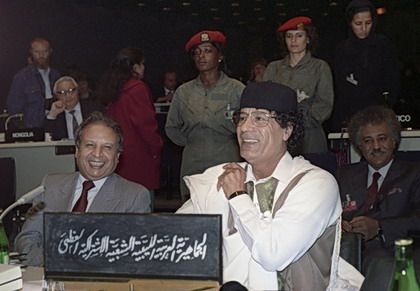
Muammar Gaddafi was considered a mysterious ruler. A young officer, who headed a group of colleagues who overthrew the archaic regime of King Idris. The theorist of the national government, who tried to combine the ideas of the Bolsheviks and anarchists with the Koran, who was proclaimed the basis of Libyan legislation. The Arab leader, who preferred to live in a luxurious tent surrounded by g. Moreover, to everything claimed that Shakespeare was a Libyan who emigrated to Elizabethan England.
In fact, the fiery revolutionary since the mid-70s has been an ordinary dictator of the raw material country. He spent overpromitations from oil on the militarization of Libya (in other years, military spending absorbed about a quarter of the state budget) and for his own enrichment - and a half decades supported terrorist organizations, from Palestinian to Irish. The whole grandiose plan to create Jamahiria - a state education inspired by the ideas of the comrades of Lenin (the period of writing “state and revolution” - an unfinished treatise on the breakdown of the state machine), Bakunin and Kropotkin - in reality was due to the desire to establish hard sole power under the cover of the complete restructuring of the power structures. As a result, six of the eleven members of the Military Council, who carried out a collective leadership of the country after the 1969 coup, were thrown out of political life. Two of them then emigrated; The Moroccan authorities issued one during the period of "warming" relations with Tripoli - they claim that he was shot directly at the airfield.
Of course, there was no question of any real rule of the people, about which Gaddafi wrote in his “Green Book”. However, in the Libyan situation there was an entertaining feature. In Jamahiria, despite the socialist hobbies of Gaddafi (who ended, however, shortly before the collapse of the USSR, the support of which the Libyan leader was not accepted), there were business, traditional tribal leaders, and professional officials went to the service. But all this did not happen thanks to the supreme power, but contrary to her, despite the extravagant experiments of the revolutionary leader. It is not surprising that when the regime was staggered, it was immediately rushed to renounce him before the necessary loyal (and how not to be loyal in a system close to totalitarian!) Tribal authorities, freely speaking English diplomats and even more recently obedient ministers.
In contrast, for example, the ascetic Algerian leader of the 60-70s, Juari Bumeden, did not conduct a full-fledged industrialization-priority in industrial development during high energy prices (when there were no sanctions in relation to the country) was given to oil refining. But the Libyan leader himself and his family did not differ asceticism, while falling into various scandals. That one son Gaddafi moves out of the Lux of the Italian hotel, owing 400 thousand euros. The other is mocking the hotel’s staff in Switzerland and the outbreak of short arrest gets, after which the angry father announced the Swiss Jihad, withdrew $ 7 billion from the country's banks and sent two Swiss businessmen who turned to the arm of Swiss businessmen. As a result, the Swiss president had to personally apologize to the “king” in order to rescue his fellow citizens from Zindan. The Gaddafi family surpassed the family of Ben Ali, not to mention Mubarak, although there is something in common between them - an attempt to create an informal dynasty, the search for a successor among the closest relatives, which narrows intra -elite support of the authorities.
Unlike Ben Ali and Mubarak, Gaddafi does not have the opportunity to retreat. If the first was able to hide in Saudi Arabia, and the second is still defending the army (although this protection no longer applies to the bank accounts of the Egyptian ex-president), then Gaddafi cannot count on such scenarios. It is difficult to find a country that would accept such an odious leader - the harsh Iranian mullah, for example, has serious questions for him in connection with the mysterious case of 1978, when the leader of the Lebanese Shiites of the Musa Sadr, who came to Libya at the invitation of Gaddafi, mysteriously disappeared. The religious leader was either immediately killed or thrown into prison. Gaddafi, of course, refutes these assumptions, but few believe him. As for the Venezuelan scenario actively discussed in the press, it is unlikely that Lieutenant Colonel Chavez, who will have complex presidential elections, will want to contact a scandalous colonel, accustomed to scatter a big money - the city poor, which makes up the main electorate of the current president of Venezuela, is unlikely to like it. But the United States would like to meet with Gaddafi as soon as possible-in order to ask him questions about how an explosion was given to an explosion at the American disco in West Berlin in the 86th year or the destruction of an American plane over Lokerbi in the 88th. The option of Mubarak in general in the Libyan conditions cannot be considered seriously. The degree of hatred of the dictator and his family is so great that he cannot count on the fact that he will remain a “simple citizen” in the country, which he has robbed for decades, proclaiming the slogans about the public.
However, going to the execution of their own people and while behaving as if in nature there is no satellite television and the Internet (and, therefore, you can hide crimes behind the “iron curtain”), Gaddafi opposed himself to almost the entire international community. The League of the Arab states, which is not at all of classical democracies, suspended Libya's participation in its activities. The Supreme Commissar of the UN Human Rights Navanetham Pillas called the actions of Gaddafi a crime against humanity. Even the Russian Foreign Ministry, usually not too inclined to protect democratic values, called on the Libyan authorities to abandon the use of military means in order to disperse demonstrations - and this is despite the interest in supplying weapons for the Libyan army.
What did Gaddafi count on? It is clear that on the force, not a scattering police and the oscillating army, and special forces “lined up” by their previous acts are so that they are ready to fulfill any order, up to the bloody massacre. On blackmail, the world community is a possible explosion of pipelines. And also to the pragmatism of a number of Western countries that reach cynicism. First of all, Italy, which imports from Libya a quarter of oil consumed and a third of gas. Silvio Berlusconi pledged to invest $ 5 billion in the Libyan economy as reparations for crimes of Italian colonialists against the Libyan people. It is interesting that almost immediately after Gaddafi came to power, the entire property of Italy citizens in Libya was confiscated, and they themselves were put up from the country, but when signing the Berlusconi agreement did not remember this. Another thing was more important for him - uninterrupted supplies of energy carriers, the fight against illegal immigration from Africa and - not least - joint projects with the participation of Italian companies, implemented for “reparation” billions. However, in the West, cynicism has its own limiter - public opinion, which is definitely configured against the most odious Arab dictator. It is not surprising that the Minister of Foreign Affairs of Italy Franco Frattini called the acts of Gaddafi a terrible massacre. And also the very pragmatic Nicolas Sarkozy already demanded that the sanctions against Libya were imposing sanctions: next year the presidential election will be coming in France, and he cannot go against dominant moods. So this card of Gaddafi seems to be a bit.
However, the Libyan leader does not have much choice. Driven in a corner, Gaddafi made those bets that he still has - perhaps the latter for his regime.
Author - First Vice President of the Center for Political Technology
Photos of RIA Novosti
