
Translated material
It concerns us
In the economy
 It concerns us
August 9, 2011 Evgeny Gontmamer
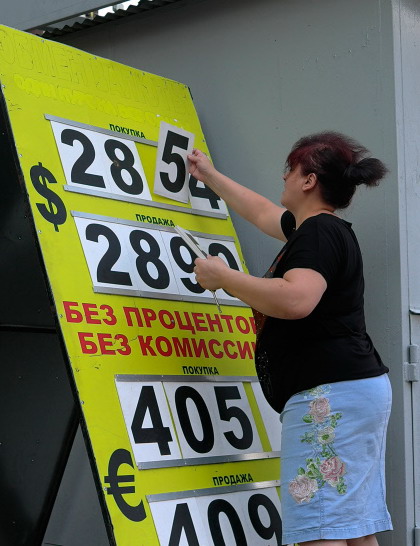
The vast majority of Russians are completely indifferent to information about a decrease in the US investment rating and a collapse on stock exchanges around the world. Some, most fooled by state propaganda, even gloating about the difficulties of the American economy (“so they, parasites, are necessary”), thinking that our “island of stability” will not affect this cataclysm. And there seems to be grounds for such optimism. These are, first of all, our solid gold and foreign exchange supplies and high oil prices. But let's try to understand the points with what consequences for our everyday life can have current events.
1. Fact: the main international currencies - the dollar and the euro (political economic aspect) rose sharply in relation to the ruble . The external illogicality of the situation is immediately striking - in the USA and in Europe problems, and people get rid of the ruble. In fact, there is nothing strange here. Simply, when it comes to the crisis (and this is not the first time), everyone quickly forgets about Russia as an island of stability. Against the backdrop of our problems (words carefully hidden by Fler) it is the Western economy (and this implies the entire social structure) is a really stable education.
I'm not going to look through pink glasses at what is happening in the USA and Europe. There is much outdated and requires replacement. But - and this is fundamentally important - the values of democracy and a market economy are called into question only a few marginals. Therefore, no revolutions, no “to the foundation, and then ...” in the West there will be. And there will be economic and financial reforms, repeatedly discussed with all public groups and, as a result, which are the fruit of heavy (sometimes painful) compromises. This is confident even by those who, from the screens of Russian television channels, covers the latest abroad with the last words, which is about to fall at the feet of “stable” Russia. After all, it is not without reason that these people and, most importantly, those who stand behind them have long been throwing their anchors in the West (families, real estate, accounts, business).
Conclusion: the current difficulties of the world economy at any time can provoke an acute crisis in Russia, which will quickly become political. This “any moment” can happen not tomorrow and this year, but, as all serious domestic experts warn, the score is only in years, and not for decades .
What are the most likely points at which the transition from the current jelly -like state to the stage of the open crisis, which will hit the welfare of most Russians?
2. Fact: the main international currencies - the dollar and the euro (consumer aspect) sharply rose in relation to the ruble .
Over the past year, during which Russia allegedly gets out of the crisis, there has been a steady tendency to avoid imports. So in January-May 2011, the importance of the country increased by 48.6% compared to the same period last year, while export became most 28.5%. Moreover, this growth was provided mainly due to raw oil (+29.3%) and natural gas (+35.9%), and this is almost half of the total export of the country. If such a skew continues to continue (and the country is increasingly dependent on the production of raw materials), then in a few years we risk getting a negative balance of trading balance (when the import exceeds exports). And this means that our well -being will be even more dependent on oil prices and gas (more on this in Clause 3).
But now there is an disturbing fact: expensive dollar and euros - this is an increase in prices for imported goods, in many respects due to which we live. Go to any store and look: I can’t understand why, for example, we sell Chinese garlic or Israeli carrot, as well as Polish night pots for children. The climate, or something, is unfavorable, and there is no more plastic?
A cheap ruble, if Russia were a country with a diverse economy, would be a blessing (look at the same China) both to saturate our domestic demand, and for domestic exports. But this is not: the share in our export of machines, equipment and vehicles - only 5%, food products and agricultural raw materials - 1.3%, statistics are generally silent about consumer goods.
Conclusion: if the trend of reducing the reduction in the ruble continues (and about this, as the necessary step after the 2012 elections, our financial authorities also speak), then we will get an additional impulse of consumer prices, which, as you know, causes the greatest damage to the standard of living of medium and low-income families .
The side consequence of high inflation is well known: further deterioration of the already bad investment climate due to a lack of available long-term lending and excessive risks for the payback of serious business projects.
And this, in turn, further exacerbates the problems of our labor market, which is dominated by low salaries due to the archaicity of most jobs.
3. Fact: there is a trend, if not yet to fall, then at least to stabilize oil prices, gas export prices under pressure, first of all, European consumers will decline.
A decrease due to the current problems of the growth rate of the global economy in combination with the programs of transition to alternative energy sources (for example, biofuel) creates all the prerequisites for reducing oil and gas prices steadily implemented in many countries. What does this mean for the balance of the Russian trade balance - see above, in paragraph 2.
In social terms, quick consequences are obvious (especially since they are already evident). For example, this is a leading inflation increase in domestic prices for gasoline and gas.
But there are equally obvious, but so far inconspicuous consequences for budget industries - and, above all, for education and healthcare. Even now, with 110 dollars for a barrel of oil and the current export prices for gas, on these basic ones for both the economy and for the entire sphere, the state spends about 8% of GDP, which is 2 times lower than, for example, in the member countries of the organization of economic cooperation and development. And if you calculate the absolute figures for per capita expenses, then the gap will be much larger-3-4 times. And if oil costs 60-70 dollars per barrel, which is recognized as “fair price” by many experts and the gas will become cheaper in the world market? Again: this is a forecast not for tomorrow and, most likely, not for the coming months, but in the future for several years it is very likely.
Conclusion: the everyday existence of most Russians is already in the zone of extremely high external risks of reducing already low standards of life. Moreover, the degree of impact on these risks from Russia is extremely insignificant. This is the main result of our state’s activity in the “stable” 2000s.
Author - member of the board of the Institute of Modern Development
Photo by RIA Novosti