
Translated material
With ease
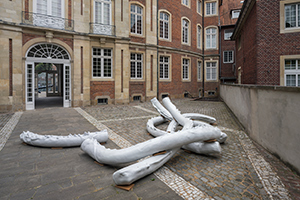
In the small Westphalian city of Münster in the north-west of Germany, near the border with the Netherlands, once every ten years since 1977 , the “sculptural project” has already become the world famous. In time, this exhibition in time coincides with the “Document”, which opens in Kassel every five years - and this is only a couple of hours by bus or train from Münster. And the relationship between the two projects is historically, if not conflicting, then at least competitive. Last time, in 2007, the creator of the “sculptural project” Kasper König almost quarreled with the city authorities, since they wanted to make the Munster exhibition almost an application to the “document” and hold it also every five years. The curator was even ready to sue, if necessary. “I'm not sure if I had a legal basis for this,” says König. “But they eventually changed their minds.” And they did the right thing.
After ten years, we can say with all the confidence that Casper König turned out to be a provider. If we compare what the Skulptur Projekte team did (and this is, in addition to the already mentioned Koenig, two more curators - Britt Peters and Marianne Wagner), and the Kasselsky project of Adam Shimchik, they look accordingly like Mozart and Salieri or like Faust and Wagner. The main problem of “Documents-14” is its heavyweight and tension. In Kassel, as in Athens (the exhibition this time is divided into two more or less equivalent parts), many interesting, important and relevant works are presented, but curatorial work with them is carried out at the level of creditors, or something. In fact, the theoretical, if not the mass media, Backgrand “Documents” is given more attention than the exhibition, which is organized and passes at several venues, which enhances the feeling of decaying curatorial thought. The works are gathered somehow, unfortunately, some kind of porridge from good intentions is obtained at the output.
The curators of the "sculptural project" acted differently. The frame in which this exhibition is originally placed is quite problematic: you need to show diverse work in the city, and this has long been not only sculptures, but also installations, videos, and performances, and much more. By origin, the “sculptural project” is something close to the festival, but in reality it has long outgrew and adapted this not the most serious format. This is a full-fledged, well-thought-out exhibition, which, with all the territorial scatter, can be viewed in a day or two (and call into the neighboring Marl, but more on that later).
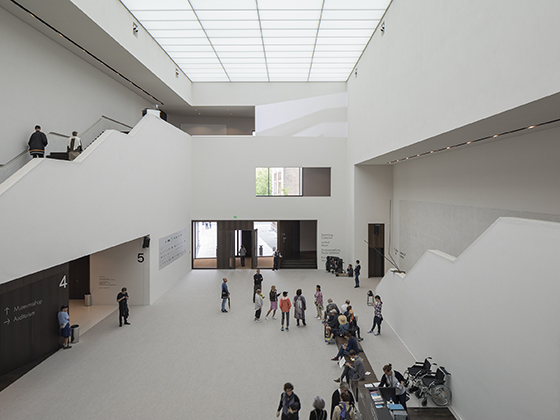 © Henning Rogge / Skulptur Projekte 2017 Nora Schulz. Pointing them with fingers to incomprehensible events behind the scenes. 2017
For me personally, the LWL museum, located in the heart of Munster (although you can choose another starting point, as well as lay a variety of routes around the city - this is the charm of the “sculptural project”). The point is not that, perhaps, the largest concentration of work (five projects) here, but rather that the museum performs the function of an ideological center, the axis around which the entire exhibition rotates - for the radial structure of the city dating back to the Middle Ages, this is a suitable metaphor. In addition, the modern architecture of the bulky building of LWL contrasts with the city reconstructed under the old days. Munster, like Kassel, was almost completely destroyed during the Second World War, but in Munster, when recovering, they decided to reproduce as much as possible, its former appearance.
Inside the museum itself, Nora Schulz changed the view of the foyer: put a sound -absorbing carpet on the floor, covered the light hatch on the ceiling with plastic. Two videos are projected onto the walls of the hall, shot here using GoPro and drones. The recorded noise from unmanned flying devices sounds.
One of the most ironic projects this year is the work of Kozim von Bonin and Tom Burra “Benz Bonin Burr” . It is a truck parked at LWL , on which there is a huge black container with the Fragile icon - “Caution: fragile!”. However, the box is empty. The artists suggested packing the sculpture of Henry Moore, who stands on the pedestal right there, a couple of meters from the car. Of course, they were refused, since “sacrilege”, “Henry Moore Foundation will never agree to this”, etc. The desire to pin the pompous modernist art is always worth welcoming.
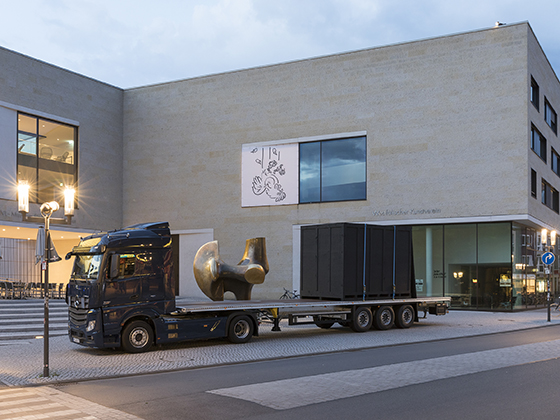 © Henning Rogge / Skulptur Projekte 2017 Kozima von Bonin + Tom Burr. Benz Bonin Burr. 2017
Opposite the museum, on the building where shops and offices are located, the word angt (“fear” or “anxiety”) is fixed, to the left of which a wave of a golfist is a symbol of an ever -worn middle class, and the church is a church. This is the work of 1989, Ludger Gerdes from the collection of the Ruri Art Museum in Marle. The current edition of the “Sculptural Project” also takes place in this small village half an hour from Munster. And, in particular, both cities decided to exchange works.
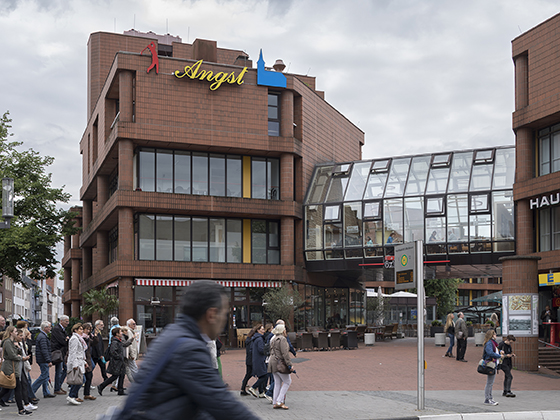 © Henning Rogge / Skulptur Projekte 2017 Lyudger Gerdes. Angst. 1989
A few minutes walk from previous locations is the Elephant Lounge bar, where Benjamin de Burka and Barbara Wagner demonstrates the musical film “Farewell, Germany! The melody of life. " According to the catalog, the authors turned to the “Felar, a separate genre of German pop music” and explore its historical and structural characteristics, shooting immediately, in Münster, several videos, which later united in a common work. In the twilight of the bar, this work looks fascinating.
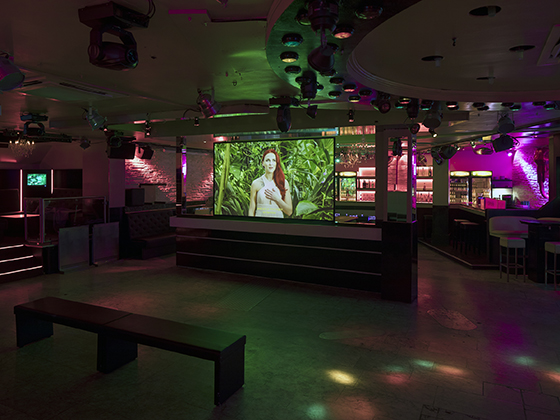 © Henning Rogge / Skulptur Projekte 2017 Benjamin de Burka, Barbara Wagner. Goodbye, goodbye, Germany! The melody of love. 2017
Another film, this time in the spirit of magical realism, is demonstrated in a product store from Asia. In the trading space on the shelves are Hello Kitty cats, inflatable circles in the form of pineapple, ceramic elephants, all sorts of exotic sauces and tinsel. And in the depths (apparently, in the back room) the video of Mika Rottenberg is shown - a story about how people fall into other worlds through a street trading pan.
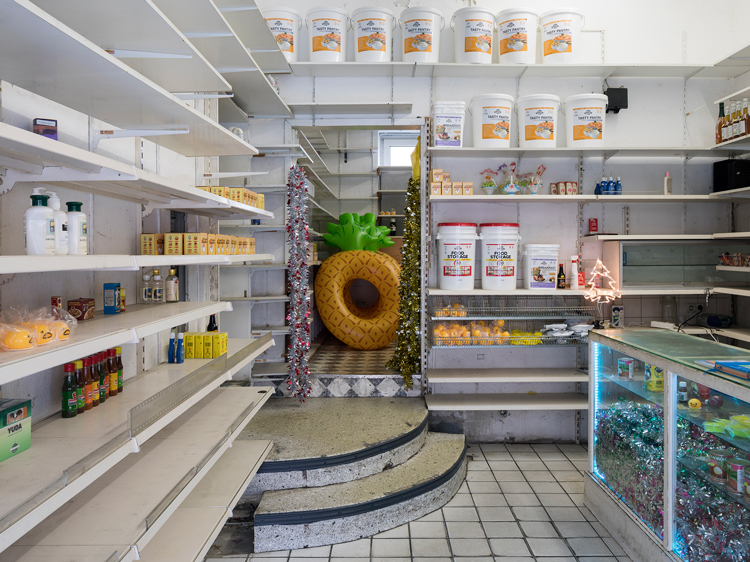 © Henning Rogge / Skulptur Projekte 2017 Mika Rottenberg. Space generator. 2017
Hito Steierl took the five most popular words in the English -language musical industry, according to Billboard ( Hell , Yeah , We , Fuck , Die ), and collected a funny video installation from them. And Michael Smith opened a real tattoo salon , the drawings for which were invented by participants in the current and past publications of the “sculptural project”, as well as friends of the artist (visitors over 65-discounts).
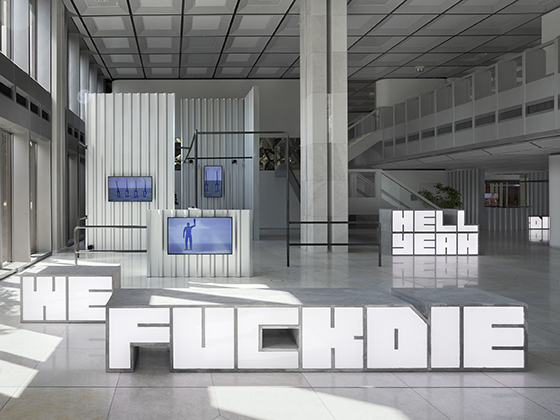 © Henning Rogge / Skulptur Projekte 2017 Hito Steierl. Hellyeahwefuckdie. 2017
In general, playful work here is enough, but there are quite serious ones, addressing the same problems that are affected by the superpolitized “document-14”. And, it is worth adding, doing it much more eagerly in relation to people than this happens in Kassel. For example, Koki Tanaka gathered the residents of Münster of completely different origin and background and invited them to talk about how to live together. The ten -day discussion process, as well as the rest, was recorded on the camera. Participants were invited to spend the night on mats in the gym, prepare food according to wartime recipes, chat with the Syrian globalization expert and work out physical exercises in the old bunker created in case of nuclear war ”( records are available online ). In fact, everyone could feel like a migrant or refugee.
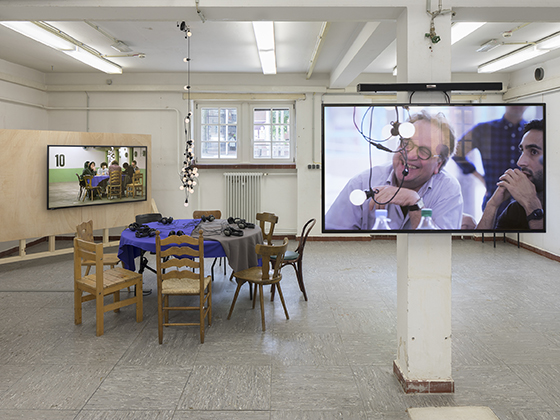 © Henning Rogge / Skulptur Projekte 2017 Tanaka COKI. Preliminary research. Vorkshop #7. How to live together and share the unknown. 2017
Lara Favaretto installed on one of the Luja “momentary monument” . This is a granite thunder with a small hole, where, according to the artist, you can put the money that will go to the fund supporting those who are threatened with deportation. The monument itself will be destroyed. But this is not the whole story. Through the road from the work of Favaretto there is an old stele dedicated to the military who distinguished themselves in the colonial wars in Africa and when suppressing the boxing uprising (and this was a cruel, but still logical reaction to many years of China’s plunder). Later this monument arose another function - a mention of the First World War appeared. There are many such monuments in Germany, they are trying to simply not notice them (especially those that are dedicated to the shameful pages of colonialism), but they do not demolish, although they are not very far from the monuments of the Third Reich. And the main message of Coarto is just this: for some reason, and now still positive initiatives are temporary, but all obscurantism as stood and is worth it.
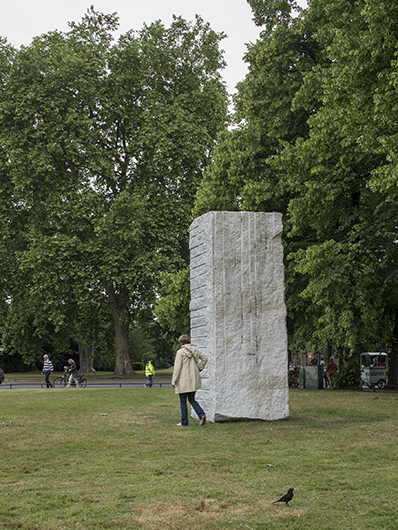 © Henning Rogge / Skulptur Projekte 2017 Lara Favaretto. The momentary monument is a stone. 2017
But there are other stories with monuments. Justin Maszli built - also on the lawn - “Nietzsche Rock” . This monument, reminiscent of a climbing climber for children, should remind you of a well -known episode of the biography of the German philosopher, when the thought of eternal return dawned on it.
There is more “landscape” work, however, hidden indoors on the outskirts of Munster, the authorship of Pierre Yuiga . Descriptions here are useless, look yourself .
Finally, the two most popular work. The project of the Emeki OGBO was addressed, rather, to the unsuspecting public. He created a musical accompaniment for an underground transition with large cross -country ability (located at the station). But this work is not so simple, behind it is an interesting story .
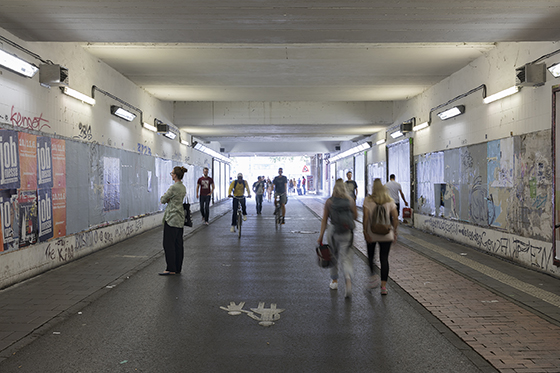 © Henning Rogge / Skulptur Projekte 2017 Emek OGBO. Mundog's transition. Quiet storm. 2017
And Aisha Erkmen built a bridge over the backbone separating the industrial zone from the bars and cafes area. The bridge itself is almost invisible and also passes at a small depth under the surface of the water. I don’t know how much the Turkish artist managed to break the urban structure of Münster (and she hoped for it), but this bridge looks funny .
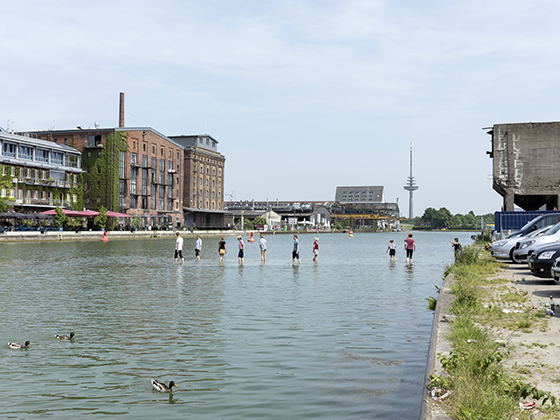 © Henning Rogge / Skulptur Projekte 2017 Aisha Erkman. On the water. 2017
These are far from all projects that before October 1 can be seen in Munster. The most important thing is to evaluate the lightness with which the exhibition is made.