
Translated material
Corruption - 17. With hope ...
In society
 Corruption - 17. With hope ...
May 4, 2009 George Satarov
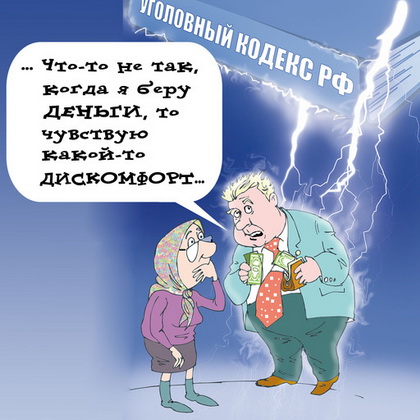
In 2005, the Indem conducted a second large diagnostic study of corruption. This made it possible to evaluate the explosive dynamics of its growth in our country. I talked about the main results in the first articles of this cycle. Then we formulated the diagnosis: what causes us the stunning growth of bureaucratic theft and arbitrariness recorded by us. Since then, I repeat this diagnosis whenever the opportunity is given. It seems not in vain. Now, after five years of my constant courageous, I began to hear a kind of echo: the same automatically pronounced words, but from other lips. Even from experts "close to the emperor". This is good: ideas penetrate the masses. Not afraid of repetition (what is now afraid) even within this cycle of articles, I will again reproduce my “aria”.
So, the main reason for the frantic growth of corruption over the past eight years is that over this period, Russia has become sovereign and uncontrollably controlled by bureaucracy. But when the bureaucracy is provided to itself and is not controlled from the outside by anyone, it works for itself, and not for society (or the state, if someone else wants it). And work on itself is expressed in corruption, in its unlimited and unlimited growth .
I remind readers: this diagnosis directly follows from the principal-agent model (see articles under numbers 3 and 4). If we are ready to consider ourselves as a principal in accordance with the Constitution, and the bureaucracy as our agent, then we must control this agent. Our allies in this are any legal opposition, if it is not controlled, as ours, bureaucracy and if she intends to come to power and control this bureaucracy. (True, this requires real competitive elections, which has long been gone.) Such an opposition is also a participant in external control.
Another ally - strong independent media; They help reduce the influence of asymmetry of information. Their motives are not important to us, it is important that they - independent media - exist and do their work: they follow the bureaucracy and honestly talked about how it works. Finally, our ally is freely working public organizations. Many of them are engaged in control over various authorities.
Our partner may be parliament. True, for this he must be independent of the executive branch and depend on us, voters. (“Not in this life! Not here!” The reader exclaim.) An independent court may be our partner. One study of the Indem fund enriched us with a pearl of oral folk art. A certain entrepreneur whom we interviewed said: “Give us an independent court, we will solve all other problems ourselves.” Imagine that we, citizens, loners and organized, have the opportunity to make claims to officials for their corruption decisions that cause us the damage - to present and win. Then we ourselves could influence corrupt officials, without waiting for the police, the FSB or the prosecutor's office. By the way, the last two conditions regarding the independent branches of the legislative and judiciary are simply called the separation of powers. It is spelled out in our Constitution and destroyed during the Putin presidency.
And another important condition - the power should be as open as possible. But she herself will never become like that. It becomes transparent only in conditions of political competition and with the constant pressure of the participants in external control.
Is it all possible for us? I affirm that yes, perhaps. Moreover, this originated with us - swiftly and effective. We just easily forget about it, encouragingly succumbing to constant propaganda. Let's shake our memory. In the fall of 1997, several high -ranking officials, among whom were close employees of B. Yeltsin, resigned as a result of the campaign in the media. They were charged with the receipt of unreasonably large fees for joint work on the history of privatization in Russia. I do not go into discussion of the issues whether there were fair attacks, whether the punishment, etc. I just remind you that the media scandal was enough for serious personnel changes. Ask yourself a simple question: is this possible now?
Another example: the Federation Council has repeatedly rejected the candidates of the judges of senior courts represented by President Yeltsin, because he did not want his former employees or obvious like -minded people. This allowed the judiciary to maintain independence. Hence the third example: in the 90s, the president repeatedly issued decrees of normative action, replacing the absent laws. Some of these decrees were disputed by the Duma, and the requests were sent to the Constitutional Court, which recognized some decrees by unconstitutional.
Whatever the obedient media are injected, no matter what you think angrily about the “dashing 90s”, but it was a time when real democracy was formed in Russia. It was she who created the conditions for external control over the bureaucracy and the authorities as a whole. That is why the growth of corruption was quite moderate and was determined mainly by the general influence of the transition period, anomia (I wrote about this above when we discussed the causes of corruption).
Of all this, an important conclusion is follows regarding the necessary (but not sufficient) conditions so that anti -corruption could become effective. For the role of such conditions to become clear, I will use the following metaphor. Imagine that you come to a doctor with all your troubles. You take the tests, the doctor makes a diagnosis, and then prescribes treatment. As always, something inarticulate writes on a small piece of paper and says: “Here, the medicine is written here. Three times a day before meals. But this treatment will give a result only if you quit smoking, you will walk more often and stop working at night, exhausting yourself. ” Do you already understand where I am getting? Of course, we must distinguish between treatment and conditions of its success, counteraction to corruption and the conditions of its effectiveness.
Well, so, our reasoning, together with historical experience, is pushed to the following conclusion: in Russia, to success corruption, it is necessary to restore external control over the bureaucracy, which is tantamount to the restoration of democratic institutions.
I have already said that I expressed these straightforward ideas repeatedly, including publicly. In the latter case, of course, they asked me various questions. Now I can use this and ask them to myself on behalf of the readers in order to answer right there. So.
Question : Georgy Alexandrovich, this is all beautiful, but too similar to some abstract theory. Can you get something specific?
Answer : Please. Many of you have probably heard the sounds of fanfar and the calling of the Litaurs regarding the President’s efforts to oblige officials to submit declarations about your income. The chatter in the media is about everything: who has the richest wives, who has the smallest apartment, and whether the mother -in -law still needs to put it on display and so on. Only one question is not discussed: what's next? Well, they told us about their income, so what? There is an answer and it is simple: all these games in the declaration make sense only when external control exists. Only with him is it possible to expose lies and the adoption of sanctions. Imagine an alternative: the Russian President creates a new control body intended to verify bureaucratic declarations, collecting corrupt officials from different other control departments. Just do not ask who will check their declarations.
Question : Mr. Satarov, but what about Singapore, about which you yourself like to tell? After all, there was opposition to corruption under the conditions of an authoritarian regime. And they achieved more than impressive success. Can't Hong Kong serve us as an example?
Answer : A good question. Good because useful. Alas, no. We can borrow a lot from the experience of Singapore. From technological experience. But there were their necessary conditions. This is the British administration. The type of external control, after all, it performed the function of external control. In addition, this is a monocultural country. Finally, this is very important: Singapore is very small, which means that centralized control schemes can work on such a scale.
And now about us. We cannot count on external control. Unless we will declare the war on Finland and immediately surrender in the calculation of the immediate entry of the Finnish occupation forces and to the establishment of the Finnish colonial administration. No, we can only rely on ourselves. In addition, we are a polycultural country, with a tremendous regional diversity. We are a huge country. In such a country, the mechanisms of bureaucratic control do not work, collapse. Therefore, for us, alas, we use only our own control. And this is possible only in conditions of democracy. Hopes on the dictatorship, on a strong hand is just one of the varieties of slave psychology, the essence of which is the calculation for uncle and unremarking to take responsibility. And all.
Question : Georgy Alexandrovich, you said that external control is a necessary but not sufficient condition. I am a mathematician by education and understand what you mean. That without external control it is impossible to limit corruption. But if there is external control, then only a chance appears, it is not enough. What else is needed? What other conditions? I clearly asked?
Answer : I see, I'm also a mathematician. Thanks for the question. I actually just said about one condition. We ourselves need to get rid of slave psychology. This means that without the efforts of society no power, even amicably aimed at combating corruption, is able to defeat it. Consolidated power is able to intimidate people with total terror. But she is not able to ennoble society if it is not ready for this, if it does not want it passively.
And the third condition is the power itself. Imagine such a speculative experiment. Power disappears somewhere. I don’t know where, it doesn’t matter, it just disappears. And society is left alone with itself. And it wants to be no longer corruption. For this, it establishes special institutions and delegates its representatives there. How to call these institutions in one word with these representatives? Yes, very simple - the word "power". It can be called the word "state" in one of the possible interpretations of this concept. But I prefer the word "power." In short, without power, without its constant meaningful efforts, counteracting corruption is impossible.
Here is the formula: there are always enough resources in power to become an obstacle to limiting corruption, its own efforts are not enough if they are not supported by society, but without its efforts it is impossible to limit corruption .
If now try to summarize everything, then it will turn out about the following. To limit corruption, an active society and purposeful power are needed. But in Russia, they should be united by a democratic political system. Only within its framework is the effective activity of society is possible and the constant determination of power is ensured.
Question : Georgy Aleksandrovich, but what if corruption has already become more than threatening, but the authorities do not itch? What to do then?
Answer : A dangerous question. On the verge of calling for the overthrow of the constitutional ... etc. Therefore, I will not answer the question “what to do”, but I will answer the question “what happens”. Actually, there are only two possibilities in power: either she changes herself, or others change her. When I am talking about changes in the authorities of myself, I mean different possibilities: the change in the power of my policy, a change in the staff, a combination of both. If we talk about the second option, then there is a wide range - from a peaceful change in power as a result of legitimate elections to bloody coups.
Question : Does all this mean that any attempts to limit corruption in modern Russia are completely useless?
The question is very important. But there will be no answer here. We will continue in the next article.
To be continued
Author - President of the Indem Foundation
RIA Novosti drawing