
Translated material
About mice and people
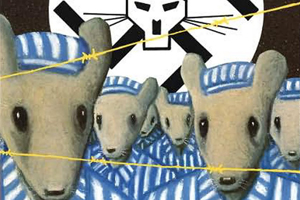
“Mouse: the story of the surviving” Art Polimelman finally translated into Russian: this is the only one of its kind a work is a graphic novel-in other words, a comic book about the Holocaust. The first part of it was released in 1986, the second in 1991, a year later, Mouse became the only example of this genre, awarded the Pulitzer Prize. In America and Europe, where the theme of the Holocaust is covered by many ways and with all possible detail (what to say about Russia), “Mouse” occupies an extremely important place in the historical and literary canon, and not in vain.
First of all, the point is an extremely accurate, witty and therapeutic combination of shape and content. “Mouse” is an autobiographical book about how the author’s father, Vladek Spiegelman, a Polish Jew who survived Auschwitz tells his son, born after the war, the story of his survival in the ghetto and in the destruction camps. At the same time, all participants in the events described in the comic are portrayed in the form of animals. The Germans are cats, Jews - mice, Poles - pigs, Americans - dogs and so on. With such an artistic technique, Spiegelman creates the necessary distance that allows the reader to digest this - indeed inhuman - plot.
It is difficult to talk about the Holocaust with children, because it is too scary. It is difficult to talk about disaster and with adults, because there is no place for a funny place here, and on any kind of pathos the skeptical mind reacts with boredom and instinctive detachment. Spiegelman chose almost the only intelligible optics: he tells a private story - and in the first person. The history of the disaster is too traumatic for the human mind to can summarize it and derive morality - it is also a catastrophe that it is impossible to realize it from within a normal life. But as soon as she acquires a specific human (or mouse) face, she has to be correlated with her own experience.
Vladek Spiegelman, who describes the story of his survival as a game of cat mouse, turns the Holocaust into an adventure novel-as befits a comic book. According to the laws of the genre, the hero of the novel is constantly in mortal danger, but always comes out of the water dry, letting the reader take a breath, digest read and rejoice at the hero’s resourcefulness and perseverance. In this sense, “Mouse” sometimes resembles “Robinson Crusoe” or - closer to our realities - the great novel by Alexander Chudakov “lies with a haze on the old steps”. Here is a shelter scheme that is disguised as a coal basement, where the heroes are saved from the raids in the ghetto (look, son, you can come in handy); Here is the illustrated alphabet of shoes (this craft saved the hero in Aushwitz). Here is the moment of the incredible Sassens and the incredible emotional impact: Having happily escaped from the ghetto, Vladek is hiding in the barn - and it goes out at night to get food, hoping that he will not be noticed or take up the Pole. “And I heard soon: someone is coming behind me. I walked slowly. He also walked from the back slowly. I walked quickly ... He walked back in the back quickly. We were alone ... He spoke: "Amcha?" In Hebrew, he told me: “Our people?”
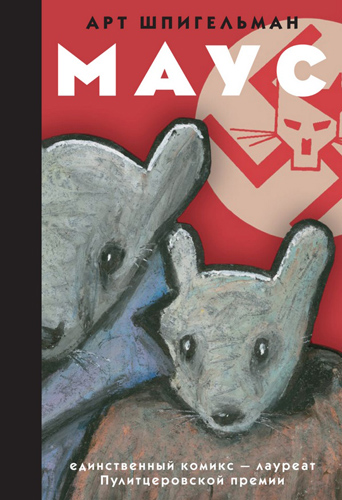 © AST Publishing House
And, of course, the adventure genre assumes that everything will be fine at the end, and this is a very important condition for maintaining reader interest. We are talking about the Holocaust, the happy ending is impossible-but the story of a single Vladek will end happily. He will not only survive, but will also reunite at the end of the book with his wife - and over time, art, the author of the novel, will be born.
However, Vladek is not the only hero of Mouse, and his adventure is not the only topic: almost more important is the figure of the author there and his reflection as the book creates. As the mouse art says: "Yes, I can’t even figure out my father - where is it in the Holocaust." And this is the second reason why Mouse is extremely important - both in general, and for us today in particular.
In psychoanalysis, there is such a thing - intercoral trauma. It appeared as a result of one observation made after the Second World War. The surviving prisoners of the camps often successfully returned to normal life, worked fruitfully, created families - but their children born after the disaster grew up poorly socially adapted and depressive. This is due to the fact that the people who met the disaster have already formed, carried out the margin of safety from their peaceful childhood, allowing them to recover. But their children were brought up by parents who recently survived a huge injury - and could not convey to the children the feeling of the happy strength of the world in which they grew themselves. This most destructively affects society in the next generation after the disaster - and in some cases, as in ours, and in the next few generations.
In the second volume of Maus, Art Spielman describes how, after his father’s death, he goes to a psychotherapist - a Czech Jew, who survived Terezin and Aushwitz: he talks about his guilt - for never he was there, and about the feeling of guilt of his father - who was there and survived, unlike many others. And the therapist answers him: “Ultimately, life is always on the side of life, and one way or another, but the victims are to blame. Although not the best people survived the camps, and not the best died there. This is all a case. So is it worth it to toss history? After all, people do not change. "
When Spiegelman says that in his youth he sometimes “imagined that“ cyclone b ”and“ wanted to be in Auschwitz with his parents, to be able to understand what they experienced ”, he recreates the experiences of a European, informed and educated in respect for historical memory. In Russia, where at an individual level the historical memory is almost erased (and on the state is used in order to build a new ideology, and in the most bizarre way), a different approach reflected in an old joke is common: “Your name is immortal, your feat is unknown” - those who survived and won, you can only be proud. It is known between the fact that war veterans, like people who have passed Soviet camps, do not like to go into details - because survival often suggests the ability to adapt to cruelty and play according to the rules of the disaster: say, kill yourself or refuse another help.
These psychological changes that are inevitably waiting for a person at the time of the collapse of everything that he considered normal, and which he later does not want to “collapse”, with Spiegelman are shown with medical clarity. Here is a prisoner of war camp at the beginning of the war. A starving Jew receives a parcel: “Chocolate! Cigarettes! Jam! She was priceless for me, this package ” - why did you think? Because she meant that his family is safe. Well, then, of course, cigarettes could be changed for food. This is a reaction of a peacetime man, for whom hunger is still a secondary misfortune compared to anxiety for a family who only recently shot the first German in battle and was glad when he, the prisoner, was forced to bury the dead: so he felt that he had done at least something for him. Now many are surprised why the Jews during the Holocaust went to death so dutifully and disciplined, why they did not throw everything and did not run, and later they did not try to resist, because there was nothing to lose. However, a catastrophe is a situation for which there are no rules that cannot be foreseen and which cannot be prepared for, you can only adapt.
Now, having already freed himself from the captivity, Vladeke is reunited with his family and finds himself in the ghetto, from where the old people begin to take away: at first the family hides them, but in the end gives them to death - on this subject, according to the story of Vladech, by this moment no one had no illusions, however: “Some Jews thought like this: if they give the Germans a few Jews - they will save the rest or at least save themselves. And they gave their grandparents. ” As Vladek soon recognized, this did not help, but as we know now, this is the general rule: developing the image of Art Polman, following my grandparents, everyone else is taken - a mouse after a cat, a cat after a bug, a bug for a granddaughter. But this episode shows how the human mind is looking for a new algorithm for survival at the Apocalypse - and is ready to pay for this price, in a peaceful life is unprincipled. Later, a relative comes from another ghetto who offers to give him children, he will be able to save them, he has ties-and here is the proof: “My 90-year-old father lives with me-90! There was a 43rd year, there were no Jews of this age. ” This circumstance is already everyday: they have not seen white bread for a long time, the oil is over, the old people all came out.
So it turns out that guilt is an expensive, but the necessary price of recovery. Where people carry out painful lustration and try to imagine a “cyclone b”, currently from the shower, the injury over time is overcome at the level of society. If the catastrophe fits into the life of one generation, the memory of a peaceful life helps to return to it. In Russia, where the war, terror and other misfortunes (from the revolution to recent years) were partially heroized, and partly silent, we ourselves do not know where it is, the norm, and what it is - a peaceful life. But it is better to start dealing with this late than ever. For example, reading aloud on Lubyanskaya Square the names of people executed during the years of terror, as the Memorial society has been doing the seventh year. Or here - showing the children comics.