
Translated material
Air image
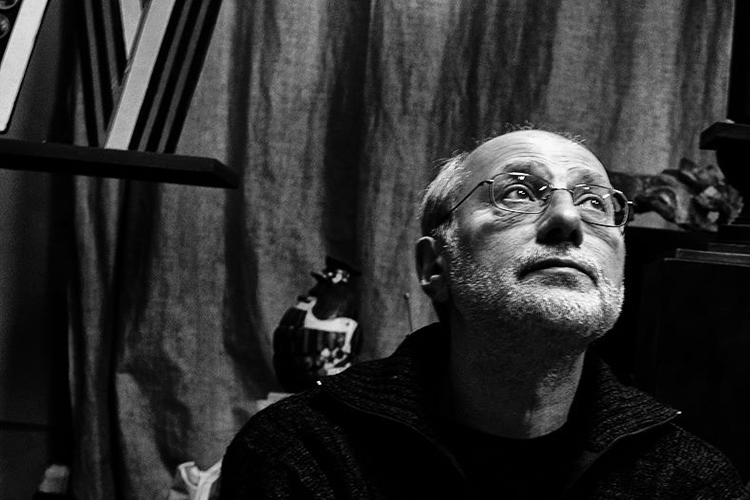
These verses first appeared in the "air", in the fourth issue for 2011 . Each number of “air” opens with a large selection of the poems of the “author of the number”, a large figure on the poetic map, and when the “Aizenberg number” finally came out, it seemed strange that this did not happen before. The point, perhaps, is that the poems of Aizenberg usually appear in large arrays - the captured stages of a poetic biography, which is probably not easy to part with the poet. At the presentation of “Air”, he read these new verses, as usual, quietly and persistently, abandoning everything that was happening around. It was evident how one at that moment he was - which is quite consistent with his position in Russian poetry: unconditionally respected, it seems, is sensitive to what is happening, attentive and friendly to new names, which is in his essay to the most precise words for describing both time and poetics - and at the same time completely isolated. An ideal observer, a sensor-for-set, opening a veil for us over a complex process of his thinking, over his sensations.
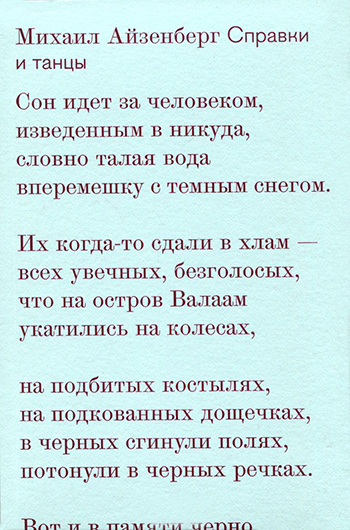
The Air magazine for Aizenberg’s poems was a suitable place also because the air itself is a key image of his poetry. In the review on the cover of the collection “Help and Dancing”, Maria Stepanova calls Eisenberg’s books “something like a sample of air that is taken from the time that is still going to occur.” I’m not sure how exactly this is for the early books of Aisenberg, written inside the frozen time of the 1970-1980s-an era, which was best expressed in his essay. But the truth is that the level of complexity and tightness of Aizenberg’s poetry serves as an indicator of air pollution - despite the fact that the verses of the social and political areas rarely concern and, as a rule, casually. The poems of Aisenberg of the late Soviet period are one of the darkest in all of the then poetry. These are the verses of a person who fenced his world from a shameful outside world with an impenetrable cocoon. The hints sounding here are not always clear - from inaccessible cultural references to a specific geography of the area in which the poet exists. The output is fraught with poisoning: “Back. And so the breast is straightened, / as if a burial urn is growing ... ”Poems of the 1990-2000s (the books“ Behind the Red Gate ”,“ A meter from us ”,“ Scattered mass ”)-on the contrary, all closer to the pole of clarity:“ Having passed the non-residential array, / notes that the forest is beautiful, / in the whole, / in the new one ”... in the new one in the new one The book, “Inquiries and dances”, the darkness is thickening again.
 © New Publishing House
The connection of poetic tightness with the fullness or durability (purity or gasket) of the social atmosphere seems vulgar only if you forget that the poet walks through the same streets and breathes the same air as everyone else. And if you do not forget about it, then such a connection will seem both forced, both noble and tragic. It testifies to daily work with momentary and long -term - the poet does not have (fortunately) tools of political analyst, much more often unreliable than accurate, but has an internal instinct, so this work can be compared with a blindfold sorting. Aizenberg’s “possibility of saying” is built on an unreliable, impossible support, which, however, becomes the only reliable and possible: “not an accident, but an opportunity / between signs of borely, / which loses caution / and clings to the air.” Breathing, so simple and inconspicuous, materializes in critical situations, and it can be likened to the steps by which life rises (and in one good science fiction novel, the breath is called "a series of continuous explosions").
Let's see for a start what is happening with the image of the air in “Help and Dances”. The air appears in the first poem, but is not yet in the center of the figurative row: “Birch takes the air back” - with the help of a triple paronymical attraction that conducts the association between “birch”, “take” and “back”, Aizenberg makes the tree absorb air; Birch is really one of the most “airy”, lungs in the appearance of the trees, but, in addition, this one detail is already introducing an alarming the theme of painting: taking air back means to perform some reverse photosynthesis, replacing oxygen with carbon dioxide. In subsequent poems, the alarm will be called directly: “Ozone interferes with anxiety ...” - and the topic of departure, drawing in air will develop:
How, overcoming the void,
to an underground city without lights
The elevator shaft leaves;
How the air reaches for her.
The air associated with the elevator shaft becomes part of the man -made mechanism, a complex system, moreover, clearly unkind to a person. This motive also develops in the “summer” cycle “June-July”, which begins almost pastorally (“Well, you, so round, / in the gray-beige cloak / over the karmin bastard- / are you raspberry?”). Summer stuffiness, however, is served here through the images of the mechanics: “So wait, when the air vice is bloomed ...”, “On the air drawing”, “The creak of the gates of the air”. The same technicalism is in the July -August cycle: “Air Loop will be blossomed”, “Air in heaps of piles”. Poems, apparently, dates back to the summer of 2010, when the famous forest fires raged in Russia and Moscow was indeed littered with “poisonous smoke”. There was a terrible heat, and people were not to blame in all fires, but the very disaster became, like many natural disasters, a social indicator: the thesis about suffocation (“new suffocation”) was literally confirmed. The conceptualist would call this a metaphor implementation, but Aizenberg works thinner. His poems are not poster, they cannot be thought as objects within the framework of an exhibition, mating a natural phenomenon with a social context. Instead, he creates a lyrical diary in which a condensing atmosphere speaks for himself.
Captive and life -giving air is opposed to this unkind air:
Life -giving air layers,
Dressed fabrics with dragonflies;
Green sheets diverge
And they drink air with the smallest sips.
One could say that in the verses of Aizenberg there are two air: one kind, the other evil, one alarming, the other serene, and both active (“and the air in the dark relieves the measurement”). But air is a universal environment, and you can talk more about its different states. Now it is often said - and I love these conversations - about poetry as a kind of research, that the poet is becoming optics. Aizenberg has a set of magnifying lenses for measuring the density and gas content of the air, and also the emotional background that he creates. The first two devices, in my opinion, have names (and, it seems, rather ugly), the third has no. You can name him in honor of the Creator, about whose verses we are talking about.
The connection of unity and duality can lead to the word “dialectics”, which the generation of Aisenberg was filled with a point. However, we can try to revive this concept, applying it not to Hegel and Marx, but to something to mythological: so day and night, solar and lunar in the myth are two halves of the circle. It is in this context that the name “Help and Dancing” can be considered: state and strict against the spontaneous, sincere, wacched. This is one of the important conflicts in Aizenberg’s poetry, and each time in it the side of the “official” is occupied by a person, and the side of the spontaneous - of course, the forces of nature. In such early verses as “I saw the light and abandoned the roaming ...”, “The whole earth is already with stickers ...”, “Here is a city painted in a saber ...”, “That except for the hydraulic line of the water supply ...”, human deeds, it seems to be good and correct (guard, honest craft, urban movement of life), the harmony that is ready to sink over the stage. This harmony can even be “boring rug”, but thin processes occur inside it (water stretches to water collection, birch takes the air back), which is easy to break. A variant of escapism (and escapism is an important thing for a big poet) is shown in verses such as the famous “Man by gone through the non -residential array ...”: you can become part of the ecosystem - let it be more merciful: it will be more merciful:
And what is the earth like a ajar box
Will it release on us to another summer?
Oh, if only the monsters of the real
She coast, leaving in reserve.
The first clash of ugly-articular with the natural in the “Help and Dances” is performed in the second poem of the collection “Sleep follow a person ...”, taken out onto the cover. It is paradoxical that the ugliness here manifests itself in deliverance from ugliness, a shameful historical fact: the war disabled people were sent to the island of Valaam, where they survived the rest of days in terrible conditions (there, artist Gennady Dobrov captured them there). At the same time, the Valaam plot in Aizenberg’s poem is only a comparison illustrating the spiritual state, likened, in turn, to bad sleep (current reality), where the speaker is forced to drink “bread wine” “at the Feature of the cannibals”. The onyir motif in Aizenberg’s poetry is almost as important as the air motive, and as ambivalent. A dream can be a form of blissful escapic care (which, in fact, is biologically: a means of transition to a new cycle of activity): “And again a dream begins, / calling the elders” - or, from a neighboring poem about the earth: “And now from the grass of oblivion / stands up, sounds, / says that you are not a judge, / and it is not convicted”. But he can be, as in the poem “Dream goes after a person ...”, and dark trouble, from which it is impossible to wake up.
It seems to me that the conversation about the new Stoicism in Russian poetry has long been stirred: there are enough poets who can be called the Stoics.
Release is characterized by implicit plot, similar to the one that we meet in the verses of this book. The poem “The Glass of the New Patrolum ...”, ending unusual for Aizenberg by the straightforward maxim “This is I am poems about the Motherland. / This is if you do not understand ”, it looks precisely like a dream and his interpretation: the image of a half -hearted woman engaged in a humiliating work in Moscow becomes the image of the homeland. This poem clearly echoes one of Sergei Gandlevsky’s most famous poems - “Can't you change the plate? But the homeland dreams again ... ” , built as a description of“ Prospects from dreams: sleep in a dream, sleep in a dream, sleep in a dream. ” Gandlevsky has a motive for guilt “in the misfortunes of the homeland of this”, which the old woman seemed to take upon himself. Eisenberg wine is not directly named, but there is an accusation: "At the next bend you / eyes did not look for her." Invective addressed to the reader is a sharp, almost painful technique that instantly pulls out of a state of sleep. Sudden awakening or sudden irritation of the poet? This poem, in my opinion, does not belong to the best in the book, but, despite everything said earlier, significantly corrects the established idea of Aizenberg as a “quiet” poet.
In the verses of the first part of the book there is also didactics, a conversation at the level of generalizations characteristic of, for example, Pasternak: "The backwards and the case is saving, / and the time is added for the laggers." Aisenberg’s connection with Pasternak is generally a very interesting topic that requires study. It is not possible to go into it in detail here, but it should be noted (forcedly coarsening) that both poets went the path "from complicated to simple." The opacity of Aizenberg’s early poems in this scheme corresponds to the Pasternak darkness of the 1910s, while the crystal clarity of the Aisenberg poems of the 2000s is “unheard of simplicity” of the late Pasternak. But here the vulgar sociologism will intervene in our comparison again: the most complicated poems of Pasternak were written in free, by the standards of further events, the 1910s, its simplicity became his credo in the fierce period of Russian history. This is perhaps a paradox. The sealant of the early Aizenberg serves as a kind of spiritual armor in the suffocating 1970s, starting in the 1990s, it has no need for it. This is a more harmonious model, reminiscent more likely (only, fortunately, in the reverse order) the evolution of the poetics of Mandelstam. We have already noted above that “Inquiries and dances” indicate a new turn to a darker style, to an object that eludes decryption:
In the dark you will not recognize her, in the bright
It is dark, then bright
Melting in the face of the poorest
Tears and Kruchin
A life that was not
It is really incurable
I would share it, but with no one,
And I can’t forget her -
Sading a soft gloss,
Like wrapped in foil.
In the light of all this, poems such as “The glass of the new patrol ...” should be understood as the latter in the current historical situation of Aizenberg’s attempt to feel the previously not used modus of speaking: loud, lobe, fraught with a breakdown. This poem is an important evidence. It is characteristic that the Moroks of the previous years are now perceived as something long for, in the memories of him, you can now find lightness and even happiness (which, of course, did not think about then):
How notes fell to the head
These years. Still write down
What then made love
We are almost on the fly, like cutting.
These years, no one taught them
Flaw on the fly, on the run.
And leaflets in colorless ink
I can still share -
How to go empty -handed
call the glass for the battle,
only would squeeze a stone from the air
And on it to establish a foot.
The future, on the contrary, seems rather gloomy; The rethought children's counters "came out of the fog" came out as a prediction:
The knife throw is careless,
Thread is thin saliva
not so funny
Wait for war.
A warfare lurks in the dark,
It is incomprehensible and cruel,
He stands in the bowels
and horns east.
“Inquiries and dancing” generally a transition book: the poet goes through the stylistic registers in it, then returning to the unknown clarity (“On the wall goes on the wall, / We, passers -by, are incomprehensible, / Toy of toy, emerging like stains”), then, as before, pushing away from a simple image for creating a metaphysical picture (“in the sky, a cloudy staircase ...”. “The day comes in like a correspondence ...”), then shaking the sonnet (in the poem “What is the new author? It seems that he is silent ...” 15 lines), then experimenting with graphics and “short breathing”:
After ten
On the night path
White white
Dark paths
The pebbles rustle
on their own
There are also many poetic sketches and sketches that make the emotional spectrum of the book more saturated: the eight -play “here is someone in training on a great ...”, a small cycle of poems about girls and women, the poem “In a dark vaulted chapel ...”, describing architectural decoration. Finally, there are the final “two voices” requiring attentive reading. Metrically, intonationally and compositionally, they are associated with the “dialogue” of Brodsky (and with its “hills”), but the title and the previously mentioned “social” context obliges us to recall the poem of the same name by Tyutchev .
Of course, Tyutchev’s two voices are two monologues, two variations with radically different meanings, written from the same paradoxical position as his “Silentium!” The author of which offers to be silent, but is not silent. Anyone who speaks in Tyutchev’s “voices” about the bliss or the envy of the Olympic gods, and he himself is over the fight, as if on Olympus: nothing gives his participation. Aizenberg’s poem is a completely different look (views) on the battlefield: observers speak - but also participants. They, just like that of Tyutchev, testify to the hopelessness of the struggle or generally existence in a given conditions: “there is not enough strength”, “all the cows have longed out. / The beast was handed over for weight ”,“ Time for wear. / Time is a cut. " The decision to give the word to ordinary participants who are not counted by the Olympians is a decision justified by all the historical time that has passed from Tyutchev to Aizenberg. But an authoritative imperative appears here. The dialogue breaks off (which is emphasized in the text graphically), after which its compiler addresses himself (thus, we understand that the dialogue was played inside one consciousness):
Choose a step hold
not to drive your head,
Do not complain.
Choose life, not death.
Life, and not all.
You can’t complain.
It seems to me that the conversation about the new Stoicism in Russian poetry has long been stirred: there are enough poets who can be called the Stoics. But in the final of the Two Voices, we hear stoicism classic. Its direct expression - it would seem - is not very characteristic of Aizenberg, but in this transition book it sounds so natural. It is a place here, and very important, because Aizenberg managed to create a book of diverse, but not eclectic, bringing many elements into balance.
So, by the way, and air: it seems that there is nothing easier and more natural in the world, but remember how much it is included in its composition.
Mikhail Aizenberg. Inquiries and dances. - M.: New Publishing House, 2015.