
Translated material
Hey, where is it all?
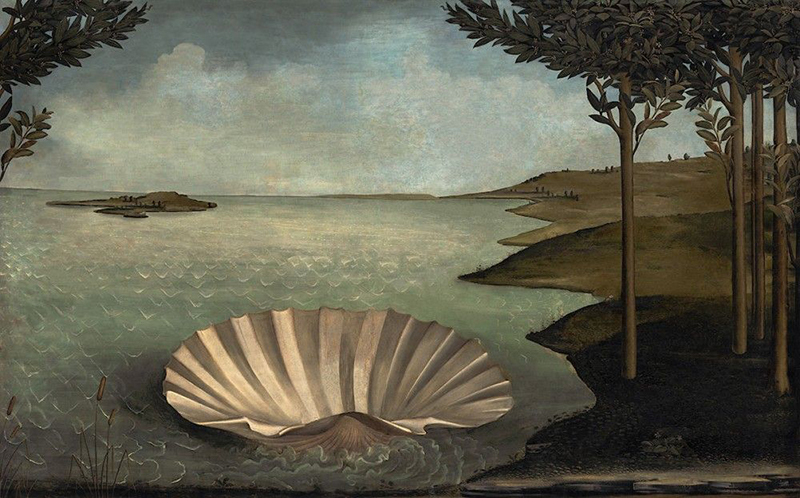
What did the coast of the kifer look after the solemn greeting of the sea Venus born of the foam? What were the rocks of the grotto after the saints Madonna and Anna left them with the babies? Asking these questions, the Spanish artist decides to conduct an experiment: not mental, but real.
In the Museum "New Jerusalem", the works of Jose Manuel Borleter are exhibited near Moscow. The exposition opened back in April, but you can visit it until October 29.
The artist was born in Madrid in 1960 and began to exhibit in the 1990s , engaged in sculpture, painting and architectural photography-digital and analog. He began working on a series of paintings with disappearance in 2006. It was this series “Hidden Spaces”, which was widely known on the Internet, and gave the name to the exhibition in the Museum “New Jerusalem”.
When looking at the paintings of Balleellter, I would like to say with annoyance: "Am I again late and everyone has already dispersed?" “Washing” from the masterpieces of the world painting of characters, it leaves only a space in which historical, mythological and religious events were accomplished. Among the objects of the study, there are even without human figures the canvas da Vinci, Diego Velazquez, Sandro Botticelli, Rafael Santi, Jerome Bosch, Yana Vermeur. You can even play guessing: try to recognize the masterpieces even before you approach the explanatory label with an image-winner.
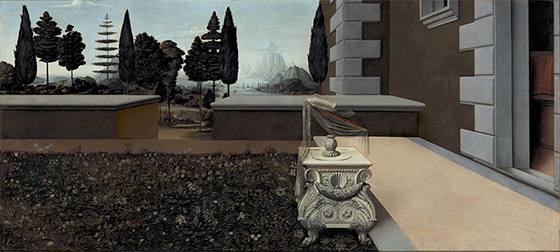 © granted by the press service of the New Jerusalem Museum Jose Manuel Balleser. The place for the Annunciation is 2. From the original Leonardo da Vinci "Annunciation." 2012
Many have seen the work of Balleser on the Internet. They became especially popular during the pandemic, when the nozzles and nights noisy day and night are unusually empty. All over the world, people preferred to stay at home (and sit on social networks). It’s not to joke here that the goddesses, nymphs and saints from the paintings, too, obviously went home.
And what remains when all the characters leave? The background remains: the bosom of nature, architectural details, rooms, furniture. And, of course, emptiness. Almost all works eventually look incomplete. This is natural: after all, with the departure of people from the paintings, the composition is violated, the dynamics is removed, cieses are formed. And most importantly, we have seen these paintings many times - and memory tells us that last time they were definitely more crowded.
In “menwalls”, an echo walks on the naked walls without men, and in the “garden of earthly pleasures” without righteous and sinners are too quiet: no one bathes, does not kiss, does not ride unicorns and cows, does not stick flowers into anyone, only broken things are scattered everywhere, as after a stormy party. Some paintings turned out to be unnaturally empty and surrealistic, which remind of de Kiriko’s painting: they have the same clearly bred direct prospect, fragments of architectural buildings and a feeling of no air, but a vacuum.
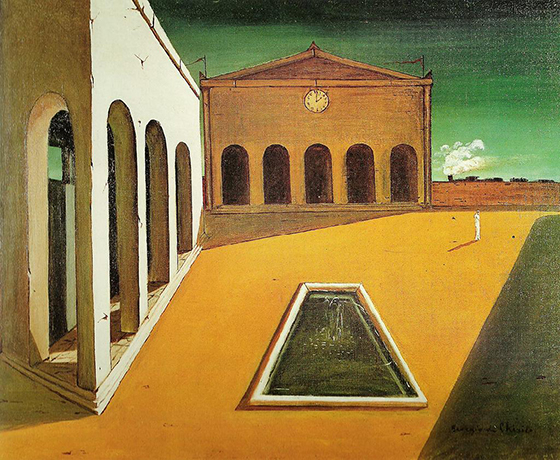 Georgio de Kiriko. The pleasure of poetry. 1914
With the departure of the retinue of Venus, the shell remaining on the shore acquires the meaning of the only character of the picture, as the exaggerated objects of the surrealist Magritte. The Belgian has a number of paintings, landscapes on which are placed in the shape of a Gentlemen silhouette in a hat. It turns out a situation when there is no person, but there is a reminder of him - emptiness, a slot in a certain wall in the form of a human figure, opening the view of the ocean or lunar garden. In this case, the silhouette works as a trace that means the absence. Not nature in itself, but nature, devoid of man's presence. The visible emptiness in the paintings of Balleser - as a sign of absence, works approximately the same.
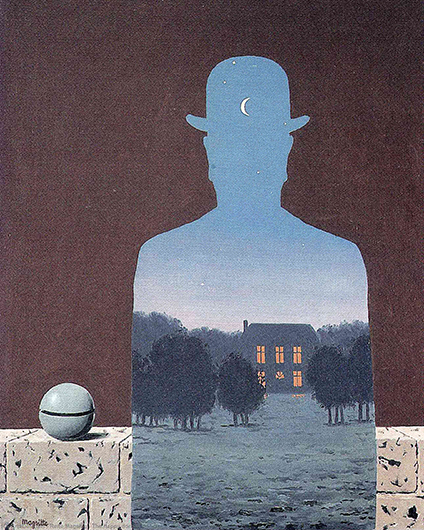 Rene Magritte. Happy donor. 1964
You can think and fuel up why emptiness has become a favorite image object in the last half a century and at the plot level, and at the compositional level. Why do you really want to conduct this experiment and see a feast without guests, a garden without pleasure, a workshop without an artist? Is there only a pandemic? Globally behind this is a whole worldview of the era. A person is lonely, a man is small, a person will not be at all soon. Specifically, I'm alone, small, and I will not be soon.
But the artist himself did not want to delve into the ontology so. His artistic experiment borders on the scientific - he reveals the compositional principles of world masterpieces and offers their new reading. Thinking art historians and not this turn about works of art: they increase, cut, mirror and draw on top to identify the axes, rhythm, compositional formula and it is still unknown what. I remember my university professor: he ritually apologized to the artistic work, transferred him to black and white-and after that he painted spirals, lines, triangles, lips, onions, what else was there ...
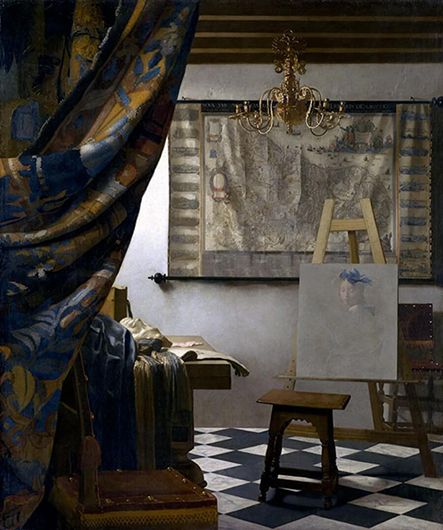 © granted by the press service of the New Jerusalem Museum Jose Manuel Balleser. Workshop of the artist. From the original, Jan Vermaur "The Art of Painting." 2008
Postinernet-art is not painting and does not require a carrier. Balleser is an artist of “old hardening”, his work is printed on canvas, but not all the subtleties of strokes and screening are preserved. The author does not focus on the skill of geniuses of the past - his experiment is to study the background, not a picturesque surface. Not only people go away, but also the aura that Benjamin writes about is a feeling of the uniqueness of the picture, which is before us. The dry residue is a place of action where the trace acts as a sign of absence. However, to see in full the art previously seen on the Internet remains “museum expirence” in every sense. A spectacle, atmosphere, participation: you can also take a photo against the background of an empty picture that you are Venus or Infanta, and children at master classes offer to finish the paintings in their own way .
When the exhibition opened, another continued - "The younger Bruegels and their era." The curators extended the thread from the Dutch painting of the New Age to today's digital, placing at the entrance of the “place of hunting” Balleser - a snowy landscape based on Peter Bruegel the Elder. This funny roll -call, it seems, is not even about continuity, but about appropriation - the method of postmodernism, which allows all the masterpieces of the past: if it does not reassess them, like modernism, then at least sets its accents.
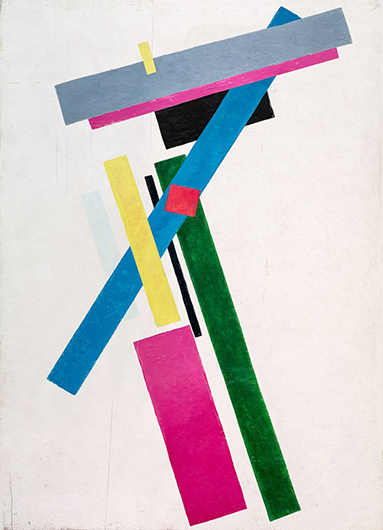 © granted by the press service of the New Jerusalem Museum Jose Manuel Balleser. Variation on the topic of Malevich - 1. 2017
For an exhibition in Russia, Balleser provided four works from another large cycle - "Variations on the theme of Malevich." The author does not proceed from the message that the Suprematic painting has exhausted itself, but from the idea that repetition behind the master makes it possible to understand the course of his thoughts and interaction. So the impressionists studied, copying the painting of the Louvre, and in St. Petersburg in the second half of the 20th century, the Hermitage School of Grigory Dlugach was organized [1] , the participants of which created “analytical copies” of the paintings of Western masters in order to identify their hidden geometry.
“Through the system of relations between the forms that make up the composition, we can observe how various stresses, attraction or repulsion come from their location in space, thereby revealing the playing Magnetism of formal, chromatic, spatial and tonal qualities for Malevich,” we read in the author’s annotation for the project. It is curious that he would say about the desire to actualize and re -interpret his work a hundred years later the “Prophet of the New Art” himself, which did not want to look back, at the “Babushkin Old bra” of world artistic heritage, saw the art of continuous evolutionary line and actively urged artists to move forward, without turning around.
You can also recall the quote from the literary heritage of Casimir Severinovich, which creates another bunch between the Suprematic project of Balleellter and his series with the disappearance: “The composition cannot be considered for creativity, because the distribution of figures in most cases depends on the plot: the procession of the king, court, etc. The king and the judge are already determined on the canvas of the place for persons of secondary significance ” [2] . You can check these words in practice-now that the baller “erased” from the paintings of the characters, we can rearrange the figures on them or have new ones, which children do at the master classes in the museum. Apparently, in order to decide on such bold manipulations, you need to be either a child or an artist.
The project of Jose Manuel Balleser can be perceived as a joke, meme or creative find, relevant in the conditions of pandemia. You can see him as a postmodern artist who applies a world artistic culture, committing another manipulation over it. But you can try to treat his approach as an instrument with which it is worth working further: both artists, researchers, and viewers. Moreover, the author showed: his method is applicable even to an indescribable art.
[1] O.Yu. Koshkina. "Hermitage School" G.Ya. Dlugach: Creativity as an adaptive interpretation of the painting of old masters // Three centuries of searches and achievements. Domestic art of the XVIII - XX centuries . - M.: Bogsmart, 2020. S. 16–19 .
[2] K. Malevich. From cubism and futurism to Suprematism // Black square. -St. Petersburg: ABC, ABC-Atticus , 2019. S. 19.