
Translated material
Feminism walks along the planet
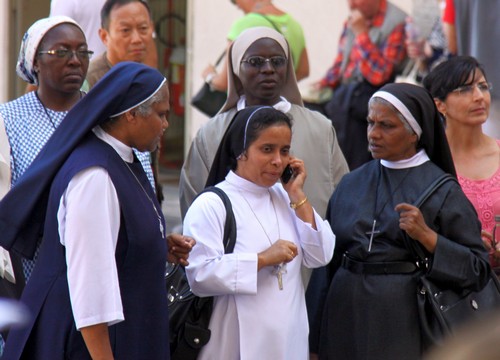
Religious feminism has many shades and nuances, and the appearance of female episcs in the Church of the Church once again indicates that the gender theme can be associated not only with sexism, but also with responsibility.
In Protestant denominations, female preferences have existed relatively long ago, since the end of the 20th century. And experience shows that they can collect the community, work with children. In Stockholm, the author of these lines had a chance to observe how, after the service, one of these servants of the altar arranged a tea party with schoolchildren, during which smart conversations alternated with jokes and the parents spoke at ease with their children at ease.
Not every priest can help them to help them solve spiritual and psychological problems, for this we need a special gift. And the opportunity to choose suitable candidates both from the male and female part of Christian humanity increases the personnel resource of the church.
Now it has come to gender changes among top managers. The other day, the British Lords approved the proposal of the General Synod to allow women to become bishops. After the approval of this proposal by parliamentarians, it will become a law.
Perhaps someone will have bewilderment: why on earth do legislators intervene in purely religious affairs? The answer is simple: the Anglican Church is state and therefore the state regulates many aspects of its existence. By the way, the experience of Great Britain shows that the phrase “state church” does not always have a purely negative meaning. It is expected that by Christmas, that is, by December 25, 2014, the Anglican will have the first female epiprus.
Orthodox movements in the direction of religious feminism are not observed. On the contrary, many priests are relieved to enter the altar, where free access to the weak floor is closed. And with pleasure they repeat the saying that Catholics are destroyed by papism, and Orthodox Babism. Catholics, however, are also in no hurry to meet feminism, but their altars are open and it is difficult to hide the priests from a female look.
In Russia, a female question, of course, is not as acute as in the West. But there are enough problems. At one time, Metropolitan Anthony (Bloom) called on believers to reflect on this problem. But what are the thoughts in the context of the Sovietization of the whole country?
The Patriarch of Moscow and All Rus' Kirill said about five years ago that "today the Orthodox Christian should take an active social position, acting as a keeper of Christian moral values in the family and society." He did not even hint about the appearance of the weaker sex on the amvon. And today, it seems, the question is closed.
Yes, the theme of the female clergy for the faith built on the patriarchal myths is not easy. The wonderful British Orthodox theologian Metropolitan Callist (War) spoke quite definitely: “Imagine that you bought an old house and, rising to the attic, hit your head on a beam that seemed to be not needed here. It is still unknown to us, but will it not be reckless just to take it out without studying the house of the house? The lack of convincing precedents and instructions in the Holy Tradition encourages us to be extremely careful. ”
OK then. We will be careful. But after all, some overdone problems, including related to the female theme, must be solved in the church today. Let a woman cannot stand at the altar. But in the temple can she feel comfortable?
Four years ago, an union of Orthodox women arose. Today he has developed violent activity. On the organization’s website, we can read about the participation of members of the Union in numerous conferences, about the raise funds for the construction of temples and charity. But practically nowhere is it written about attempts to arrange the intra -church space, about the organization of parish life, and communication in the parish. When the organization got to his feet, the speaking of the importance of the appearance of the mother and child’s room at each temple sounded, about a specially allocated corner for babies, where they were engaged in trained people. In case, for example, if the abbot does not tolerate a children's scream. From feminism, of course, all this is far away. But it is directly related to real life. Today, the union, together with other Orthodox female organizations, serves the episcopate and fights for traditional values, not realizing that this is a two -edged stick and the patriarchal world is of a lot of problems.
The Islamic state, for example, showed how it understands traditional values, announcing sex jihad. Yes, in addition to everything, it decided to turn Christian women into concubines. And all this under the Muslim banner, under the banner of the patriarchy. Two young fools from Vienna came to Syria, became pregnant, now they ask home , they do not know how to run away. This is the power of tradition.
Of course, in Christianity, male violence is much softer, streamlined. Even in the most fundamentalist parishes. But it still is.
The refusal to call feminism in practice means that women around whom the parish life moves obviously on the second roles, in strict dependence on men. Even under the Soviet regime, it was easier with this. A woman, for example, could be an elder and solve some important issues. Today in the parish, the father of the rector is fully commanded - in accordance with the letter of the new parish charter. And if we take into account that the priest himself is not free and entirely depends on the whim of the top manager, then involuntarily there is a crazy thought of the Orthodox female bishop. Fantasy of pure water. But if you imagine for a minute ...
Definitely: to the priests with a woman-board will be easier to agree.
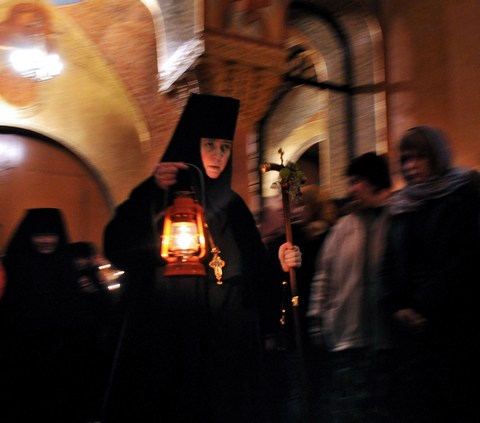
In the photo: St. Petersburg. The abbess of the Voskresensky Novodevichy Monastery Igumen Sofia (Silina) with the fertile fire delivered from Jerusalem during the Easter worship in the Voskresensky Novodevichy Monastery.
Photo by Ruslan Shamukov / TASS