
Translated material
Saga about components
In uniform
 Saga about components
July 31, 2013 Alexander Golts
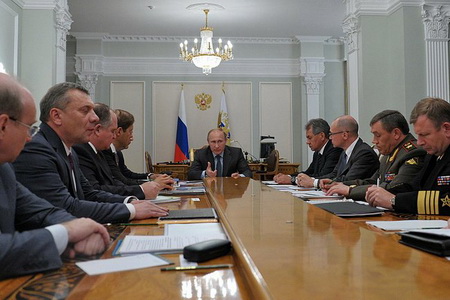
Well, finally. Opening a meeting on the implementation of the state defense order for the Navy, the chief chief of the country recognized what was obvious for a long time. The ambitious state program of weapons (GPV), worth 20 trillion rubles, is failed. Of course, this recognition was made in the style characteristic of Putin - on the bureaucratic new heap: “I know that there were ideas to make adjustments to financing ships that should be submitted until 2015, and for ships with the deadlines after 2015 to determine the amount of funds already within the framework of the new state program until 2025. It's all possible. Let's look at, only so that we have no failures. ” Moreover, the head of state actually agreed that the state of domestic industry is such that it is unable to master the money that is allocated to it.
Putin is not that I understood (this is still ahead), but at least I felt what the real problems of the defense industry are. It turns out that the point is not in the selfishness of private owners of the defense industry enterprises (there are few of them) and not in the slaughter of the performers (which is a consequence, not the cause). The reasons for the constant breakdown of the deadlines for the completion of the construction of new ships are, in Putin, “the inefficiency of interaction between state customers and organizations of the defense industry, failures in the supply of components by member personnel, the lack of proper cooperation between industrial and design organizations, as well as the low quality of the supplied equipment”.
In fact, this is a sentence of the OPC organization system that Vladimir Putin and Sergey Ivanov created in the middle of the last decade. It was then that they drove most of the industrial enterprises into the so -called united corporations. Ineffective and bureaucratic, as Soviet ministries of defense industry. But Soviet ministries managed to massively produce weapons. The problem of their today's heirs is that there is no one in the absence of a state plan, which in Soviet times tried to balance prices for products and raw materials, thereby giving at least some economic meaning to the functioning of the defense industry.
Putin’s “malfunctions in the supplies of components” is an obvious result of the collapse of the Soviet operating system of the defense industry. In the USSR, the overwhelming part of the components was made in civilian plants. The Stalinist concept of industrialization was that in order to build enterprises seemingly for the production of civilian goods. But at the same time, military products were produced there. Which naturally was reflected in the quality and price of civil goods. In fact, Soviet people who bought Pants of the Bolshevichka factory or Minsk refrigerator financed the production of components for missiles and atomic submarines.
In the 90s, most of the Soviet industry died. Smaller - it was re -profiled to produce other products. The current owners of surviving enterprises do not need a defense order at all, an attempt to sell which will inevitably make their main goods more expensive, and therefore less competitive. But without serial production of components, it is impossible to begin serial production of weapons.
The Deputy Prime Minister Dmitry Rogozin, who is responsible for the defense industry, is at the duty explanation: it turns out, in the disruption of the supplies of components, and in their low quality it is to blame, of course, the former Minister of Defense Anatoly Serdyukov, who “destroyed” the military acceptance at enterprises. At the same time, Rogozin does not explain why the shortage of components and their low quality disrupted the implementation of the arms program, which was responsible for the current head of the presidential administration Sergey Ivanov ...
In fact, manufacturers of complex military equipment are faced with a choice. They can produce components in the final assembly factories in a half -brushing way. Or they can buy them on the side, risking to get a hack, worked out in some shed. Of course, the problem is not exhausted by the reconstruction of military acceptance in enterprises. It is necessary to create complex chains of subcontractors. And, note, even if there is money, this is not a banal task. We are really talking about new industrialization, about the construction of new enterprises. But just what?
It is unlikely that Joseph Vissarionovich will be able to go: to create civilian enterprises that would have been conducted in parallel to military production. In this case, you will have to leave the WTO and prohibit all the imports, introduce an economic “iron curtain”, which cannot exist without political self -isolation. Only in these conditions can you force citizens to buy domestic. Another option is to build specialized plants for the production of components for defense seizure. But this is monstrously costly. In this case, it will be necessary to choose only a few most important weapons systems, the serial production of which is really vital for the Russian army. In my opinion, these should be means of communication and intelligence, drones, high-precision weapons, and what Russia systems have lagged behind industrialized states for decades. In other cases, you will have to think whether new tanks are needed and an armored personnel carrier or Uralvagonzavod and Kurganmashzavod will be limited to the modernization of old equipment. Is it worth spending 5 trillion rubles on renewal of both the surface and underwater fleet of Russia? Does the country need a new “heavy rocket”? We will have to painfully choose priorities. To withstand the merciless attacks of lobbyists who will prove that the abandonment of tanks, machine guns and aircraft they produce is work on a potential enemy. That is, a real attempt to begin serial production of any military equipment will inevitably put Mr. Rogozin in a very difficult situation.
Obviously, he understands this perfectly and tries to postpone the moment when he will have to fulfill the promised Putin and begin serial production of weapons. And there is only one way out - to transfer the implementation of ambitious plans until the next weapons program. Rogozin quite frankly stated this after the meeting: “In fact, we discussed issues of the 2016-2025 weapons program.” The rearmament of the Russian army went in a new circle. Without any results.
Photo kremlin.ru