
Translated material
Permutation and arrangement
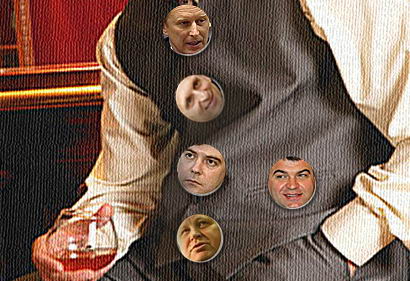
The last permutations in the executive system gave rise to the next discussions on the subject of the balance of power in the Kremlin and the government - the presidential elections are approaching, and the “one hundred percent” successor is not visible. As a result, Russian “picket vests” immediately came to the conclusion that Sergei Ivanov had more chances for the presidency than Dmitry Medvedev, and then it turned out that Sergei Naryshkin was “also a head” and could count at least for premiership. In fact, the president only corrected the balance of power in his near circle, and the new appointments, rather, allow us to judge not the candidacy of the successor, but about what the Russian power system will look like after the 2008 election.
To begin with, last year, with the resignation of Prosecutor General Vladimir Ustinov, the hardware positions of the “power” faction (aka Igor Sechin’s faction) were significantly weakened in the presidential environment. Ustinov’s transition to the Ministry of Justice looked like a weak compensation for him on two grounds. Firstly, the political influence of the Ministry of Justice is traditionally less than the Prosecutor General. Secondly, the ministry is in charge of three federal services (registration, bailiffs and execution of punishments), whose leaders have autonomy from the “minister”, which even more limits his real powers. At the end of last year, the head of the Federal Penitentiary Service Yuri Kalinin filed a resignation report, and last week it became known about the upcoming resignation of the “main registrar” Sergey Movchan, a protege of the influential president of Russian Railways, Vladimir Yakunin. Thus, Ustinov strengthened his position in his own department-we add to this that he was given a carte blanche for permissions in the central apparatus of the ministry. As a result, the leadership’s leadership began to resemble the “upper echelon” of the Prosecutor General’s Office of a year ago, including Vladimir Kolesnikov, a “horror story” for liberals, an active adherent of the extension of presidential powers and a wrestler with a loan interest. Thus, the “security forces” somewhat strengthened their positions at the expense of Yakunin (there is reason to believe that the Movchanes will not remain without compensation for the lost post).
Now pay attention to the appointment to the Ministry of Defense and the State Tax Service. At first glance, everything looks absolutely simple - to replace Anatoly Serdyukov, who headed the military department, his “supported” deputy Mikhail Mokratsov came. However, we recall that Serdyukov does not belong to the client of his predecessor as Minister Sergei Ivanov. Thus, increasing its status in the government and having received the industrial sphere (with the priority of the military -industrial complex), Ivanov loses real control over the Ministry of Defense. Apparently, in the near future he will inertialize Serdyukov inertia, but soon the situation will change. Moreover, despite the almost six -year stay at the head of the military department and a significant political influence, Ivanov did not acquire an extensive clientele inside the army corporation, remaining a “man from the outside” for her.
However, Serdyukov was able to leave his protege at the head of the tax service. Recall that both Serdyukov and Moklatsov worked in the St. Petersburg Tax Inspectorate under the leadership of Viktor Zubkov - a person from the near presidential circle, now heading financial intelligence (Rosfinmonitoring), whose functions may expand in the near future. So, financial exploration plans to increase the period of analysis of suspicious operations that banks have the right to suspend from five to 45 days. In addition, the adoption of the bill is expected, according to which the Zubkov department will be provided with information about the movement of funds in the accounts of officials, primarily a high rank; The control systems will also include the heads of state -owned companies.
After the transfer of Zubkov to Moscow, Serdyukov headed the Tax Inspectorate of St. Petersburg, and Moklatsov worked as his deputy. In 2004, Serdyukov headed the Federal Tax Service, after which Moklatsov again became his deputy. It is significant that the issue of the new head of the Federal Tax Service was not resolved in the general assignment package, but a little later. This may mean an old bureaucratic game, when the already agreed appointment suddenly turns out to be failed. However, a few days later, Moklatsov still became the main tax authority, which, from the point of view of hardware logic, may mean preserving the influence of Zubkov and Serdyukov on this important political and economic sphere. If we add to this that Zubkov is considered a figure close to Viktor Ivanov, responsible in the Kremlin for a personnel policy, then the outlines of an influential hardware “ligament” are loomed.
The appointment of Sergei Naryshkin as deputy prime minister can also be relevant in the context of hardware contacts of this influential official. Namely: when he oversaw foreign economic relations in the administration of the Leningrad Region, Oleg Safonov, who then made a somewhat unusual career: deputy plenipotentiary of the President in the Southern Federal District, an auditor of the Accounts Chamber, and since November last year, was a deputy minister of internal affairs. We add to this that both of them worked in the early 90s in the St. Petersburg City Hall, although under the leadership of different deputies of Anatoly Sobchak (Naryshkin’s chief was Kudrin, the chief of Safonov-Putin). Both Naryshkin and Safonov are now on a career ascent, which may be connected with the president’s desire to foresee the figures, which for a long time were on the personnel periphery.
Finally, the distribution of powers among deputy prime ministers, the order of which last week, signed Mikhail Fradkov, is noteworthy. Typically, the comments say the new duties of Ivanov and Naryshkin, but the powers of Dmitry Medvedev are no less interesting. On the one hand, he became the curator of the “problematic” social complex, but this is unlikely to negatively affect its image, since society has already determined the main responsible for all sins in this area - Mikhail Zurabov, who, in its unpopularity, will soon catch up with Anatoly Chubais. On the other hand, Medvedev becomes responsible for the extremely popular demographic initiative associated with the so -called maternal capital of 250 thousand rubles. Thus, he has additional opportunities for promotion in public space (just like, however, Sergei Ivanov’s diversification of the economy).
In any case, current hardware layouts will not affect the question of determining the candidate of the successor. They could be important if the issue were solved by the vote of the main participants in the Putin environment. But there will be no vote - the question of the next president will be resolved only by the current (and the announcement of the “sovereign solution” will happen as soon as possible - in order to avoid the effect of the “lame duck”). However, the main players will have to agree with this choice - another decision will be fraught with too great political risks. Moreover, they all receive a sufficient number of posts in order to have certain guarantees to maintain their hardware and political positions-that is why, following the nomination to the first positions of Medvedev and Sergey Ivanov, a personnel expansion of other groups and individual influential figures are taking place.
Thus, the future president - whoever he is - will be limited from the very beginning in his political and personnel capabilities. Vladimir Putin is already forming a team for his successor, based on his own interests. Defense, foreign economic relations, tax service and, apparently, financial intelligence in addition - it will be extremely difficult for the new president to carry out his creatures (as well as Putin himself, with all his influence and popularity, it was not easy to replace key posts in the power of his people - we recall that he was able to change the “Yeltsin” prime minister only at the very end of his first term). And if so, then the likelihood increases that Putin and after his resignation will retain arbitration functions within the framework of the team he selected.
Author - Deputy General Director of the Center for Political Technology