
Translated material
"Cloud pillar" - afterword
Around Russia
 "Cloud pillar" - afterword
November 26, 2012 Andrey Kozhinov
I stand in line for the cashier in the district supermarket. It takes, a cashier girl, regular customers know by the names and standard set of products. In the week I saw her at the bus stop - she missed the bus and the look was unhappy. Conscience does not allow me to be late in the first month of study at a lecture at the university. Threw it. The hook is very small .
- Hello .
- And you .
- Listen, at the university they ask so many works to write - I do not have time. All days have already mixed up. So when did you bring me to the lecture - before the ceasefire or after ?
I could not remember. My days also mixed up. In my opinion, I brought it to ... but in the supermarket I started going exactly two wars and from a dozen two large and small military operations back ...
The next operation in the gas sector ended, as expected, by the next truce and the feeling that something was wrong again ... not so started, not with the results that were hoped for, finished. Maybe this feeling arose because Netanyahu, one of the most stringent critics of the results of the Operation “cast lead”, promised to finally destroy Hamas. Bring, so to speak, work to the end. The process itself - hostilities - was carried out brilliantly and with surgical accuracy.
Intelligence worked perfectly - the bank of goals was in advance and clearly defined. Fajer-5 long-range Iranian missiles were destroyed at the first hour after the start of the operation. Information from this or that field commander of Hamas or Islamic jihad is located, flowed - eliminated them with minimal losses among the civilian population. The missiles of the small and medium radius of the defeat were destroyed by hundreds - even before the launch. Or in the mass, they were intercepted by the system about the "iron dome". Blows at the launch points were applied within a second after shelling - if it was not possible to detect them in advance ... Hamas’s communication systems were also caused by considerable damage. Several Khamas drones (apparently staged by Iran or the Lebanese Hezbollah) were also destroyed before takeoff. Conventional militants - not to mention more high -ranking commanders - tried not to stick out their nose out within eight days, although this did not always help. Within 48 hours, the reserve (tens of thousands of people) was called up and the technique was pulled up - the mobilization model received a very good running -in. 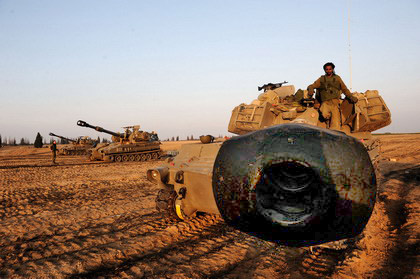
From the final army summary:
In total, the blows are inflicted on more than 1,500 targets. Among them:
19 -operational headquarters Hamas
140 tunnels for smuggling
66 “shock tunnels” (mined tunnels in the sector used to undermine troops for a ground operation)
26 weapons and missiles
Israeli missile shelling:
In total - 1506 missiles and mortar shells
Offered in open areas - 857
In densely populated areas - 58
Intercepted by the Pro - 421 Pro - 421 system (from aimed at densely populated areas)
Failed launches - 152 (explosion at launch or explosion in the territory of the gas sector)
The dead:
On the Israeli side - 6. Wounded - 240 (varying severity)
On the Palestinian side - 158. Wounded: 1000 (varying severity) - according to Palestinian data.
The operation began on the 14th on Wednesday, and already on Friday, Hamas said that he would not go to a truce until Israel satisfy his requirements-although attempts to offer such were made from the first hours. For eight days of confrontation, the Islamists also managed to achieve military successes-however, more symbolic: Jerusalem and Tel Aviv were fired twice, the bus was undermined for the first time in many years near one of the central checkpoints of the Israeli General Staff. For several minutes they were able to suppress the satellite signal of the 2nd and 10th channels of local television and start their video. In addition, Hamas connected his imagination and published a duck about the downed Israeli fighters, helicopters, drones and a sheated missile boat ...
Conclusions based on the results of the operation, as always, are twofold. And, as always, the Israeli government had to choose the lesser from two evils. From a tactical point of view, the air operation has obsolete itself on the fourth or fifth day: there are actually no qualitative goals, and it is impossible to destroy each rocket from the air and each warehouse with weapons. It was necessary either to stop the operation, or to enter the troops into the sector and proceed to the ground phase. Uncertainty is the worst enemy in the war. The units pulled to the border of the sector were completely ready and waited for the order. Alternately and daily, either the head of the General Staff Beni Hanz, then the Minister of Defense Ehud Barak arranged blitz-visits to the sectors, supporting the moral mood of the soldier. However, at first, Israel introduced the ultimatum to Hamas and Egypt with a demand to come to the ceasefire Agreement within 36 hours, then extended it for another 24 hours, then it was necessary to reach the latest agreements - the army and society were in a state of intense expectation: if the impatiality breaks, we entered the sector. If not, at home. At the same time, it was clear that Hamas in any case will announce his victory: the ceasefire, from the point of view of the Islamists, is evidence of the weakness of Israel and his army, and the ground operation gives Hamas, using his population as a living shield, positioning himself with an innocent victim and cut the coupons of the Arab solidarity, exposing himself to the main defender of Islam and the Palestinian people from Zionist invaders.
No matter how deep the feeling of dissatisfaction may be-apparently, it was impossible differently. Initially, Israel did not set himself the goal of destroying Hamas as the ruling power in gas - the goals were more modest and even amorphous: to cause serious damage to the missile potential, to restore the deterrent factor and achieve a long -term ceasefire from Hamas.
The successes of the “Iron Dome”, a small number of victims of the Israeli side and a small number of dead civilians in gas, allowed the Israeli government to show more flexibility in decision -making - many victims from the Israeli side would inevitably lead to a powerful pressure of public opinion, and battalions would cross the border selection march. In fact, the order for the entry of troops was given twice. And he was canceled twice-due to outstanding progress in negotiations.
Levka called, a longtime friend. Doctor of Physics, who worked in the States for many years and returned to Israel a couple of months ago. He said that they called on an emergency agenda .
- And how are the impressions ?
- You know, I came to the gathering point without anything - even the form with boots for so many years has not been preserved. Everyone was given on the spot. Berets look like new ones. Not a crack. I climb inside - the newspaper is stuffed there. Guess what year? 1980 ...
By agreement of the ceasefire, Israel undertakes to stop the practice of point liquidations, and military units should not be included in the so -called perimeter - a strip three hundred meters west of the border fence. Israel will also allow the Palestinians to cultivate the land in the immediate vicinity of the border and expand the fishing zone. As a remark: it was in this three -hundred -meter “perimeter” that the militants laid high -explosives for many years, tried to dig under the border of the tunnels and had sniper points ...
Hamas and other groups, for their part, undertake not to shell the territory of Israel and not initiate the attacks of any kind from the Gaza sector. Egypt, in turn, promised to relieve the regime at the RAFA checkpoint, sharing gas and the Sinai Peninsula. This is that on paper ... And in words, Egypt and the States gave Israel the guarantees that "they will contribute to the suppression of the smuggling of weapons into the gas sector."
At the end of the Operation “Little Lead” in 2009, the ceasefire agreement looked approximately the same. Relative calm lasted for a long time - a little more than a year and a half. However, during this relative calm there was not a single month without missile shelling.
The “cloud pillar” gave Hamas what he could not dream about a couple of days ago-the official visits of Emir Catar, the Prime Minister of Egypt and the Minister of Foreign Affairs of Turkey. The latter, when he was taken to a local hospital, bitterly and excitedly real tears - with all the television cameras - sobbed from compassion to Palestinian victims. Hamas was able to actually legalize himself-not every day the US Secretary of State flies to some Arab capital in order to announce the ceasefire between the state and the terrorist organization, and this is not to mention the personal intervention of the UN Secretary General. 

Israel-despite the internal disappointment-made sure that it was possible to wage a short-term war with Hamas, despite the power of the Muslim brothers in Egypt: in the end, the President of Mursi, with a tough anti-Israeli rhetoric and statements about the revision of the peace treaty of the 79th year, have deeply pragmatic interests. As for the deterrence factor ... Hamas, of course, shouted loudly that hundreds of Shahids were ready to meet the soldiers of the IDF, but he was afraid of the ground operation - and very: the Islamists could not hold power after it ...
In principle, the presence of a containment factor can be talked to the first rocket from the other side to the first reaction of Israel or its absence. The Minister of Defense Ehud Barak said the other day that the IDF would respond to missile shelling hard, but at the same time will not allow each self -proclaimed combat Palestinian group to draw Israel again into the next round of confrontation. Translated from ministerial into human in the realities of Palestinian-Israeli relations, this means that the reaction, of course, will follow-but not to every shelling. And here it is, the next stick about the two ends: not to react - to undermine the very factor of restraint with your own hands, to respond - to risk returning everything to its own circles when you will follow the response to the response to the response ... and then in the spiral.
As far as Israel still managed to create this notorious deterrence factor, it will be possible to judge only after time. In this context, it is worth noting that at the time of the X truce, Israel again tried to fire with missiles from the Sinai Peninsula and mortar shells from the Lebanese village of Kila - apparently as a reminder that Hamas was not lonely.
There is such a famous figure of Hamas - Musa Abu Marzuk. In an interview with Associated Press, he opened in open text that the Islamists are not going to stop the production of missiles in the sector and even more so to refuse the smuggling of weapons. Between 2009 and 2012, Hamas received humanitarian aid from Iran in the form of long-range “Fajers”. During the current truce, the Iranian bosses, apparently, will try to arm militants in Gaza with even more serious “gifts”-and smuggling needs silence and calm, at least for some time.
Another observation concerns the conduct of military operations against terrorist organizations: in these so-called low intensity wars, to defeat-so that military successes look unambiguously and are translated into a plane of state-political achievements-there are virtually impossible, since there are many limiting factors. During the Second Lebanese War, the chief of the General Staff Dan Halutz Oblazreb is a lot of criticism for his words that the war was won not by a knockout, but by points ... Now his words appear in a completely different light. The only problem is that in the Middle Eastern game with a zero amount, if I did not win convincingly and spectacularly, then I lost in public opinion. Both internal and in the opinion of the opponent.
If you glance at the dynamics of the development of events in the gas sector, look at the quantity and scale of military operations that Israel is forced to carry out, it becomes clear that each new round is larger and more intense than the previous one. At the end of the Operation Cloud Pillar, one of the Israeli generals in a closed conversation with some bitterness said that he could not give a guarantee how much the current ceasefire will last - a week, a month or a year. So we are waiting for the next - and hardly the final - part of the Marlezon ballet.
Tel Aviv
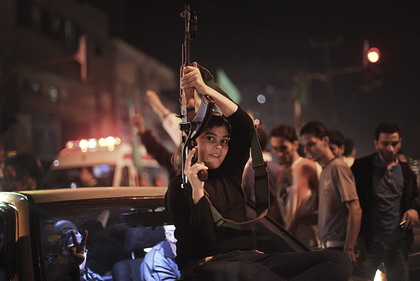
First photo of ITAR -TASS/ EPA - GAZ sector
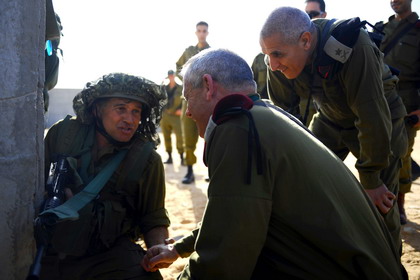
The remaining photos are provided by the Zahal press service
In the photo: Israel. Mali training center, one of the Air Force bases, a border with a gas sector;
In the lower photo, the Minister of Defense Ehud Barak, Prime Minister Benjamin Netanyahu, the Nachgen Staff Beni Ganz, com. Air Force Gen.-Major Amir Eshel