
Translated material
Before the choice
In the opposition
 Before the choice
September 6, 2013 George Satarov
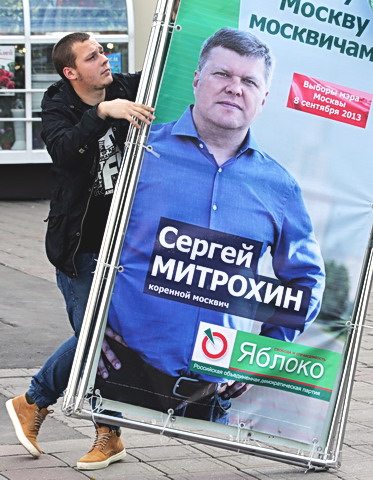
The election campaign in Moscow ends, and you can summarize preliminary results. The first thing that catches the eye is the campaign makes his way to the voting day, hiding from the voter, as a scout through the front line into the rear of the enemy. The idea of the authorities is understandable as the cunning of the child: to reduce the turnout, since it usually increases at the expense of opponents of power. The main television channels, for example, are shamelessly piastic for the acting mayor of Moscow, silent about the upcoming elections. An uncomplicated trick works. The forecast of the FOM for the turnout is below half of the voters. Also dull compromising, which everyone pours on Navalny. A serious incriminating evidence would warm up interest in the campaign, so they are sampled by small things.
Only by the end of the campaign did I realize that there are eternal values. And the main one in Russian politics is Grigory Alekseevich Yavlinsky, his sincerity, honesty, unattainable intelligence. And exemplary morality, of course. I understood this when I heard on Wednesday how he campaigned for his mayor's candidate. He was assertive and convincing, as before, in the best years. So he lists what wonderful people supported Mitrokhin, calling, among others, Dmitry Bykov. This is on Wednesday evening. And on Thursday morning, I hear according to the Echo of Moscow, as Dmitry Bykov personally tells why he is going to vote for Navalny.
But Grigory Alekseevich says that if he is asked not to do something from the Kremlin, then he does this. He is so independent. And then I recall how I was once a member of the Expert Council at the apple. I then told them, the leadership of Yabloko, which cannot be simultaneously defiling in white clothes in front of their electorate and run for instructions to the Kremlin, which in the end you can lose this electorate. To me, the uninterested, Yavlinsky with Ivanenko explained that politics is practical, and that we must reckon with the existing rules of the game. It was in these elections that Putin threw a practical “apple”, and since then noble practices in the Duma have not appeared.
Although they tried to earn a return. In the middle of the 2000s, for example, the Kremlin was scared by the appearance of “other Russia” - a movement in which the first opposition to unite from all flanks occurred. In a breakthrough, the Kremlin threw practical leaders of democratic parties - Yavlinsky and White. For the first time I heard and read how sworn enemies wrote and declared the same texts dictated in the Kremlin. And their servants publicly lied, cynically smiling at the face of those about whom she lied. They worked with inspiration. But they were thrown again, in a blade. They will continue to throw: in the gangster world, they despise weakly, betraying their own.
I was not going to write about all this, but Yavlinsky inspired me. I will not return to the "apple" anymore.
It seems to me that to analyze the course of a boring campaign is unproductive. It is enough to state the following: the dull intensity of the campaign does not correspond to its importance. Let's talk about its end better.
Now I will need sociological data. But in order not to conflict with the law, I will not operate with numbers. Moreover, this is not necessary. They are still available on the sites of the Levada Center, Thomas and VTsIOM. The information I cited dates back to the end of August.
All three sociological services give victory to Sobyanin in the first round. In second place, everyone put Navalny. But there are differences in published data. FOM gives two forecasts with a shift of two weeks. According to this forecast, the turnout grows by several percent. The result of Navalny is growing on the same value and the result of Sobyanin falls. But this dynamics are not enough to dawn the chances of the second round (by numbers). Remember this fact. Sociologists of the Levada Center do not give the results of their forecast, but simply data from the survey, but they are generally close to the forecasts of the rest. But they give support figures from the entire sample and from ready to go to the polls. Take a look yourself, this is curious . The data is given about the number of fluctuating, to go either not to go to the polls, and about the number of undoubted, for whom to vote. There are many of them. More than thirty percent is obviously. So. I declare that the rest of the text is for them.
We will forget about the future protocol of the Mosgorisbirkom, represented by the faithful VTsIom and certified by the president of the country, a friend of lawyers. Let's talk about the rest of the data. If the fluctuations regarding whether to go or not to vote and for whom to vote did not depend on political addictions and electoral intentions, then in the second and third columns of the last table that you can find at the address I have given, we would have the same result, far from half. But we see a different picture: Sobyanin voters are more ready to go to the polls than Navalny voters. Or in other words: among the submissions of Navalny’s, undefined regarding the plans for Sunday, they are represented relatively thick than Sobyanin's supporters. I will allow myself the following statement based on the data analyzed by me: if half of the indefinitely comes to the elections, then the second round cannot be avoided, and the result of a bulk and a half times a forecast for the Tsar of Sociologists will surpass. And this is only according to their data.
However, the main question remains: why go and vote for Navalny, if he does not like him. This is exactly what the majority of hesitating stops. I gave part of the answers in my series of articles on Moscow elections. Now I will share the remaining arguments that I saved for this last election article.
First. It is pointless to vote for Navalny, because it has some personal qualities. He is too young for a politician, so that his qualities, both positive and negative, could be seriously talking.
Second. It makes no sense to vote for politics on the grounds that we like it. Politics is able to spoil any angel (well, almost any). True, on one condition: if we do not control politicians and do not put on them constantly.
Third. It is also pointless to reflect, worthy of a bulk to vote for it or not. Think for yourself: after all, Navalny does not think about whether you are worthy to vote for him. The reason for this is simple: he needs your votes, regardless of your personal virtues. This is a very practical approach, inevitable in politics, when voters are considered by politicians not as a goal, but as a means. We can answer the politicians only in the same way, regardless of who it is - Mitrokhin, Navalny, Sobyanin or even Putin himself. We must consider politics as a means, and not as a goal (or otherwise: as an object, not a subject). Voting for politics, we should not think about the fact that we choose a life partner with which we want to live to old age. We must think about this: whether the victory is capable of the politician for which we vote is to change life as we consider necessary. Of course, Immanuel Kant would be indignant that we are violating the categorical imperative. That we justify our means with a high goal. And I have nothing to object to a genius. But I'm afraid that otherwise we will miss the opportunity to significantly affect the political situation in our country.
How much to endure that, for example, the intention of Obama to meet with our human rights activists turns Putin into a bunny at his meeting with the same human rights activists?! It is time to change the situation and, first, force the regime to adapt to us, and not to Obama. Now we can do this only by going to the polls, voting as we consider necessary and control the elections. And then control politicians. We have no other way out. I mean a peaceful way out.
Photo: Maxim Shipenkov/EPA/ITAR-TASS