
Translated material
Simulakra
In society
 Simulakra
September 23, 2011 Alexey Makarkin
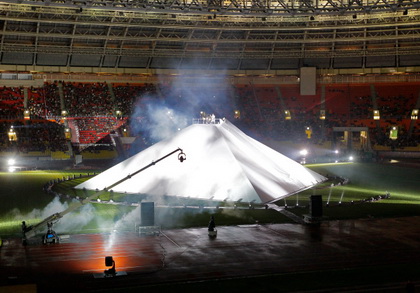
The recent disputes around the imperial doctrine of the zeal priest John Okhlobystin and his desire to nominate the presidency practically came to naught. And not surprising.
Presidential campaign about. John was over without starting. If Okhlobystin seriously decided to run without a blessing (the chances of receiving which were zero), then the Holy Prescription could not do anything but to deprive him of the dignity - by analogy with Gleb Yakunin. Moreover, it is theoretically possible to recover in the dignity, but practically - no. In the Russian historical tradition of “cutting up” is one of the most terrible insults, and this is relevant now. Let us recall the story with the Chukchi bishop Diomid, who had many sympathizers in conservative Orthodox circles. But after the deprivation of the dignity, a bunch of fans remained with him-more or less respectable integrist hastened to dissociate themselves from the former lord. By the way, about the same thing happened with Yakunin - the Orthodox liberals clearly distance themselves from him after 1993, even before he was excommunicated, that is, he was subjected to “higher” punishment.
Of course, the deprivation of the dignity does not entail a ban on engaging in artistic activities - on the contrary, it even removes some moral restrictions, for example, in choosing roles. But now on television, it is politically correct to express sympathies to Orthodoxy - therefore, there could be problems here. If not immediately, then in the future.
As for the text of the doctrine, the imperial idea permeating this document belongs to modern Russia in modern Russia, that is, imitation products. In general, recently, the number of simulacra in Russian reality seems to go off the way for all reasonable limits. For example, Mason Bogdanov as a simulacrum of liberalism (despite the fact that the current program of the right words in the current program is even the need to return the elections of governors). Or the election campaign of Matvienko in the “Red River” as a simulars of elections (although there was a decent number of candidates - in the absence of even signs of real opposition). Or the Mikhalkovskaya “Citadel” as a Simulakr “Great Style” in the cinema, which is even presented with an Oscar - apparently that the most advisable cinematic zoils do not leave without work.
The imperial idea, at first glance, is not so rude Simulakr - there are a considerable number of people who seriously believe in it. It is no coincidence that most of the listeners of Okhlobystin remained in the stands during his speech - and only a smaller part left the stadium disappointedly. But a real, not imitation imperial idea does not provide for conversations, but sacrifice. The empire needs constant expansion - otherwise it decays and dies. The empire is alive while there are a sufficient number of people who are ready to go into the exhausting Hivinsky campaign or to storm-with blood and then-lost in the sands of the Geok-Tepe, defend Hartum from the host of the Mahdists or to speak with three thousand against fifty thousand Bengals.
The British Empire ended when, after the Second World War, the inhabitants of the metropolis did not want to pull half a might - it was necessary to restore their own economy. In France, there were people who tried to hold Algeria (mainly “resistance” from the war - Salan, Bido, Sustel), but they did not receive sufficient support from society, and the dismantling of the empire was headed by the national hero de Gaulle, whom former friends unsuccessfully tried to kill. The Soviet Empire - as the “midnight” successor of the Russian - died with the departure from Afghanistan, when the overstrain of the country and the people became obvious. Further events were a matter of time - when General Gromov left Afghanistan, in Lithuania the leading position won Sayudis, and in Tbilisi Gamsakhurdia was preparing to take people to the square.
In modern Russia, sometimes they talk about the empire - before the crisis of 2008 they spoke more often. But before and after the crisis (and before its possible new wave), almost no one was ready even for minimal not only victims, but also inconvenience in the name of the imperial idea. And if so, then you can listen to the priest-actor-orator at the stadium and then return to warm apartments for the next cases. Or to consult a fashionable topic on the Internet without leaving the usual chair. Sometimes you can, sitting in Moscow, to grieve about the Russian people as divided - but in the meantime, the Russians in Estonia quite rationally vote for the centrists of Savisaar (the first premiere of the country after the restoration of independence). In Latvia, the Russian leader Ushakov pronounces the word “occupation”, and the radical Russian party, which will never utter it, receives less than 1% of the vote.
Simulakra with at least relative stability can live for a long time - especially if they are supported by power, fueling resources. But when the “thunder breaks”, they will turn out to be useless - like any (at least talented, even mediocre) cardboard scenery under the storm that has begun.
Author-First Vice President of the Center for Political Technology
Photo by RIA Novosti