
Translated material
Against everyone
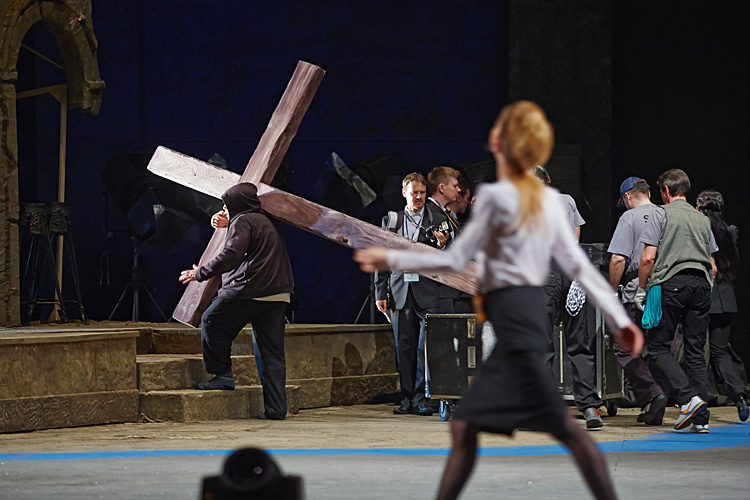
On Monday, the Investigative Committee of the Novosibirsk Region announced the end of the audit in the case of director Timofei Kulyabin and the former director of the Novosibirsk Opera and Ballet Theater Boris Mazhrich in connection with the ill -fated Tangayer performance. The verdict of law enforcement officers: the case will not be opened - for the lack of corpus delicti. This event is as joyful as the puzzling. I propose to be puzzled on the subject of the Ministry of Culture of the Russian Federation and its role in the broken scandal.
I must say right away: I respect the feelings of believers. The performance in which the actors would dirty or break sacred paraphernalia would make fun of the sacred figures for believers and put up believers with scoundrels or idiots, I would not approve. But the approach to the theater through the prism of the establishments of the Holy Synod, acting before the 1905 revolution, is impossible for me today. Then, as you know, it was forbidden to bring to the stage of Christ, all the more to indulge in any creative fantasies associated with His image-for example, what he would say and do, being in modern times. The sad incident is widely known with the stanislavsky playing the play of Hauptmann “Hannel” at the Moscow Art Theater (1898): the heroine of the play - a girl dying of the cold - was Christ in visions, which became the reason to ban the performance for the show. Nobody warned us about the revival of church censorship of the model of the 19th century at least. In the Federal Assembly of the Russian Federation adopted in 2013, the law on protecting the feelings of believers has not a word about such restrictions.
It was obvious to me from the very beginning that the play “Tangaer” did not violate this law. In contrast, even the “Hannel”, in the “Tangaiser” of Kulyabin there is no Christ, there is only a scene that imitates the shooting of a “scandalous” film about Christ, quite vegetarian, not ridicurating and not humiliating the sacred image. My opinion was confirmed twice - by the decision of the Novosibirsk World Court and the resolution of the Investigative Committee for the Novosibirsk Region. Of course, everyone is free to relate to the decisions of law enforcement agencies. They can be criticized, you can internally protest, but we are obliged to obey them.
I don’t know who how, but I am surprised by the disregard of the Ministry of Culture to the verdict of the Russian court. Literally a few days after the issuance of the acquittal of the mining body under the Ministry of Culture - the Public Council - is arranged by the real judgment of Mezdrich, he, an outstanding director, a living legend of the Russian theater, is forced to listen to “criticism”, bordering people who did not see the notorious “Tangaiser”. Why was this done? Why was it backed up by ministerial press releases that splashed a scandal to the first lanes of newspapers? Why was Madzrich the absurd assignment was given to apologize to those from whom he won the process? Suppose tomorrow, according to the same law on the protection of the feelings of believers, in some other case, a conviction will be sentenced. Will the ministry also challenge him shamelessly?
In this whole story, there are a lot of oddities that are difficult to find a reasonable explanation. Why did the offended believers evade public dialogue, why did not turn to the director of the theater? Why did the first thing they undertook filed a statement to the court, thereby making any dialogue impossible? In the conditions of the trial and investigative verification, communication between the accused and the victim, as you know, is not welcome. Then the founder - the Ministry of Culture could stretch the hand of helping the theater. The ministry was not aware of the problems of his accountable institution? What prevented the Minister Medinsky from forming a conciliation commission that would go to Novosibirsk and tried to resolve the conflict with the world? Boris Mezdrich is a multi -heartdic leader who perfectly own the art of compromise, and Timofey Kulyabin was never a “scandalous director longing for Piara”, as the Pisaks are trying to imagine him. I do not exclude that as a result of this communication, adjustments would be made that would have arranged all parties.
If the Ministry of Culture of the Minulus about the rejection of censorship in the theater is sincere, it makes sense to think not about the twisting, but about the weakening of the nuts.
The director of Mazhrich, who had already won the court, demonstrated his peaceful mood at the March shows of the performance, when the image that surfaced half a minute in the depths of the scene and caused the complaints of believers was closed by a white screen. It seems to some kind of unusual stupidity the absence of at these shows, held exactly on the eve of the meeting at the ministry, a high-ranking ministry of the Ministry of Culture. Even if there were no officials who were versed in the theater in the ministry, more than aspirations, in Novosibirsk could well have to fly an awkward. Just for the pattern, for a short report on the council. See whether his performance will insult his performance. Follow the reaction of the thousandth hall, which adopted the performance quite enthusiastic. But in the hall, undoubtedly, there were Orthodox believers ...
Honestly, I would not venture to condemn Boris Mezdrich for intransigence and stubbornness - after such an attitude to him. I see in the inaction of the Ministry of Culture and indifference. I can’t believe in the words of the speakers of the Ministry of Culture that they allegedly prevented a dangerous conflict. There is one of two: either this is not true, or a dangerous conflict flared up with the connivance and sleepy inaction of ministerial officials.
In an interview with the newspaper Moscow Komsomolets, Minister of Culture Vladimir Medinsky said the following: “As Vladimir Medinsky, a publicist-historian, being between two extremes-the Russian Orthodox Church and the leadership of the Novosibirsk Theater, I will tell you frankly that in this case my positions are much closer to the Russian Orthodox Church. But as the Minister of Culture, I am in the middle. ” Dear Vladimir Rostislavovich, you cannot be in the middle: your ministry is the founder of the very Novosibirsk theater, and you - you want, do not want to - must protect the interests of the theater in this conflict. This is your position.
I do not think that it was correct to ignore letters written in support of Madzrich and Kulyabin with prominent theater figures. I do not think that the fate of the theater and performance in a hurry and fever should be decided. I do not think that Boris Mikhailovich Mezdrich earned dismissal bordering on a spit in the face. I do not think that the new relations of the ministry about increasing the responsibility of directors for “mass protests” are not difficult and not difficult, and they will arise due to theatrical deliveries. The only mechanism that the director owned in this case is early planning. Yes, the director is responsible for the choice of the director, the choice of material for setting, but to cope with "mass protests" is clearly not in his competence. After all, the theater is not an authority, but only a socially useful institution, but the competence of the head of the institution is limited to its walls. Mass protests of the employees of the institution - in the competence of the director, “massive protests in general” are engaged in completely different bodies. I don’t think, by the way, that these “mass protests” should be encouraged against the performances. Somehow we lived without them until recently-and did not push. In any case, the Ministry of Culture should appeal to such conflicts: it will be quite sad if the theaters remain orphans with a living founder.
It would be rudeness and stupidity to consider the conflict around the “Tannhaiser” the next clash of “liberals” and “patriots”. Among the “liberals” there are many characters with dense views on the theater, among the “patriots” there are many people, the theater sincerely devoted and completely unwilling to destroy the ideological and aesthetic diversity that has settled on Russian stages today. It would be a cunning to say that in today's Russian theater there is no censorship. There is self -censorship - and quite severe. I can’t forget the statement of the young director who came to one of the St. Petersburg theaters for the production: “Give me a piece of paper in which it is written, which you can’t.” These are the mores - especially in the provinces. If the Ministry of Culture of the Relief of Censorship in the theater is sincere, it makes sense to think not about the twisting, but about the weakening of the nuts.
A number of publications depicting a modern Russian theater in the form of some kind of garbage dump have passed through the media. No, gentlemen, here you definitely lied. Go to the theater, and you will find that it is different, that it develops in various ways and that, unlike a television grid, which for some reason does not insult anyone, is by no means stupid entertainment, but meaningful and noble searches. There is also a grateful viewer. There is also international recognition. The Vakhtangov Theater, under the leadership of Rimas Tuminas, traveled half the world, taking applause and enthusiasm. “Gogol-Center” by Kirill Serebrennikov for the first time in many years will represent Russia at the main theater festival of the planet-Avignon. Isn't that a reason for pride? Even in the days of the most fierce Cold War, it was not shameful "to be ahead of the planet in the field of ballet." But the Cold War between the Russian Theater and the Ministry of Culture would somehow be avoided.