
Translated material
Neighbors in war
A year ago, federal troops, with the help of local militias, expelled Chechen militants from Dagestan lands. However, the events of those weeks will affect the lives of the mountaineers for many years to come.
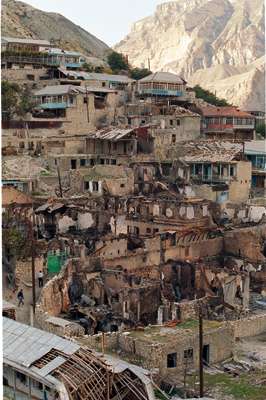
This is what the Dagestan village of Ansalta looked like a year ago, immediately after liberation from Chechen militants. Then people did not yet know how they would live further. Without a roof over your head (Photo: Ruslan Yamalov )
The men were arguing. Moreover, citing various arguments, they mostly appealed not to each other, but to the Itogi correspondent. “I assure you,” said Shamil Kerimov, deputy head of the administration of the Botlikh district of Dagestan, several villages of which were captured by the militants of Basayev and Khattab last August, “the time will not soon come when we will be able to forgive the Chechens. We treat them like brothers (in the first Chechen war, the residents of Botlikh sheltered 12 thousand Chechen refugees - “Results” ), and they destroyed ours home. This will not soon be forgotten." “Well, let’s say the houses were destroyed not by the Chechens, but by the military. Moreover, at that moment, when there were no militants there anymore,” local administration lawyer Nazhula Aliyev objected to him, “and there is no need to generalize. Mercenaries are one thing. And ordinary peasants are quite another. So tell me: what relation do the Binoites have to the militants? (Bino is a Chechen village located not far from the Chechen-Dagestan boundaries. - “Results.”) Did any of the Binoyans come with the bandits? No. Or are they also guilty? So, if they come into my house tomorrow and ask for help, I will embrace them and accept them as dear guests.”
This dispute is quite common between Dagestanis who have suffered from the invasion of militants. Someone hated the Chechens as such - all of them, someone believes that “since there is no blood between us,” then there can be no long-lasting hostility. But now, after a year, there are much more peace-loving Dagestanis - passions have noticeably subsided. Then the overwhelming majority of mountaineers spoke out in the sense that Dagestan and Chechnya are enemies forever. But the realities of everyday life force local residents to gradually reconsider their irreconcilable attitude towards their neighbors. For example, the pastures of the Gagatli residents (Gagatli is a high-mountain village near the Kharami pass, through which the local militia did not allow Shirvani Basayev’s detachment to pass) are adjacent to the Chechen ones, and the residents of Ansalta, by mutual agreement, have been grazing their cows and sheep on Chechen territory from time immemorial. Now they don't graze. “Well, this is not only because of the Chechens,” sighs Nazhula, “there are troops stationed there, and since Russian soldiers are hardly fed, you understand... But we, Allah knows, are not offended by them. The guys who protect us must eat something.”
The people and the army are united
It must be said that over the year the attitude of the Botlikh residents towards the Russian military has also undergone some changes. If at the height and immediately after the end of hostilities, local residents actually identified the troops that came to their aid with the federal government (then they did not say: the military helped us, they said: Russia helped us), now a division has occurred. For the most part, Dagestanis are quite critical of Russia’s policy in the Caucasus in general and in Dagestan in particular. No matter who you talk to, no one believes that a great power cannot cope with small Chechnya. Here, however, opinions differ again. Some say “with a bunch of bandits”, while others say “with the Chechen people”, but this does not change the essence. Everyone agrees that “war is commercial.” This means that only big bosses and multi-star generals benefit from it, while ordinary people, including soldiers, suffer. As for the situation in Dagestan itself, everyone is more or less unanimous and believes that the Russian authorities are turning a blind eye to the plight of ordinary people and the endemic corruption of Dagestan leaders (“under the Soviet regime, of course, they also took bribes, but still not as shamelessly as now”) because they do not want to quarrel with local bosses loyal to the Kremlin. And they, in turn, taking advantage of their immunity, continue to rob the people.
Meanwhile, over the past year, the attitude towards the Russian military has not worsened, but rather the opposite - the Botlikh people know how to be grateful. More precisely, they have already divided the military into “our own”, that is, into those who fought in these mountains last August and are now guarding the Botlikh region (they call them “our soldiers”) and the rest. The mountaineers generally speak poorly of those who fight in Chechnya - there is, they say, robbery and lawlessness. “Our soldiers” are forgiven a lot. The locals are ready to turn a blind eye even to some “misunderstandings.”
True, a few days before our arrival, one such misunderstanding almost escalated into a serious conflict. During regular command and staff exercises, Russian artillery destroyed several high-mountain villages. Fortunately, no one was hurt, but the shepherds have nowhere else to spend the night. “I can still understand this,” an acquaintance from Gagatli justified the military, “they need some kind of goals. But here it’s immediately obvious that if there is no more sheepfold, it means that he’s in trouble. But explain to me why it was necessary to shoot the herd from a helicopter with missiles? 45 cows from Gagatli were destroyed, the shepherd lay in a crevice for two hours, he was afraid that the pilot would go for a second round.” Gagatlin residents wrote statements to the local administration demanding compensation for material damage. “What will I do with these statements?” Kerimov shrugs. “I’ll tell the military leadership, let them sort it out.”
The local population is tolerant of the military also because the Ministry of Defense provided material assistance (that is, construction materials) to those whose houses were damaged during the battles with Chechen bandits. True, they need to be picked up from Makhachkala, and transportation costs a lot of money.
However, the main help came from the Ministry of Emergency Situations. Immediately after the end of the fighting, the Botlikh residents, who had not been spoiled by the attention of the authorities, for the most part did not really believe that they would be paid anything. But the state fulfilled its obligations almost completely. Meanwhile, not all residents were satisfied.
Help
Last fall, the Emcheis commission determined how many houses were damaged in the Botlikh district. It turned out to be almost three thousand. About half of this number cannot be restored. The government decided to distribute the money as follows: 40 thousand rubles for each family member (this is if the commission declared the house beyond repair. If it can be repaired, 18 thousand) and 50 thousand for the whole family for loss of property. “I don’t know why they decided to settle on this principle of distribution,” Shamil Kerimov shrugs, “in my opinion, it would be fair to proceed not from the size of the family, but from the area of the living space. And here, probably, the Soviet habit of equalization affected. And look what happened. Let’s say, you worked all your life, built a big house. But Allah did not give children. Well, get 130 thousand. And for this money you can’t even build a shed. Another example - they lived in a shack, but they gave birth to about a dozen children (we say: he who works little produces many children). Such a family is owed more than half a million.”
However, when the money had already begun to flow into the personal accounts of the victims, it turned out that another mine was laid in the compensation distribution scheme - no government documents indicated who, in fact, should be considered a family member. A typical example: a daughter grew up and got married in a neighboring village, district or republic. And there her children were born. So, should her new family receive compensation or not? Of course, she would never return to her father’s house, but the head of the family could theoretically assign the property to her too. Therefore, she is also a victim. Or another example: a father who died a long time ago left a house to his three sons. One of them remained to live within their native walls, while the rest moved around the country and started their own families. Formally, all of them are also victims and have the right to state assistance. “Can you imagine the mess we are in?” Kerimov complains. “We thought for a long time and decided that we would include only direct relatives in the lists and only those who have legal rights to property - registration, will or deed of gift. Moreover, these documents should have been drawn up before the invasion of Chechen militants.” As a result, all the drawers in Kerimov’s desk are filled with complaints from dissatisfied people. But there were some abuses, and the republican prosecutor’s office has already opened three criminal cases on the facts of the additions. Only in contrast to Soviet times, when cunning business executives improved the economic performance of the enterprises entrusted to them by providing false data, the Botlikhs attributed children. “Of course, this is a crime,” says Kerimov, “but people can understand that the compensation money was not enough for the majority to restore housing.”
Of all the villages in the region, two suffered the most - Tando and Ansalta. They decided not to restore Tando for now - residents were given empty land for development a few kilometers from the regional center. The residents of Ansalta were not given new plots of land - either rebuild on the ashes, or buy housing in another area. (This, by the way, is what many did. Some large families even purchased apartments in Makhachkala.)
Ansalta resident Kamil Magomedov has four children. He received almost three hundred thousand rubles. The family decided not to leave. “Of course, this money won’t be enough for me,” Kamil complains. “That is, a house with three rooms, and even then made of adobe brick, can be built, but one like the one I had, there’s no way.” “To build a normal house, you need at least 700 thousand,” the head of the local PMK Ali Asluev enters into the conversation, “we live in the mountains - transport is expensive, but bring cement, bring timber, and labor costs a lot. And if there is one adult man in the family, he still cannot do without helpers.” But housing is not the only problem.
Almost all mountainous regions of Dagestan are subsidized. Botlikhsky is no exception. The local budget is 95 percent formed from the money allocated by Makhachkala. It must be said that for the first time in many years, the republican authorities fulfilled their obligations to Botlikh - funds were transferred to the account of the district administration on time and in full. Therefore, now salaries of state employees are paid on time. The restoration of schools, hospitals and other public buildings destroyed during the fighting was financed directly from the federal budget. They are already preparing for the commissioning of schools in Ansalt and the new Tando. New medical posts have also opened in these villages. The situation is more complicated with the restoration of the handicrafts factory in Ansalt. Just a year ago, this was essentially the only profitable production in the area. More than two hundred people worked in two shifts to make buroks. These burkas were in great demand, sold throughout Dagestan, and some of the products were even exported to Georgia. The construction of a new factory building will take at least two years. At least this is the time frame they are talking about in the local administration. This question is extremely important for Ansalta residents, since there is no other work (except for housekeeping) in the village. Now, however, some residents are engaged in the construction and repair of public buildings. But this work is temporary. 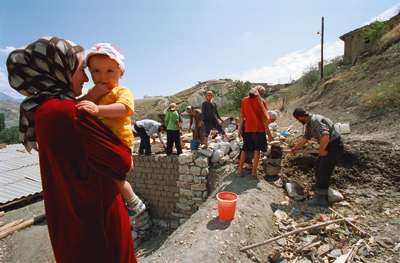
Today, houses in the villages of the Botlikh district are being built by the whole world - old people help with advice, and boys carry stones on donkeys (Photo: Ruslan Yamalov )
Mother of six children Khadizhat Ismailova plasters and paints the new school. She joined the brigade about two weeks ago. When asked by an Itogi correspondent about her salary, Khadizhat answered: “They promised to pay me well. But I don’t know how much exactly.”
At the beginning of the year, another attack unexpectedly fell on the heads of the Botlikh people. In the area, gardens began to dry up and livestock died.
“The loss of livestock began in the spring,” Abdurakhman Murtazaliev, the chief regional emcheisnik, shares his misfortune with us. “So far, not many cows have died. But the main thing is that we don’t understand why this is happening. We sent meat samples to the laboratory in Makhachkala. Fortunately, no serious infection was found. I personally think that this is all because of the fighting. In the spring, TNT began to flow from the mountains along with melt water. Here are the cows and they licked themselves. And why the gardens began to dry out, only Allah knows.” “Everything is well known to you, Abdurakhman,” one of the women standing nearby enters into a conversation (journalists now rarely come to Botlikh, and as soon as you talk to someone on the street, a crowd gathers around). “We sent dried branches to the institute. What did they answer? They say you’re watering incorrectly. How is that wrong? As our grandfathers taught, we water it. For some reason, their gardens did not dry out. Here everyone knows: the gardens began to die after the federals began to destroy the “green stuff” in the Vedeno region. They water the forests from an airplane with some kind of poison, and the wind blows everything towards us.” “Well, there’s no evidence,” Abdurakhman justifies himself. “Yes,” the woman continues, “but the fact that the gardens began to dry up on the Chechen side is not proof for you? You understand,” she now turns to me, “if our gardens die and our livestock die, we will all die of hunger. It’s not like in Karamakhi. Most people there have KamAZ trucks. But what do we have?”
Stronghold of Wahhabism
Today, often in news reports telling about the invasion of Chechen militants in Dagestan, the names of Botlikh villages are adjacent to the names of villages in the Kadar zone - Karamakhi and Chabanmakhi. It seems that in both cases, federal troops dealt with the militants and protected Russia from aggression. Meanwhile, there have never been any occupiers in either Karamakhi or Chabanmakhi. There, simply part of the local population professed one of the radical trends of Islam, which is commonly called Wahhabism.
Let us remind you: at the end of August last year, when the army and police had already completed the operation in the Botlikh region, the country’s leadership decided to attack the Kadar villages at the same time. Their residents posed no threat to the outside world and never took hostages. True, the rules that they established (women walked around with their faces covered, and men were punished with sticks for drinking alcohol) were not liked by all their fellow villagers. The authorities thought this was enough reason. Following the lead of the leadership of Dagestan (the Karamakh leaders spoke sharply against the current order in the republic), the military began to storm the villages. The Wahhabis put up armed resistance. In those days, newspapers wrote that the Islamists created entire fortified areas with dugouts in three layers, concrete bunkers and trenches. Itogi correspondents did not find anything like that then. But we saw villages destroyed by artillery and aviation, and residents trying to insulate what was left of their houses before winter. (Itogi covered this in detail last September.)
Today, even outwardly, Karamakhi is fundamentally different from the Botlikh villages. While most of the houses in Ansalt or Rahot are still in ruins, Karamakhi, with the exception of public buildings, has been almost completely restored. There are two explanations for this. Firstly, the residents of Karamakhi always lived richer than the mountaineers (the Kadar Gorge is located in the foothills of the Greater Caucasus, not far from Buinaksk), and, therefore, they had something to add to the compensation payments. In addition, construction work here is much easier than in Ansalta - the houses are not huddled on the mountainside, but are located in the valley at a fair distance from each other.
There have been no troops in Karamakhi for a long time. They left last winter - there was no one to defend the village from. It must be said that everyone with whom I was able to talk assessed what happened to them unequivocally: from the military, they say, what is the demand? They follow orders. And the local Wahhabis are to blame for everything. Especially the leaders. They drove people crazy, now everyone is paying the price. True, the Dagestani authorities don’t like it here either. “To be honest, I don’t understand why it was necessary to destroy villages and then release all the Wahhabis for money,” complains local foreman Akhmed Akhadov. “It’s like it is now in the republic: those who have money don’t have to be afraid of the court. And the Wahhabis are all rich people. Many of them are now returning to their homes.”
On Fridays, people discuss pressing issues at the local mosque. Various issues are resolved at such meetings. Including whether to allow another Wahhabi family to return to their native village or not. Everyone is given one condition - the head of the family must swear on the Koran that never again will he or any of his household members profess Wahhabism. Most took an oath. But there were also those who refused. The jamaat forbade them to stay in the village. 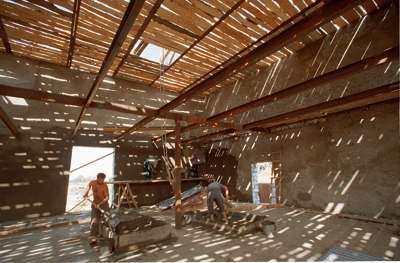
Karamakhi is being rebuilt faster than the villages of the Botlikh district. Even before last year’s raid, richer mountaineers lived here. Almost all of the private houses have been restored, and the builders hope to complete the mosque by winter (Photo: Ruslan Yamalov )
If in Botlikh, from which Chechnya is just a stone's throw away, local residents constantly discuss the problems of the war, then in the Kadar Gorge people are much more concerned about their own affairs. In response to questions about Chechnya, many Karamakh residents usually shrug their shoulders and say that it doesn’t concern them much - the war is far away, the militants will no longer attack Dagestan, which means their homes are no longer in danger. Everyone here understands: if the bandits had not come to Botlikh last year, their houses would have stood intact now - after all, Wahhabism appeared in Karamakhi several years ago, and the authorities put up with it, even Sergei Stepashin came and promised that they would not be touched
Already on the way back to Makhachkala, our driver Hamid, slyly squinting, suddenly said: “Listen, you are probably talking to big bosses there in Moscow. Please tell me that when there are elections in Russia again, they will burn down some other villages. Not the same ones.”