
Translated material
Instead of war
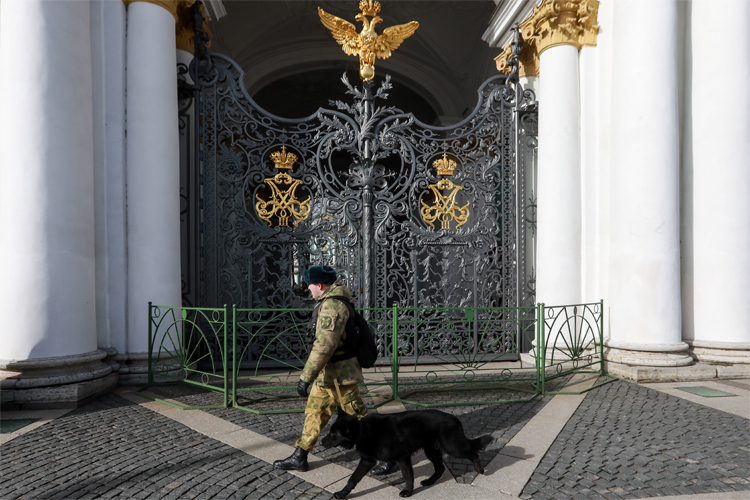
“This is a war,” writes in his appeal the director of the Hermitage Mikhail Piotrovsky. He recalls the years of the blockade, recalls how our predecessors “caught and stewed bombs, gave lectures to soldiers, invented and conducted excursions along empty frames.” But my God, as a floridly he describes the most important thing: that the Hermitage closes in connection with the pandemia. We read these lines. “In the conditions of world pandemia and panic, the last function - accessibility - temporarily crosses Online , which is fully consistent with the spirit of time.” Some function goes somewhere, which corresponds to the spirit of time-I want to exclaim: what is it about? What is easier - to say: "The museum is temporarily closed, but we can handle it, believe, hope, until soon meetings."
But today it is impossible in Russia today. The worse than any real threat-even for such a respected person-to say something directly. Actually, finding a tone for an educated person is not a problem for a situation. But this skill is lost, driven somewhere deep into it, it is self-impressive. In return, there are only two permitted forms of communication: to refer to each case to the experience of the war or to express themselves as foggy - "to prevent panic." Here is the result of the “discourse of discourse”: there is no natural, living language with which they are addressed to people at a critical moment. The language of human solidarity and sympathy. This is a complete failure of culture, humanitarianism itself.
It is dangerous to say even “we”. Where is this artificial structure crushed by propaganda for years? Where is it “we” now, when do they really need it? He is not, how he sang BG in a famous song. All this is your “we”, dear propaganda, scattered into atoms, on fragments at the first signs of anxiety - and it was known to buy that.
This is not a war. That's the point. This must be understood. This is instead of the war.
The most dangerous enemy is now - we ourselves. This threat requires another approach and another language. Appeals, first of all, to oneself, internal dialogue with themselves, as classics taught.
The essence of the virus is this. This is his lesson. Hello to you, the militarists - those who were preparing for attacks, for assaults, for taking heights. Preparing his toy tanks. How can they help now? Pandemia - as if the answer to everyone who considers the war a “natural state”. The virus rejected the entire militar assortment, which at the moment turned out to be unnecessary Rukhlyadi - approximately like in the spring of 1986 in Chernobyl. You, as always, were preparing for fictional and past threats. Now the threat is everywhere and nowhere. In you and in me. It turned out that the most dangerous enemy is now - we ourselves. This threat requires another approach and another language. Appeals, first of all, to oneself, internal dialogue with themselves, as classics taught.
In war, they are not considered losses. The current crisis is exactly the opposite of the logic of war: this is a story about how to preserve, save everyone. It is not known how this will affect the world economy (Kirill Martynov writes about this), but, in essence, humanity as a whole behaves today in the best way in the history of its existence: it does not save the economy, not a system, but a person, first of all, those who are weaker. Elderly people. This is a direct appeal to humanity, accountable for the whole world.
But the crisis has already shown something. The market economy, even in its infancy, as in Russia - the same "crooks" , the same capitalism - it was he who did not allow the shelves in stores. The excitement caused by panic gradually subsides, the shelves are filled. With masks, toilet paper and antiseptics will be the same. Yegor Gaidar in 1992, when he was asked about where products and goods would come from in the stores, answered: “I don’t know! But they must appear. " And they appeared. So it will be this time. Perhaps thanks to this, the majority finally realize that capitalism has come thirty years ago? And what if he does not interfere with him, he can handle better than the state?
What, in essence, happened? Everyone turned out to be thrown into a situation of collective responsibility - with limited possibilities (for action). Very soon, people will get used to a new situation (passive responsibility, passive ethics) - and a new misfortune will come: this very self -isolation. The world will not change the virus, but the massive long experience of forced self -repayment. When, simply put, nowhere to put yourself. The most important problem will be boredom. In essence, in the era of the Internet there are many excellent possibilities - for self -education, cleaning of tails, for learning languages. A unique and excellent opportunity for self -improvement.
This time is a problem for those who are raised by a TV - in a broad sense. The TV helps to forget, but he is not able to create a space “outside of himself”. He does not encourage the arrangement of his own worlds, autonomies, and wanderings within himself. But we are, of course, not about the box as such, but about the culture of the background. Here is the keyword of the former, pre -avirus, era. We all need some kind of “background”. We learned to entrust the care of our existence and inner harmony to external stimuli. This background most often takes the form of deafening music in public places - in cafes, in shops, on the streets. Musical garbage, according to the plan of the owners, should create “comfort”. This finally weaned people from the internal dialogue with themselves. And now everyone will suddenly find themselves in deafening silence. Where only something important can be “heard” as they taught us, but we fail today. It is possible to hear only one’s own fear, to feel the nullity of our existence. Who are we without this Gama? Nobody. All this “background” deprived us of protection, deprived of existential immunity.
In the absence of normal communication in society, you will have to literally again, we ourselves do the development of an adequate, modern “language of dialogue” - instead of a monstrous medieval herald in the square.
The most affordable way to cope with social loneliness-as a couple of last days showed-write notes on the Web that, as a result of trouble, "the European Union broke up in three days." Oh, then a secret portal was opened: everything that had previously done at the very bottom of the souls climbed out. Not propagandists, but quite sensible, thin, educated people write and post today - each has their own “sunset of Europe”. There is some kind of work of the unconscious: deep down, we cannot believe that this is fragile, relaxed, “without a captain inside” the European community can survive a storm. He will survive - and not so worried. If only because most of them have something to desire - an early return to the “norm”.
The main question of philosophy: why do people buy toilet paper with a panic? There will be many interpretations, books will be written yet - and for now the author offers his own: this is a desire to buy strength cheaper. Unconsciously, this is an attempt to find “something strong in this world”, which, alas, cannot give people a sense of confidence in the future-what he gave, for example, socialism. The very essence of the new world is in its fragility: it is all at mobility, variability, at risk, case. However, thanks to this fragility, it is just stable: Europe is the strength of fragility, the strength of complexity, the strength of variability. This dialectical strength is achieved due to communication.
The culture case today is not at all in the physical action, not to urgently translate your collections and films online, into free access. The work of Russian culture is to replenish the shortage of communication, this gap, a vacuum of humanity that arose with us thanks to propaganda. In the absence of normal communication in society (“Dialogue is to wait for the other,” Ricker wrote) will have to literally reinstall, we ourselves engage in the development of an adequate, modern “language of dialogue” - instead of a monstrous medieval herald on the square. Now is the time for this. We need a new language of solidarity, sympathy, mutual assistance. It is necessary to come up with a language of public consent. TV channels of the new type - “Rain”, like his Ukrainian twin “Gromadske” - perfectly caught this main impending deficit. Mass request for dialogue, complicity; So that people in quarantine do not feel abandoned, do not go crazy, they need to talk with them, communicate. The Russian state TV continues not to speak, but to notify. Broadcast. This is a big mistake, and therefore the old TV is doomed. It does not perform even direct functions today - informing.
Self -isolation should be perceived as a game. Such a new game where you need to go through all levels and win. "This is not heroism that we are sitting at home." Not heroism-but something can be done in this situation. Do not drive once again, whims for the sake of couriers - and in general all those who remained today "work on the line." They turned out to be the most unprotected. Take care of loved ones. “In this situation, nothing can be done” is a misconception. Something is possible. Just call them more often, your relatives, especially the elderly. Those who are locked in houses. This is what they need no less than foods and drugs; It is the most difficult thing to endure this self -repayment - just talk to them. Fluent means allow us to do this. In a broad sense, we all need to become psychologists for each other. So they do in many countries. The presidents of France and Ukraine, for example, have turned into psychoanalysts: every day they are now talking with the country - people now need simple supports. So that the echoing silence does not seem worse than viruses.