Date
Author
Source

Preserved copy
Translated material
Patrushev's path
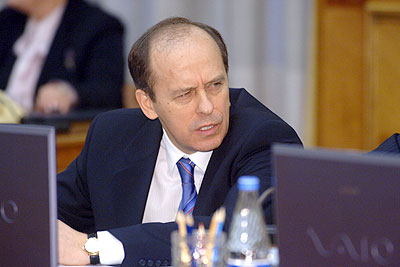
Alexander Bortnikov reported for the activities of the FSB for 12 months in full accordance with the traditions established by Nikolai Patrushev - two days before the day of the Chekist, in the presence of journalists, but without the right to ask questions.
Again, we heard statistics in the style of the FSB: according to Bortnikov, in 2008 the FSB stopped the activities of 48 personnel employees of foreign special services. This is almost twice as much as in the past - then only 22 employees stopped the activities (in 2006 - 27). What this means - improving the quality of counterintelligence under new leadership or increased attention of spies to Russian affairs - it is impossible to establish, since neither the names of agents, nor even the state they spied on, the FSB traditionally reports.
Bortnikov called the names of the spies of the agent network only one state - as it is easy to guess, Georgia. The director of the FSB again mentioned the Russian citizens of Bogdanov, Imdishvili, Kushashvili, Khachidze and Khachirov, who, according to the FSB, were recruited by Georgian intelligence. Georgian intelligence, of course, spies on the territory of neighboring countries - like any other intelligence. The FSB can only be congratulated if the special service managed to prevent the work of the agent spy network in the midst of a military conflict. In this case, the problem is that these names, including the surname of Herkeladze, the deputy chief of the special intelligence service of Georgia arrested by the FSB, were named in August this year.
Five months have passed since then. Recall that according to Russian legislation, the preliminary investigation period is two months, and even if it was extended, but time has passed enough to not repeat the information of five -month ago, but to report in which ships these cases are obeyed. Spying in favor of the state with which the country is in the stage of military conflict, of course, should be punished. That is why the FSB is obliged to inform which of the spies convicted, or at least at what stage the consideration of their cases in court is located. This is actually quite a common practice for the FSB. After all, nothing prevented Bortnikov, reporting on other counterintelligence affairs, to inform that under article 275 (Gosizman) in 2008, "convicted Alekseev, Starikov and Kritryuk."
And it’s not scary if the court has not yet issued his decision: the predecessor of Bortnikov Patrushev announced a year ago in the report for 2007, that in relation to the slick, the case was still listening to the Kaliningrad Regional Court (he was convicted only in 2008). Limited only to the repetition of his own August statement, Bortnikov put himself in an uncomfortable position, recalling the previous awkward statements of the Federal Security Service. The FSB already fell into a situation where, having reported a large counterintelligence success, she was subsequently forced to quietly hush up the scandal. Two years ago, in the spring of 2006, the FSB reported on the “spy stone” found, allegedly laid down by English intelligence officers to communicate with the Russian agent. Allegedly, because a few days later the Russian public reported that together with the stone, counterintelligence officers caught two Russian citizens, the trial of which was promised in the coming months. Two years have already passed, there were no ships, as the names of these citizens were not named.
Speaking about the fight against terrorism, Bortnikov also followed the road outlined by his predecessor six months ago. He said that in addition to 670 “militants” from the North Caucasus, whose criminal activity managed to stop, 23 members of the Khizb-Ut-Tahrir international terrorist organization were convicted. Last spring, Patrushev already called Hizb-Ut-Tahrir, or the Islamic Liberation Party, as the main threat to the Ural region of Russia, and since then, local FSB have been trying to discover members of this organization.
It should be noted that, despite the formidable name, “Hizb-Ut-Tahrir”, which declares its goal to build an Islamic caliphate peacefully in an unknown future, is not prohibited in Europe and even in the USA. Although this issue was considered after the attacks on September 11, but since there is no reliable information about the involvement of this organization in terrorism, it was left in the legal field, precisely in order not to radicalize its members. Russia did not listen to the West, but, on the contrary, at the request of the President of Uzbekistan Karimov, who was afraid of Hizb-Ut-Tahrir as its main political competitor, included it in the list of terrorist organizations. (Most of the supporters of the organization in our country are refugees from Uzbekistan.)
Therefore, now, in order to receive a charge of terrorism and forcibly seizure of power, it is enough to remove the forbidden literature of the party and two cartridges. In Russia, not a single terrorist attack was recorded committed by members of the Hizb-Ut-Tahrir, but the witch hunt continues. For example, when the UFSB officers in St. Petersburg announced the prevention of attempt on the governor Valentin Matvienko, arrested as killers of three young people were declared Islamic fanatics from Hizb-Uthtyrir. It soon became clear that the young men had nothing to do with this organization or attempt - they were justified by the jury by the jury.
However, judging by Bortnikov’s report, not everyone was so lucky. And he is unlikely to be lucky in the future - perhaps the main actual achievement of the FSB this year (which the director of the special services modestly silent) became amendments prohibiting the jurors of the jury of terrorism and espionage.