
Translated material
White mirror
This year, Colta.ru decided to go to the experiment and invited to temporary curators over the section “Photo projects” of young and talented representatives of leading Russian photocurium. We divided the calendar year between six curators and asked them to select the most interesting samples of modern Russian photography for publication.
Invited curators
Katerina Zueva , center of photography named after Brothers Lumier
Nadezhda Sheremetova , "Femicip"
Sergey Lostev , "House of Metenkov"
Daria Tuminas , Freelance Curator, Amsterdam
Anastasia Bogomolova , The Blog This a Photobook
Svetlana Taylor , British Higher School of Design

Fifth resident: Anastasia Bogomolova. An artist working with photography, installations and performance. The circle of close interests includes topics of the mobile nature of memory and oblivion, the boundaries of the existence of the archive and document, as well as issues of mythology and self -identity. Curator and lecturer; researcher, collector and author of the photo book; Flog editor This is a Photobook. Graduate of educational programs "Photode Department". Participant of Savignano Immagini Festival and Bitume Photofest (Italy), Pingyao International Photography Festival (China), OBSCURA Festival (Malaysia), “Fashion and Style in Photography” (Moscow), “Month of photography in Minsk” (Belarusian). The works were also presented as part of group projects in St. Petersburg, Moscow, Kaliningrad, Rostov-on-Don, Norilsk, Perm, Yekaterinburg, Kazan and other cities. Personal exhibitions were held in Moscow, Yekaterinburg, Nizhny Tagil and Chelyabinsk. Lives and works in the Urals.
Anastasia Bogomolova about photographs of Russian authors published abroad, and about the marvelous new world of Dmitry Lukyanov
Although the low-term samizdat remains a key component of the Russian photo book movement, in the past few years, domestic authors have been able to repeatedly attract the attention of the publishing field, ready to invest in a more or less large release. Not so much in the homeland, where only Treemedia Leonid Gusev (focusing on documentary), as primarily in Europe, works purposefully with this format.
In the focus of foreign publishers of a different scale-from small independent enterprises founded by a couple of people, to large representatives of the market with a greater reputation-photographers from Russia found themselves under various circumstances: participation in specialized competitions, festivals, fairs, portfolio-revolutions, online publications.
Olga Matveeva victory at Viennaphotobookaward In 2014 , she led to the emergence of Feud . A year earlier in the German Peperoni Books, an acute story of growing “ BE Happy ! " Igor an airplane, and an intimate diary of parting “ 25 Weeks of Winter » Katya Anokhina has become a distribution of 250 copies. Both author are graduates of the School Rodchenko. Both, preparing diploma projects, began work on the physical layouts of their photo books even at the master class of Hannes Vanderer, the holder of the mentioned publisher, who was invited by the educational institution to Moscow. When it became clear that the pilot circulation of their work brought to ViennaphotobookFestival in 2013 (several copies of “ BE Happy ! » Martin Parr acquired in his own collection), both almost simultaneously received a proposal for a full release under the Peperoni Books wing.
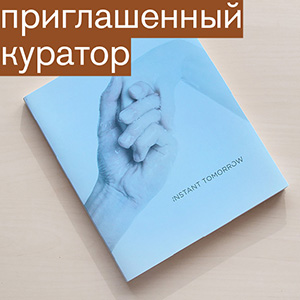
Vanderer subsequently continued to carry out workshop for students-todchenkovtsy, which strengthened the connection of his publishing house with Russian photography (the second such point of attraction for domestic authors- Dienacht Publinging , where the publications of Katya Anokhina, Tanya Cherkesan, Lilia Lili-Mi-Miyan and Vera Barcalova). In 2014, Peperoni released the noted on World Press Photo project " Escape " Danila Tkachenko, and in 2016-another initially thesis, " Instant Tomorrow » Dmitry Lukyanov .
With " BE Happy ! " And " 25 Weeks of Winter » Dima’s book is related not only by Peperoni Books , but also participation in the Vienna festival. In 2015, the photographer’s project took second place on Viennaphotobookaward , which, apparently, finally determined his publishing fate.
However, " Instant Tomorrow ” - not the first book of Lukyanov. Two years earlier, there was an independent “ DKDANCE ” , the pictures of which were methodically documented by employees, cultural figures and visitors of domestic recreation centers. The debut edition turned out to be an academic and ingenuous album. “Tomorrow” also seems to be a rather simple product, but the simplicity of its other kind, and, of course, in reality it hides multifaceted complexity.
In " Instant Tomorrow ” new buildings in the outskirts of Moscow (ordinary, boring, almost soulless, endless - in a word, typical) turn into a futuristic space, illuminated and consecrated by the radiance of gadgets - medical and cosmetological, communication and household. In the midst of these wires, devices, screens and baroacher, characters with practically erased identity (sometimes literally hiding behind masks) live, sterile, like their interiors. By operating with the modern material of the sleeping areas of the capital, the photographer constructs the appearance of a utopian future in which a person closed in his home, as if in a space capsule, equip his own everyday life with numerous technical devices, but in fact it becomes their spare part, or even merges with them.
The ambiguity of the inhabited vacuum is discovered gradually, step by step, a U -turn behind a turn. The emasculated interiors betray themselves with cracks, snow -white exteriors - anxious black smoke on the horizon, and the tension in the body of the heroes of photographs - with vertebrae cutting out human backs, irritated to the blood of the skin and a crap on the back of the crawling baby. The insignificant details violating ideal purity turn this paradise into anti-utopian space, into an alternative reality of the Charlie-Bruker “black mirror”, but more aesthetic.
In an amazing way, such anxiety breaking through the photos is reinforced in “ Instant TOMORROW » empty sections in the design of the publication. Starting from the classic samples of the genre of the late 1930s, white pages were used in a photographic design as a tool for forming the rhythm of the narrative and at the same time as a means that creates the conditional isolation of a separate image from personnel on other reversal. But in the work of Lukyanov, such voids are as if part of the author’s visual style, which continues his pictures, which enters into dialogue with them and emphasizes a conceptual statement. In this sense, the sewn binding that is cutting out the snow -white plane resonates with the leitmotif of a crack, a hidden error that permeates the entire project.
The conciseness of the visual language and the design in the publication of Dmitry Lukyanov is also enhanced by the laconicity of the verbal. With the exception of the name, a comment on the place of shooting (no details - only a time period and a vague formulation about the outskirts of Moscow are indicated) and codes with the phrase “ The Future Sure is Tense ” , the book no longer has texts. "Tomorrow" is open to the decoding, despite the demonstrative preservation of the images of the project.
In the final of the Instant Tomorrow, two U -turning views appear. On one, the sunset sun illuminates the parking lot in front of the hypermarket, on the other a female figure hid at the door, as if she listened to what was happening behind it. Maybe it is bombarded with tomorrow, not yet assuming that he is already here.