
Translated material
Demolishing institutions of power
Senator Narusova did not keep up with colleagues. Whether the followers will appear ...
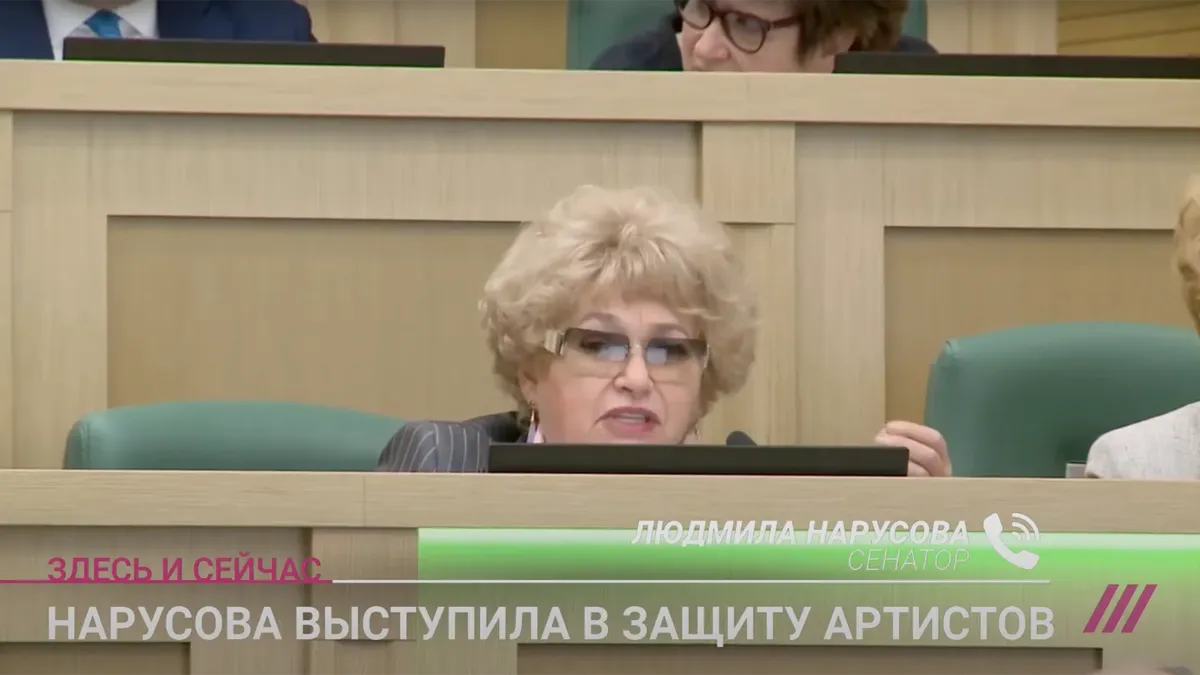
In the evening broadcast of the Rain television channel* on February 23, Senator Lyudmila Narusova told why on the eve she opposed the Federation Council against stigmatization for political motives of Leah Akhedzhakova and other cultural figures. The first place here should be put the performance not in the Council of the Federation, but on the "rain" recognized by a foreign agent in 2021: from the point of view of the Kremlin, this is a more daring act.
Narusova is quite consistent in her votes in the Senate. She refrained in the approval of amendments to the Constitution in 2020, explaining the refusal to vote against the fact that they were approved by popular vote; refused to support the use of the Armed Forces of the Russian Federation in the self -proclaimed republics in February 2022; In September, she voted against amendments regarding partial mobilization; In October, she publicly stated that she abstained from voting for the accession of territories to the Russian Federation, which, according to international law, are considered Ukraine, although the scoreboard showed that the “pros” was filed all 153 votes of the present senators.
Narusova verifies his line very carefully: so, calling for compliance with the norms of the constitution at the last meeting, she relied on quite general words about the rights of a person from the presidential message, released the day before - -
Exactly as during the Soviet regime, risky, but not going beyond certain boundaries, public performances were necessarily sentenced by references to the materials of party congresses.
The requirement to comply with its own constitution in the 70s and 80s of the last century was the slogan of Soviet dissidents, for which they were sent to prisons, a link and psychiatric hospitals. The next 30–35 years about human rights could be talked without risk, but today only one who is potentially ready to accompany their statements by a dick of a foreign agent can afford it today.
It is easy to argue that, showing the Kremlin Kukish a hand slightly pulled out of his pocket, Narusov “does not risk anything”, but saves himself from falling under Western sanctions. The status of the widow of Anatoly Sobchak and personal relations with his former assistant Vladimir Putin, of course, leave her a great degree of freedom compared to other actors of the political scene. However, the question is deeper than purely technical - it concerns the long -standing Russian dilemma about the relations of the intelligentsia (intellectuals) and authoritarian power: to what borders such cooperation is possible and at what point it turns into consonance and meanness.
Today, Narusova, in fact, alone occupied the niche, which, before the resignation of Mikhail Fedotov, filled the Council under the President of the Human Rights, and if anyone has motives to sincerely wish her, this is the current composition of the HRC. But you have to pay for all freedom, and it is hardly fair to say that the senator from the Republic of Tuva does not risk anything - it can easily lose the status of a member of the Federation Council, but, apparently, this seems to her a proportionate fee for preserving her face.
The symbolic so far the value of the Blushing of Narusova is a demonstration of what is so possible: to other senators, and deputies, and-scary to say-judges.
In theory, such democratic institutions frozen by authoritarianism are called “dormant”-that is, preserving the opportunity to wake up at some point. In this sense, Narusov, leaving her motives, known only to herself behind the brackets, is the first swallow. Many colleagues are probably already weighing potential pros and cons of the same neat turn towards the Constitution and Rule of Law, and their ratio is changing all the time.