
Translated material
In cramped, but not offense
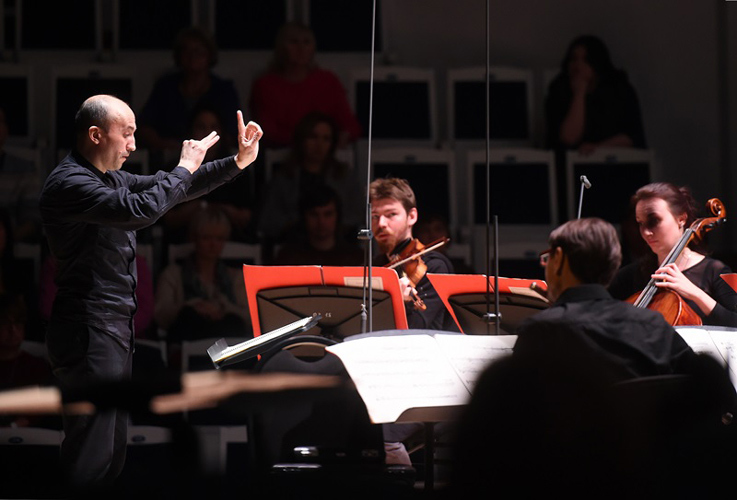
The VI festival “Another Space”, the marathon of new music and the new audience, with honor, surrounded by Moscow Philharmonic, ended. 12 programs for 5 days, perfectly organized direct broadcasts (all of them are available here ), an intelligent booklet, a tireless presenter, youth composer competition , democratic prices, skilled PR and patient midnight wardrobes.
The genre of this forum - the festival of relevant music - allows a wide palette of interpretations. For some, relevance is an effectively tailored “ de Profundis ” (2015) Alexei Retinsky (one of the winners of the competition and generally a new favorite among composer youth). Someone is nicer to the barefoot superstar of the festival Patricia Kopachinskaya , bravely overcoming the long, bright and exhausting path of the violin concert (2004) Faraja Karaev . Someone comprehends eternity with the help of the irreconcilable static constructions of “Christmas music” by Vladimir Martynov (a new version of the 1976 composition with the addition of the author of the author). And someone after a night concert is pumping an endless “spell 4” (1987-1990) to his phone Simeona Ten Holt and recalls the four heroes-pianists-Alexei Lyubimov, Yerun Van Vienn, Alexei Zuev, Vladimir Ivanov-Rakievsky.
Tchaikovsky’s hall, in which the main part of the events takes place (day concerts are placed in the chamber hall on the ground floor), is large, not filled, but many of those who came are a new audience, not traditionally Philharmonic. Sometimes - club, sometimes - enlightened, sometimes - just inquisitive. And sometimes it seems that the whole union of composers moved here, who finally woke up and passed the motivation training. In the “other space”, many different spaces are very consciously and competently combined - style, generation, and mental. And this is his absolute uniqueness.
At the same time, the grandeur of the final point of the festival was probably obvious to everyone. For the first time in Russia, the “acoustic spaces” of Gerard Grise were performed, requiring good brains from the musicians, from the audience - open ears, and from the organizers - large organizational talents. Six plays included in the cycle were created between 1974 and 1985. This composition is already a classic of the French spectral school, no matter how frightening its name for ordinary music lovers. In order to reproduce all these fantastic extras, which were originally calculated using computer programs, breathing in their strange life, unexpectedly folding into almost familiar chords or, conversely, growing into huge and inexplicable sparkling spheres, the artistic director of the festival Vladimir Yurovsky needed to gather in one team the rival ensembles of Moscow. The gam-antensemble was replaced by the Studio of New Music, the TU, in turn, is the Moscow ensemble of modern music and the state order. A series of conductors, ending with Yurovsky, consisted of Oleg Piberdin, Igor Dronov and Fedor Lednev. The most difficult solo party of Alta, a little giving the human dimension, replenished the collection of new scores of Maxim Rysanov .
Together with the teams of Philip Chizhevsky and Tatyana Grindenko, who participated in the festival, as well as the touching children's chorus named after Popov, who came to the Martynovsky kilometer, the picture of the unity of Moscow performers of modern music around the Yurovsky figure becomes even more impressive. The strong regional component was added by the Novosibirsk ensemble "Laboratory of New Music" under the direction of Sergei Shebalin, who came to show the documentary video operator Steve Reich and Beryl short "Three Stories". And the international charm is the German ensemble Unitedberlin , which, however, was lost with his discreet program among the local tectonic shifts.
Subscribe to the COLTA.RU channel in Yandex.Zen to miss nothing