
Translated material
Maxim Russo: Nervous Grebneviks
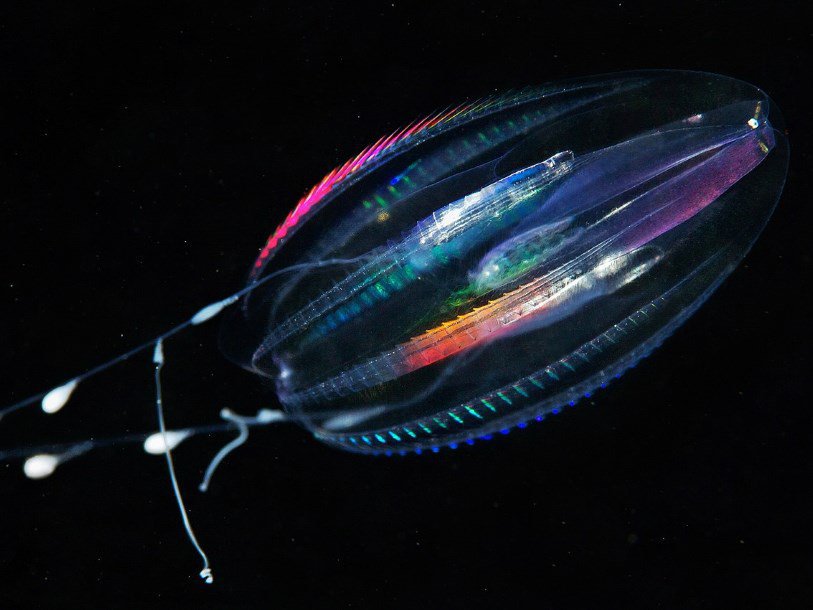
Maxim Russo 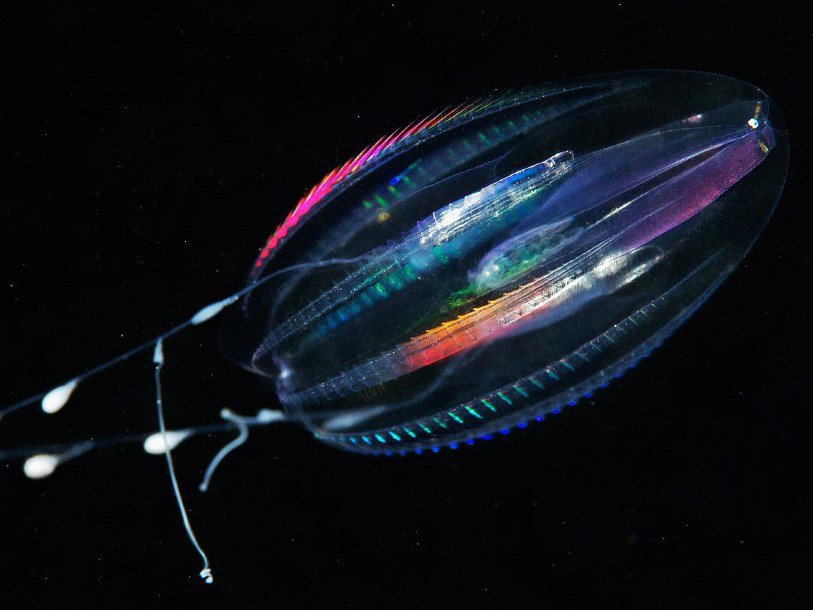 Grebnevik Alexander Semenov
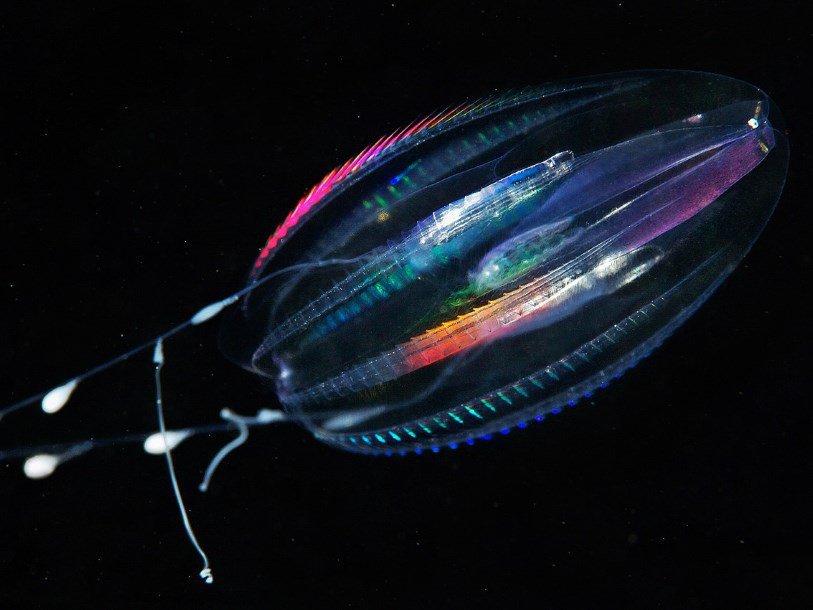 Grebnevik Alexander Semenov
The latest study gave scientists strong arguments in favor of the fact that the nerve cells of the Grebneviks ( Cenophora ) come from the same ancestors as the nerve systems of all other types of animals, and hesitated several years ago the hypothesis about the independent occurrence of the nervous system of the Grebneviks.
Grebneviks are a special type of animal. These are translucent, gelatinous creatures from a few millimeters to one and a half meters, floating in sea waters. Outwardly, they partly resemble jellyfish. Like jellyfish, a significant part of the internal volume of the body of the crests consists of a mesogle, jelly -like fabric, which plays the role of an elastic skeleton. At one end of the rounded body is a mouth. On the surface of the body there are eight rows of plates (crests) consisting of merged cilia. The plates are beaten on the water, allowing the Grebnevik to move forward. Most Grebneviks also have a pair of tentacles intended for fishing.
Modern systematists consider the Grebneviks a “nursing taxon” in relation to all other types of animals, that is, the Grebneviks had separated from the common ancestor of the animals earlier.
Grebneviks have a nervous system consisting of a network of nerve cells, the nerve ring around the mouth and an abortion organ - the accumulation of cells responsible for the intensity and synchronization of the work of the rowing records and playing the role of the equilibrium.
In 2013, scientists analyzed the genuine -bachesia bacheli -bacheli -bacheli -bachelor grab and found that he did not have many genes active in the nervous system of most animals. So, the Grebneviks had only four types of HOX Genes that control the development of different body systems by turning and turning off other genes. Whereas, for example, mammals have 48 types of such genes.
Pleurobrachia Bachei. Photo: Marine Genomics/Flickr
The Genes did not have an important neurotransmitter serotonin. This discovery led researchers to the assumption that the Grebneviks acquired the nervous system, regardless of all other animals. But many surprised how such a complex object as nerve cells could arise twice.
Now in a new study, arguments are given in favor of the fact that the first nerve cells still appeared at the common ancestor of the Grebneviks and other animals. And the predecessors of these nerve cells were secretory cells, the main function of which was the release of chemicals in the external environment. Similar cells (they are called colloblasts ) have rowers and play an important role in their lives.
Colloblasts cover the surface of the tentacles of the crest. Under a microscope, these cells resemble raspberry berries - on the outer surface there is an accumulation of granules with an adhesive substance. Inside, this "raspberries" are fixed in the mesogle using a spiral thread. When the prey sticks to the colloblast, the granules of granules easily breaks away from the surface, but the spiral thread firmly holds it and, due to its elasticity, softens the jerks of the caught animal. Then the Grebnevik pulls the tentacles to his mouth and eats prey.
Joseph Ryan computing evolutionary biology, Whitney University of Florida, and his employee Leslie Babonis, studied colloblasts, tracking the development of individual cells in the germs of the combs and analyzing the activity of the genes of each cell. Babonis detects that colloblasts arise from the same predecessor cells as the nerve cells of the animal. These unexpected results were published at the end of August 2018 in Molecular Biology and Evolution.
Now, at the annual conference of the Society of Integrative and Comparative Biology (SICB), Joseph Ryan and his employees outlined the overall concept of the origin of the nervous system of the Grebneviks and the stinging (Medus and polyps). They indicated that 25 years ago it was discovered that the stinging cells of jellyfish, which are a different type of secretory cells, come from the same embryonic predecessors as the nerve cells. Ryan cited similar evidence for hydra for fruit fly. The general origin of nerve and secretory cells seems quite likely to researchers. “The relatively simple reprogramming of stem cells during development can lead to completely new types of cells and tissues, and the nervous system is likely to serve as another example of this,” comments the result of the study by the neurobiologist Timothy Jegla from the University of Pennsylvania.
Timothy Jela himself, together with a group of colleagues, also found arguments in favor of the early occurrence of the nervous system, exploring the evolution of potassium canals - proteins that play an important role in the nervous system of animals. They found that all the proteins of potassium channels were available among the common ancestors of the stinging and other animals, with the exception of the Grebneviks, but one protein, called Shaker, arose already among the Grebneviks. From this, scientists concluded that the common ancestor of the Grebneviks, striking and bilateral-symmetric, had the rudimentary forms of the nervous system. Subsequently, the development of nerve systems in Grebneviks and all the others went in different ways, and after evolutionary parting with the Grebneviks, the common ancestors of the stinging and bilateral-symmetric have acquired the entire spectrum of potassium channels. Read more about this study in a separate essay .
Now Ryan, Babonis and their colleague neurophysiologist Yuriy Bobkov plan to determine how predecessor cells turn into neurons. To do this, they intend to study the primitive sensory organ of the Grebnevik Mnemiopsis Leidyi . This animal has accumulations of approximately 500 neurons and muscle cells that respond to light, fish smell and mechanical stimuli. When removing these organs, they regenerate, which makes it possible to track genetic activity as the cells are divided and specialized. Ryan hopes that he and his colleagues will be able to establish which genes control the formation of nerve cells, and this will help to answer complex questions about the general evolution of the nervous system of animals.
See also: Alexandra Bruther Evolution of the nervous system