
Translated material
In antiphase
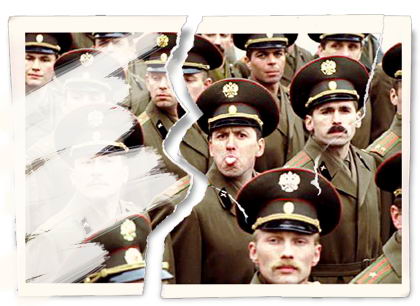
In almost every newspaper articles on the latest decisions of the Minister of Defense Anatoly Serdyukov, the word “reform” is repeated endlessly. But if we limit ourselves to only the statement of measures, even if the measures of extremely radical, by reducing the number of officers corps (from 355 thousand to 150), military units (in the Ground Forces from 1890 units and formations to 172, in the Air Force - from 240 to 120, in the Navy - from 240 to 123), military universities (from 65 to 10) - this can hardly be called the real reform.
In the end, the reduction and abruptly happened in the history of our armed forces. Let us recall at least how Khrushchev reduced the army by a million two hundred thousand people - of which half a million officers. But at the same time, the armed forces did not cease to be a mass mobilization army of the era of World War II. Actually, such a Russian army, despite the reductions, remained to this day.
Having concentrated on the story of the upcoming abbreviations that should end by 2012, Anatoly Serdyukov said almost nothing about possible qualitative changes. Without cardinal changes, the army bureaucracy will quickly restore lost positions.
Let us try to analyze the data on the upcoming abbreviations of the officer corps from this point of view. It is remarkable that the military department decided to finally change the crazy situation when one officer had two soldiers, and only two times less colonels than lieutenants. Therefore, the number of colonels is supposed to be reduced by almost three times (from 25 thousand to 9), and Mayors are four times (from 100 thousand to 25 thousand). At the same time, the number of lieutenants should even increase (from 50 to 60 thousand). This is quite natural when you consider that the minister decided to eliminate the cropped military units and military "offices", which have no number.
However, obvious problems are visible here. If out of 205 thousand reduced deducting the “two-year-olds”, as well as those, he served the due terms and must be dismissed with the corresponding benefits, there are still 117 thousand underforers who served 10-15 years. If you do everything according to the law, then they will have to dismiss them under the article “Organizing events”, which will require the payment of a lump -sum allowance in rather large sizes, and, most importantly, the provision of housing. Like it, it will require huge financial resources. Serdyukov only says that he will be given the opportunity to occupy civil positions and pass retraining. It is not a fact that in the conditions of an economic crisis, these people will find appropriate income on a “citizen”. And one hundred thousand 30-40-year-old men, angry into power-a rather powerful explosive material. Analogies with the Weimar Republic are obvious.
But the main thing is not even that. Until recently, the excessive number of senior officers, as well as the presence of cropped units, was explained by the very nature of our armed forces. It was supposed to reflect a military threat through mass mobilization. And just in peacetime, the officers should take under their team the regiments and divisions of reservists, which will receive equipment and weapons from the warehouses of the cropped units. Obviously, the mass reduction of the officer corps means the end of the concept of mass mobilization. Moreover, it has just been announced that the General Staff intends to introduce a voluntary paid service for those who want to be reservists. Thus, the most important argument of the supporters of the draft army was rejected, who claimed that it gave military training to the entire male population of the country, which allowed the General Stans, in turn, to consider all Russian men a prepared reserve.
However, with the help of simple arithmetic calculations, it turns out that about 550 thousand draftees should serve in the “new” Russian army. Moreover, all parts and formations will go into the category of constant readiness, which, in theory, implies readiness for immediate actions. It turns out that many of these formations will be formed from the soldiers. For six months, they will receive some training in training, and then for another six months they will serve in parts of constant readiness. It remains only to guess what kind of readiness will be in parts where half of the personnel changes every six months. It should also be taken into account that by 2012 (it is by this time that the reduction should be completed) the number of boys who have reached the age of 18 will actually be equal to the necessary number of army of conscripts. If in fact there was a rejection of the mass mobilization army, then the call loses all meaning. And I do not exclude that mass abbreviations of officers occur before a mass reduction in the draft. It is clear that there is no question of any million army in this case.
The decisions related to the structure of the command and the organization of the armed forces are equally contradictory. You can only welcome the reduction of the half of the Arbat Military District: the Ministry of Defense, the General Staff, and other military administrations. However, the phrase of the minister remains a mystery that their functions and tasks will remain unchanged. If so, even if the declared reduction is produced, quite soon the number of officers will increase again.
The same story with the transition from the four -level system of organizing the Armed Forces (military district - army - division - regiment) to a third -level one. The military districts will remain, but in return for the armies and divisions there will be operational commands and brigades. The transition from divisions and regiments to brigades is understandable. In local conflicts, a brigade with appropriate means of strengthening is more effective than a division with its bulky organizational structure. But the operational command should be created only if it combines the forces of different types and childbirths of the Armed Forces. Now this happens at the level of the military district. As a result, inevitably duplication of functions. And this despite the fact that the number of subordinate parts and compounds will radically decrease.
If we take into account that with such mass reduction of the officer corps, the number of general posts was reduced by only 20 percent, it turns out that the reductions are more radical, the less they touch the direct personal interests of the highest command personnel. For generals, both titles and positions are preserved. It can be assumed that all this is done in order to at least at first reduce the resistance of the general. However, the experience of previous reform attempts shows: army chiefs are well able to turn compromises in their favor, nullifying the entire reformist impulse.
So far, you can state: the general plan of reforms (if any exists) is not completely clear. Dramatic abbreviations of numbers undermine the idea of a mass mobilization army, but there is no open refusal of it. In this case, Russia can receive a decreased by five times and an absolutely non -working copy of the Soviet Army.
Finally, it is completely incomprehensible where, in the conditions of a worsening economic situation, there will be simultaneously money for large-scale organizational measures and for crazy plans for the construction of aircraft carriers, an underwater fleet, a 5th generation aircraft, aerospace defense, etc. It seems that military planning is in antiphase - some ideas clearly contradict others.