
Translated material
A traitor or a patriot?
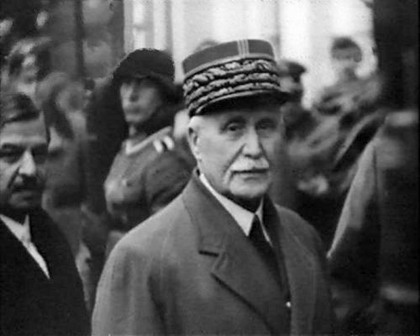
Working on the publication of the material about Marshal Philippe Peten, in connection with the sixtieth anniversary of his death, I came across the modern site of his supporters. In French, German and English, the “fans” of Peten are trying to prove that he was and remains, first of all, a true patriot. For them, there is no doubt about his honesty and devotion to national interests. They are sure that if Charles de Gaulle saved the honor of France, then Philip Peten is France itself.
Having achieved relatively mild conditions of a truce with Germany, Peten created a government with the capital in the city of Vichy in a neocup zone in the south of the country. And it was from there on October 30, 1940 that he urged the French to cooperate with the Germans. From this moment, the word "collaboration" began to denote cooperation with the enemy. And no matter how pragmatic, patriotic motives would be explained by the supporters of Peten's forced decision, this word still remained the stigma of the traitor and accomplice of the Nazis.
True, I must say that there were a lot of collaborators in France, and they did not feel at all traitors. On the contrary, many considered themselves true patriots who pacified pride and found the courage to serve France in any, even the most desperate conditions.
The discussion of collaborations does not stop in France for the entire post -war period. This is in our country a view of it is unambiguous and purely negative. Everyone who collaborated with the Nazis, invaders, no matter what reasons they proceed are accomplices of the enemy, traitors of the homeland. For most of our people, the discussion about Vlasov and Vlasovites is offensive and provocative. Like an attempt to understand the actions of those Ukrainians, Latvians and Estonians who entered the German army to combat the Soviets.
It's hard for me to accept it. These people killed those on whose side my relatives fought, they participated in the Holocaust. And to abstract from this, having gone into a purely “speculative” conversation, it will not work.
On the other hand, as the Polish population of Western Ukraine and Belarus should have been called by those who collaborated with the Soviet regime that came here in 1939 on the bayonets of the Red Army? .. Of course, there is a certain difference between Nazism and the Stalinist government, but you will try to explain it to the descendants of thousands of deported Baltic ends or executed Poles in Katyn.
An explanation is not an excuse. And that one or another concept is interpreted incorrectly, it does not follow that the bearer of evil deserves understanding as condescension. What can serve as an evil criterion? The death of innocent people.
And the same Vichy regime, created by Peten in the unoccupied territory of France, is guilty of crimes against his citizens. In total, over the years of occupation, 600 thousand Frenchmen were arrested. A special share went to French Jews.
In general, many European Jewish refugees accumulated on the territory of the pre-war France, mainly German, there were Italians and Spaniards. After the defeat of France, many of them moved to the neocked zone in the hope that it would be easier for them there. But hope was illusory.
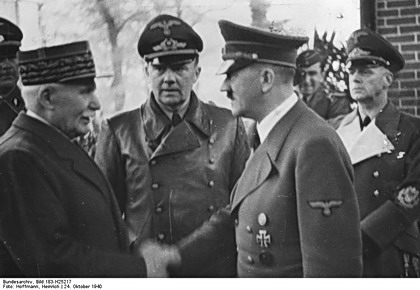
On July 22, 1940, the Peten government adopted the law on French citizenship, according to which the Jews were supposed to leave the city of Vichy and its environs. On October 3 of the same year, the status of Jews was adopted, distinguishing them in a separate category of citizens and striking in a number of rights. And since March 1941, the affairs of the Jews in the unoccupied territory of France began specially engaged in the general commissariat on the Jewish issue, which worked in close contact with the German security service created by this time.
Ultimately, especially after January 1942, when the Nazis made the “final decision” on the Jewish issue and dusted the Auschwitz oven, the position of Jews in the territory of Free France became as tragic as on the occupied. At first, the Vichy government gave the Germans to the emigrant Jews, then a sad fate befell most of the other Jewish population of France.
According to incomplete data, of the 350 thousand Jews living in France in 1939, 150 thousand Jews were taken to concentration camps, including 20 thousand children. After the release, about 3 thousand people returned - the rest died. The Jews who escaped the fate of the arrested partially managed to emigrate, someone was saved by the French, the rest fought in the ranks of resistance.
In all repressions against French Jews and resistance members, 32 thousand French policemen who worked on the principles of the Gestapo and closely cooperating with it played an active role.
Another crime of the collaborationist regime of Vichy was to send many thousands of French to work in Germany. And no matter how much Peten tried to make a “good mine”, explaining to his fellow citizens that this is the “voluntary migration” of the French in search of work and earnings, it was clear to everyone that this was a violent action. At the same time, those former prisoners of war that Peten was able to rescue from captivity fell into the category of these workers - which was always proud of and put himself in merit.
The process over Peten took place on July 23, 1945, almost five children later after he called on the French to cooperate with the Germans. The leitmotif of all the performances of the dictator of Vichy on the process was reduced to the thesis that France was saving cooperation with the occupation forces. “The power entrusted to me by the French people,” Marshal said with Paphos, “was recognized by all the countries of the world - from the Holy Thron to the Soviet Union. And he continued: “At the time when General de Gaulle waged a struggle outside the homeland, I also cleared the path to liberation ... If I had not preserved France, there would be nothing to free her ruins and cemeteries.”
Peten asked not to repress those who correctly served him, Marshal of France. But he did not ask himself a pardon.
Nevertheless, the court did not take pity on either his associates or over him. As noted by the leading specialist in the history of collaboration, Mikhail Semiryaga, it is difficult to determine the total number of repressed. According to official figures, only in 1945, during the cleaning of the state apparatus, 40 thousand collaborators were repressed, 2 thousand were executed. But it must be borne in mind that “cleaning” continued in subsequent years, moreover, many were spontaneously executed, many ended with suicide. Some historians argue that during the “purges”, one way or another, from 500 thousand to 2 million people suffered. True, an amnesty soon began - the French authorities wanted to quickly forget the tragedy of betrayal and shame and unite the nation. By January 1, 1947, 20 thousand collaborators remained in French prisons, by 1956 - 60 people. Nevertheless, several more of them were executed.
So, the court, despite all the patriotic argument, the Marshal’s military merits before the country, the sympathy for him of many Frenchmen and advanced age (89 years), sentenced Peten a death sentence. And only de Gaulle pardoned him, replacing his death penalty with life imprisonment. In the fortress where he was concluded, he stayed for six years, after which he was transferred to a civil hospital for health reasons, where he died. Peten was buried on the same island, where he was serving a conclusion.
During the war years, Peten received from some compatriots a shameful nickname Puten (Putain - whore). Others practically deified him, respectfully calling "our marshal." For some, the name of Peten became a symbol of betrayal, for others - a true patriot.
When he was convicted, he, nevertheless, was not deprived of the Marshal's wand, and the place of the Academy member remained unlucky.
In 1966, when France celebrated the 50th anniversary of the Verdensky battle, de Gaulle, who was then the president of France, ordered to be laid on the grave of Peten, the Hero of Verden, flowers. Since the mid-70s, this tradition has become annual.
Does this mean that the French pay tribute to the personality of man, the hero of the First World War, and not his collaborationism? Or, nevertheless, collaboration, not directly related to the ideas and practice of fascism, can be justified and even erected into a possible alternative to patriotic behavior? .. Questions that history does not give fundamental answers. It is generally not so much fundamental as it is capricious. The fact remains, and the interpretations are changing. From enlightenment of people to clouding their mind sometimes one step. The road back is much more difficult and longer.
For example, 20 years ago, the heads of the State Emergency Committee were convicted as putschists and state criminals, and today for many they are already heroes, and Gorbachev is a traitor. Two and a half years after the August events of 1991, the new White House defenders turned out to be rebels, and now they are increasingly called criminals those who stopped them then ...