
Translated material
Interview: Features of Online Fundraising wwf Russia
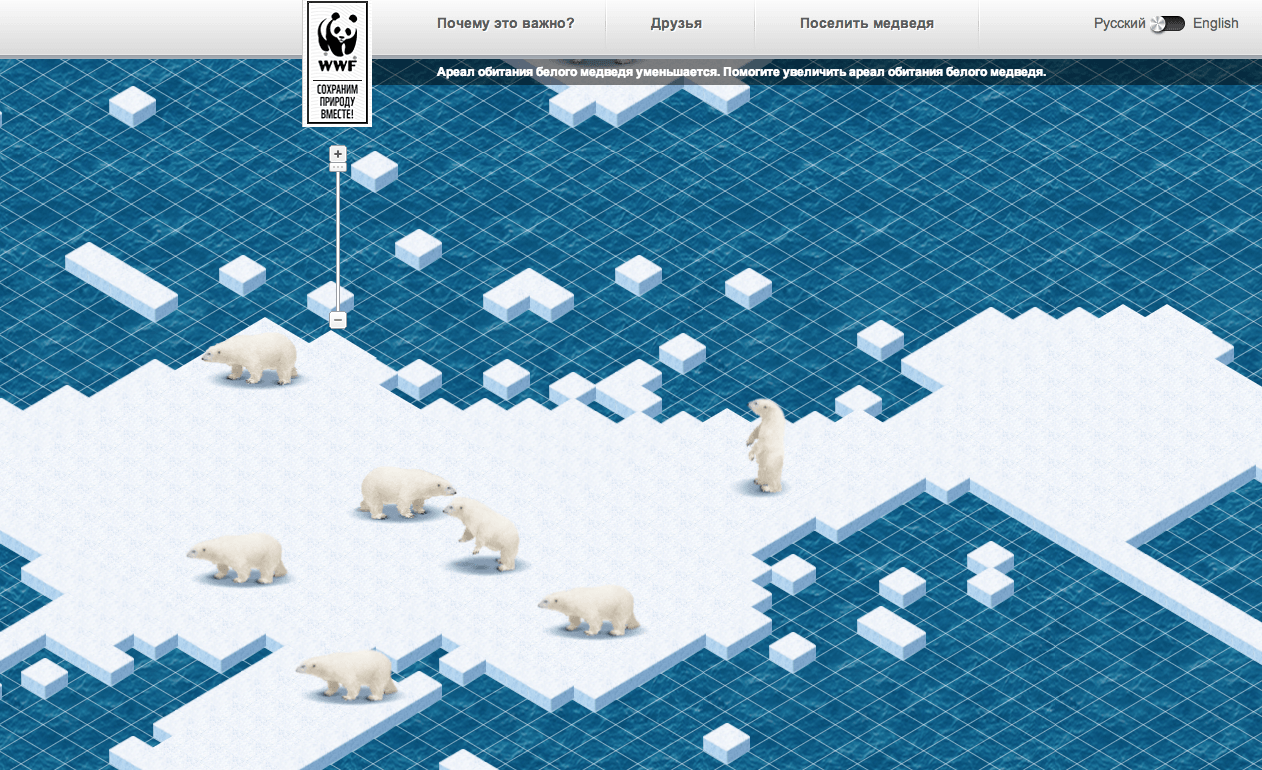
In an interview with the greenhouse of social technologies, the head of the WWF website, Alexander Evgrafov, spoke about the communication channels priority for the fund, and why inappropriate donations are of particular interest to the organization.
Interviewed by Evgeny Voropay. May 2013.
E.V: How important is the presence of the network for WWF Russia, which communication channels are priority for today? In the absence of practical functionality for users or any services, the site is more reminiscent of the supporting information site.
A.E. : This is the subject of the constant struggle between the environmental department, which is engaged in the information component, and the marketing department, which is responsible for the implementation of campaigns, raising funds, etc.
For the fund as a whole, it is impossible to single out obvious priorities in the communication channels-we will use all directions as our own possibilities: printed and electronic media, radio, tv, and, of course, Internet-social networks, mailings, online campaigns.
As for priority channels for communication with private supporters, this is certainly an e-mail newsletter. Of course, it does not fall into the sight of visitors to the site. We regularly make a newsletter on our contact database. At this stage, for us it is the most effective of communication methods. Usually, in WWF newsletters, Russia appeals to users with a request to support a particular campaign.
E.V.: There was a period when laconicism is presented, minimalism in the design was a trend in Runet. Now we have returned to resources with voluminous texts and a large number of numbers again. The WWF Russia site is no exception. Is it not difficult for the user to find the campaigns themselves for this array of information?
A.E.: I think it's hard. Of course, you need to do it easier. But when WWF Russia holds campaigns, we display information about them to the main page of the site. For the current period, there are no active campaigns, therefore, the site has general information about the work of wwf Russia.
Another thing is a constant collection of funds. We are a fundraising organization, and exist on donations. Constant fundraising cannot be considered a campaign.
An important task for us today is to add to our image a large and successful organization also that we need donations.
This is what should be on all pages of our site. On such soil, the support of specific campaigns, and just fundraising will be easier.
E.V.: In WWF Russia, Russia uses fundraising, less often crowdfunding. Is the target collection of funds fundamentally important for the fund?
A.E.: Of course, for us it is a priority to collect inappropriate donations. If a supporter wants to help white bears or tigers, his products will only go to these campaigns. They simply cannot be used differently. And if specifically now in the Tigrine program, all activity is covered with a budget, but urgently need money to fight with, say, forest fires? There is also an accounting department - to track the movement of the amount for a specific goal and then it is also worth the money. This is a problem of targeted means, and, roughly speaking, they make sense if we are talking about large volumes and more or less planned (like our partnerships with companies, for example).
A private fundraising for WWF is inappropriate money. Of course, inappropriate donations are more difficult to collect. But to convince people to “support the organization’s work”, from the point of view of Fandraizing, it is easier than gathering on specific boots to the inspector of the reserve. Money "to work" is for boots too. But not only. I must say that, to our joy, people understand this more and more.
Well, crowdfunding is a target collection of funds, but WWF has this a little more complicated. We tried to do some stories, but so far we have not found the best option for working with this tool. Our projects are quite bulky, long and it is difficult for us to tell about them in the format of crowdfunding sites.
For example, it is very difficult to raise money in principle in principle in principle for any educational program for customs officers, according to the results of which they can distinguish the bones of the dogs from tiger bones. While such a program is valid, customs officers support a certain level of knowledge, if you close it, the skill will be very quickly lost. Here you need constant financing. This is not a crowdfunding story at all.
E.V: Continuing the theme of targeted donation: in the West, donations are an element of culture. It is important for people what they give money for, and how they do it. Is the fact that the fact of help is important for Russians or users still pay attention to the campaign?
A.E.: Russia is at the stage of development. We are a little behind the West in this matter. The Russians still have other things in priority. So far, the culture of donations is not formed at all levels, it is early to talk about conscious, targeted donations at the mass level.
Misunderstanding, distrust and indifference are the most common reactions even among highly educated and wealthy people.
E.V.: On Mitapa, the greenhouses were discussed that the fund has an internal division of users into supporters and sypatayzers. Although, in my opinion, there are quite tangible and external manifestations - all kinds of insignia and encouragement are available for supporters, depending on the campaign that the user supports. Are there any other differences between these categories of users?
A.E.: Indeed, we call supporters those who donate money to the fund, the rest of the users are sympathy. The minimum contribution of the supporter today is 900 rubles per year. We still have such a category as “donors”. These are users who transfer funds, but in the amount of these donations it is not enough to go to the category of supporters.
Sympatyers provide the fund public support. These people put electronic signatures under our documents or requests, are interested in the activities of WWF Russia.
We try to transfer sympathizers into the category of supporters - both public and financial support is important to us.
E.V: Many environmental organizations have active supporters who equally lively react to any changes in situations in Online and Offline - these people are ready to go out with demonstrations, organize the collection of electronic signatures. Around WWF Russia has already managed to form such a community of people?
A.E.: I do not presume to name the exact numbers, but I think that we can talk about such a community around WWF Russia. There is a certain backbone, people who have long supported our initiatives financially, participate in most actions, come to our meetings. Mostly, of course, Muscovites. They attend most of our events.
Often on wwf Russia's shares you can meet familiar faces. Of course, new people join us - and for us an increase in the number of supporters is the main task. Sometimes supporters even accidentally meet each other (for example, turn out to be neighbors on the entrance). We really love such stories. This means that we are more and more.
E.V: We all know about SEO, selling texts, etc. Tell me, are there any similar techniques for drawing up descriptions of campaigns, requests for donations?
A.E.: As already mentioned, our main channel is a newsletter. Of course, when compiling them, we try to take into account all the moments - both our past experience and classics from “Correct Books”. The state has people who are doing this. In addition, we constantly improve all the elements of the newsletter, test them. This applies to the color of the buttons, the sums of donations, positioning them in the text, the time of mailing. Our foreign colleagues are very strong in this.
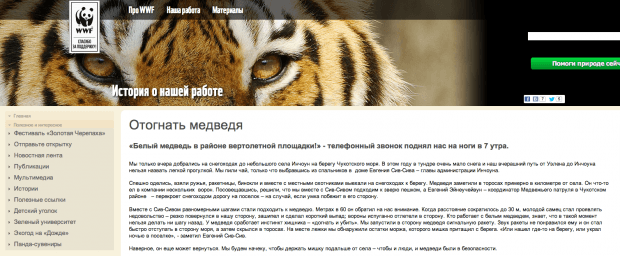
We have such a term “eye -meal megafauna” in our fund. Simply put - a large beast looking at the user. If in the text of a photograph of a person who removes dirt, this is not so emotionally charged as a picture of a tiger, pandas, or even a walrus. A larger number of users will react to a letter with such a picture.
E.V: Most WWF Russia campaigns can be divided into target (short -term) and thematic (permanent). Do they somehow differ in methods of conducting? Why cannot target programs be organized as part of thematic?
A.E.: Your classification is erroneous. The fund has six strategic directions (thematic, we can say) around which all our activities are built. These are the pillars on which the news is wwf. As for campaigns, these are, first of all, fundraising stories. Campaigns are not fundraising, for example, we collect signatures to promote some law. But this is also in the framework of the strategic direction. The main goal of fundraining campaigns is to attract funds to finance strategic directions. All of them are limited in time, because the campaign cannot be long and even more unlimited, it is by definition of the campaign.
E.V: Decree of the President of Russia 2013 was declared the Environmental Protection Year, what plans and expectations of WWF Russia are connected with this?
A.E.: It is too early to say something here. At the end of 2012, we prepared a large document in which all our proposals have fallen, that the state should make the environment a year. It would be more correct to talk about the results by the end of the year, but for now we got only to the summer. At the state level, there are a lot of proposals for real environmental activities, but what will be possible of this will tell.