
Translated material
The economy of half -life
Why the development bank was on the verge of bankruptcy, which was saddened by the Minister of Finance and, as Putin, confirmed that the script of a miraculous exit from the crisis does not exist
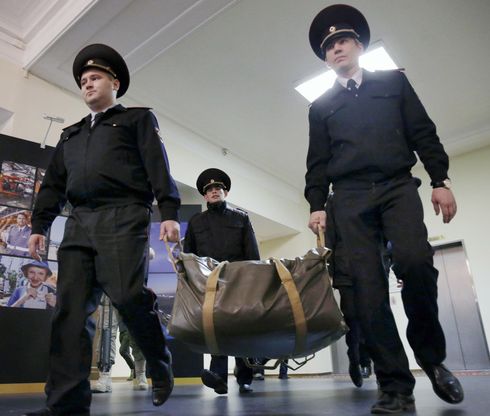
Here in this bag, the Feldyger service delivered the budget-2016, Moscow to the State Duma, October 23, 2015
Forecasts are clothed in the most unusual forms, and the less the analyst’s performance seems to be the forecast itself, the more interest he can represent.
The Minister of Finance Anton Siluanov in the current government has a privilege similar to the one that the doctor has: to tell the patient sad things that the patient would prefer not to hear. That is how Siluanov spoke with the deputies of the State Duma on November 30 (and then in an interview with Reuter agency) on the eve of the approval of the budget for 2016. Siluanov spoke about the future, albeit very close - about 2018, when the country should take place in the country, and how the political agenda of these elections will inevitably limit the situation in the economy.
In general, when high -ranking officials from the executive branch instead of the usual fabulousness about the “power”, “national elite” and “safety problems” begin to seriously discuss the surrounding reality in terms that suggest the existence of the standard electoral environment in Russia - “the will of voters”, “political mandate for reforms”, “legitimacy of the regime”, which actually means them, officials, officials, officials, officials, officials, officials, officials, officials, officials, officials, officials, officials Extreme concern. The current head of the Ministry of Finance has always been distinguished by the ability to speak in a calm tone about rather dramatic events, and our state Duma is not at all the place where the threats described by economists in numbers could not be appreciated from hearing, so Siluanov’s performance did not have much resonance. And in vain.
Economic realities ...
The main theses of the Minister of Finance looked if they are translated into a more mundane language, so. The budget for 2016, in general, does not matter. Because, most likely, it will have to be reviewed: the budget deficit will exceed 3% of GDP next year. Moreover, in 2017, the situation will be an order of magnitude worse: if in 2016 there will still be a reserve fund, then in 2017 a maximum of 1.2 trillion rubles will remain from it, which at current oil prices will not be enough even for six months of federal government costs-and this is taking into account all the cuts and abbreviations already made today. So, the political authority in Russia will have to abandon the only real macroeconomic achievement of the last 15 years - a low level of public debt. In 2017, if something extraordinary does not happen, the Ministry of Finance will have to borrow money on the domestic market and, possibly, on the external in volumes, significantly higher than the current 1 trillion rubles. per year. The Minister of Finance did not call specific numbers, but it is obviously about 2 trillion rubles. new state debt. But this is not all bad news: the “devil” will come out precisely in 2018, when Siluanov stated, it will inevitably have to discuss tax increases, and in the situation, at least the stagnation and lack of growth of real incomes of the population.
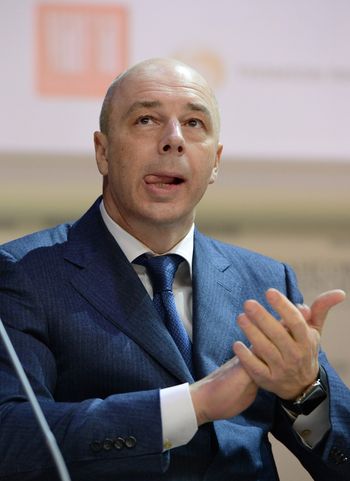
Finance Minister Anton Siluanov
... and political context
In principle, nothing particularly new: NT wrote about this prospect in January 2015. Moreover, this is a moderately optimistic, not a pessimistic scenario. But it is worth evaluating the context. The budget for 2016 is exactly why it turned out for only one year-it was believed that 2016 would be the transition from the 2015 economic collapse to the victorious restoration in 2017 or more or less confident growth with a new presidential term. Now it turns out that before this new presidential term still needs to survive. And all this - under the anecdotic public controversy of senior persons from state banks, the Ministry of Economy and the Central Bank about whether there is an economic crisis in Russia or it has already ended.
The Chertik will come out precisely in 2018, when Siluanov stated, it will inevitably have to discuss tax increases in the context of stagnation and lack of growth of real incomes of the population
Purely technically, we note, the chances that the economy will come out of the recession in the second quarter of 2016 are real. Some of the quite serious analysts (like the former Minister of Finance Alexei Kudrin) believes that in the summer of 2016 even a little revival of business activity can be expected-due to reducing the costs of wages and reduced assets as a result of a double devaluation of the ruble. However, most analysts, including (albeit unofficially) the leadership of the Bank of Russia, believe that stagnation, and even a decline in 2016, are much more likely.
However, the more and more nervous behavior of the White House in October-November is the minimum degree associated with the expectations of the plus or minus in the dynamics of GDP in the coming months. Disputes about whether the peak of the decline has been completed or it will be about the same, largely scholastic. The economic crisis in which the Russian Federation entered in 2013, even before the collapse of oil prices, the Crimean-Donbass adventure and inclusion in the Syrian war, is not an acute disease of the type of “Asian flu” of 1998, but a chronic one, which, moreover, due to purely political circumstances (mainly related to the same “sovereign” and “national security”) are not collected and will not be treated. The accumulation of problems is happening now and will happen for several more years, and this is exactly what Siluanov said in the State Duma: “Nothing will go through, the government underestimated the scale of economic depression, the script of a wonderful exit from the crisis exists.” And, importantly, on December 3, President Vladimir Putin repeated almost the same theses in his message to the Federal Assembly.
Herman Gref, Head of Sberbank , November 17, 2015: “Everything we see now is a large -scale banking crisis.”
Alexey Simanovsky, the first deputy chairman of the Central Bank , November 17, 2015: "There is no crisis, but there is a difficult but working situation."
Pavel Medvedev, financial Ombudsman , November 17, 2015 (in an interview with MK): “There is still an opportunity to flounder and give up early. But we must admit that the crisis exists, and it is difficult. ”
Alexey Ulyukaev, Minister of Economics of the Russian Federation , November 23, 2015: "According to formal indicators, the recession in the economy of the Russian Federation ended."
Institutional degradation
What is happening has a formal occasion - Vnesheconombank: to reach the accumulated resources, pretending that nothing is happening, it is he who gives the Russian authorities. The title of development of the Bank of Development after the 2008 crisis, the VEB around the same time has ceased to be a structure with which development is associated, and has turned into a government-presidential battery of hidden problems. Recall that VEB is a bank without a banking license that, in addition to a number of historical functions (for example, servicing Soviet debt), is the same role for the corporate sector as the usual large state bank. Freedom from the super -profitable regulation of the Central Bank, which are doomed to ordinary banks, and access to the money of the National Welfare Fund allowed VEB for the last 6–7 years to hide problem assets on their balance sheet, which would be separately destroyed by the average size of the bank. The most “toxic” assets in the VEB portfolio are loans to the Olympic construction construction sites in Sochi, which will not be returned with a guarantee, but besides them, the Bank of Development Bank is full of hopeless investments made at the request of the authorities - for example, investing in the Amurmetall metallurgical plant * . In general, the price of the issue for the government is more than 1 trillion rubles: the garbage from the balance of VEB must either be bought for budget money, or the bank is completed for the same amount. Or, even worse, wait until the rating agencies declare the VEB a risky borrower.
It should be noted that the problem is not new: that the VEB needs to be in need of pre -capitalization, the head of the bank Vladimir Dmitriev spoke for the past five years, both the government and the presidential administration dismissed the problems of the development bank, as there were more acute priorities. In the fall of 2015, it finally became clear - the VEB will wait another six months, after which the choice will be very simple: the trillion in cash right now or several trillions of losses and the beginning of the destruction of the institution with a half -century history according to the results of the future financial year. This thought was so struck by the government that they immediately started talking about Dmitriev’s resignation, as if she could change something.
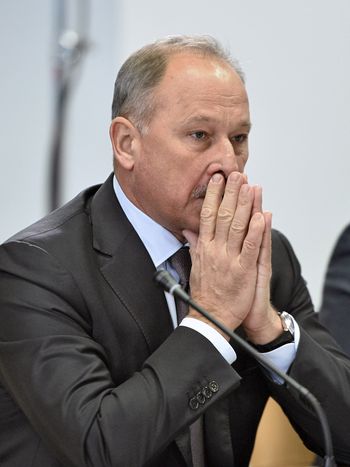
VEB head Vladimir Dmitriev was in a very difficult situation
VEB is only one example of “accumulation” of problems in the economy characteristic of this type of crisis. Since 2014, the Bank of Russia has been cynically but effectively using the same economic epidemic in the licensed banking sector to “clear” it from criminal and de facto of insolvent structures, and in 2016 this process is unlikely to slow down-and any bankruptcy of the bank is a long-term economic loss, even if you do not take into account clean losses of customers. In the road construction very far from the banking sector, the same process looks like a refusal to develop a road network while maintaining a load on the existing and loss of transport connectedness - real expenses for the transport of goods around the country will grow in the next 2-3 years, regardless of what will happen with GDP. Office buildings and warehouses will stand half -empty, the construction projects will become unclaimed before the end, production capacities will become obsolete. And all this - at least in the data of Rosstat - can be accompanied even by a small economic growth.
Dynamics of investment in fixed assets*
<figure> <img SRC = "https://archivarius-public.s3.us-west-2.amazonaws.com/RIMA/WEB/MEDIA/img/632AD7797E3D60C31649A2C83F6A17.jpg"/> </figure>Source: Rosstat, 2015
Investment collapse
That is how, at least in theory, the “slow poison” of investment collapse should act, which amounted to fantastic 15%in the first three quarters of 2015. The flight of money is the main problem of the current crisis, and how long this flight will continue, it is impossible to say. Because the reason for this investment collapse is by no means in a fall in oil prices from $ 120 to $ 45 per barrel. The reasons are the Crimea, and the DPR with the LPR, and the “deofshorization” at the request of the Kremlin, and the long -term decay of the management system, and the new achievements of Russian high officials in the field of corruption, and a lot of factors that have made a “toxic” business environment in Russia. Cheap oil in what is happening is only the trigger of the crisis that would be inevitable in 2018-2019, there was no collapse in the hydrocarbon market earlier, and the crisis was inevitable at $ 100 per barrel.
The most “toxic” assets in the VEB portfolio are loans to the Olympic construction sites in Sochi, which will not be returned with a guarantee, but besides them, the Bank of Development Bank is full of hopeless investments made at the request of the authorities
It is also important that gradually the Russian White House begins to realize the “cultural” component of this investment collapse. The fact is that since 2001, business in Russia has always been sure that with all the problems, from Khodorkovsky to the children of the Chaika prosecutor, growing markets in Russia are guaranteed to a business person. Since 2014, you can relax: new investment projects, in essence, are not needed, now everything will be, as always, very boring and almost unpleasant. You can get used to this: so, in the history of Argentina there are several similar episodes of “falling asleep” of the country's economy, which determined its strong lag from the OECR countries.
In order to get out of the “investment stagnation”, not only another investment climate will be needed, but also strong socio-political ideas-perhaps the current ideological demoniament in the state apparatus is associated with the awareness of this fact and the understanding that, unlike elections or sociological surveys, economic well-being cannot be falsified or ill.
* Amurmetall OJSC-one of the largest enterprises in Komsomolsk-on-Amur, back in 2009 was on the verge of bankruptcy. In 2010, VEB acquired 100% of the company. The company's debt to VEB is more than $ 5 billion, and the total debt of Amurmetall to 264 creditors, according to the media reported, is more than $ 26 billion.
Photo: Alexander Shalgin/TASS, Gennady Gulyaev/Kommersant, Alexander Miridonov/Kommersant