
Translated material
Not the first
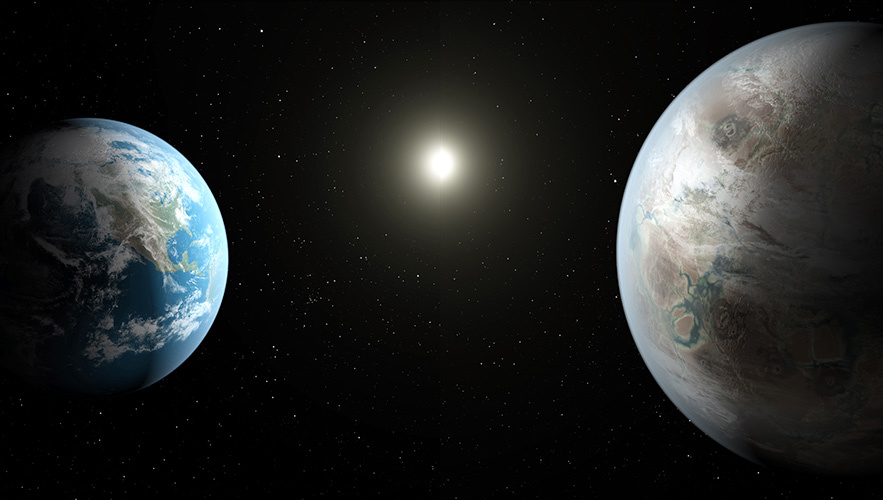
The “second Earth” Kepler -452 B , the opening of which NASAannounced on Thursday, is not the first. In the sense that the news about the next planet, which is an almost accurate copy of ours, is released several times a year.
April 25, 2007, The newspaper The Guardian : "Found" Second Earth ", before it is 25 light years." April 17, 2014, National magazine Geographic : "The Kepler telescope has opened the planet similar to Earth." January 7, 2015, the Russian BBC service: “The“ second Earth ”was found in the remote solar system.”
On the page of the Kepler space telescope (who found almost all of these “second lands”) there is a meter informing how many discoveries he has in the account: 1030 confirmed planets and 4696 candidates planets.
How is that new “second land” different from these thousands, for the sake of which NASA staged a separate press conference, and in the announcement intriguly declared: “Was found something that people dreamed about thousands of years old”?
The fact that it is potentially inhabited and the likelihood of this “habitability” is slightly more than before.
Before the “second land” 2 million 700 thousand times further than to Pluto, and no telescope is able to photograph it even in the form of a blurry point.
Seeing all the details is prevented by the haze in the atmosphere, but a pair of islands at the entrance to the bay, wide rivers through the continent and something like ice at the pole are visible through the clouds. So the news published on Thursday about the opening of the “Second Earth” , exoplanets Kepler -452 B , artist Tim Pail, based exclusively on his imagination, published on Thursday . Because there are no scientists themselves of her images.
It cannot be seen in the telescope. Even in the form of a vague point that Pluto looks like in the pictures of the Hubble space observatory. To the “second land” of 1400 light years - that is, 2 million 700 thousand times further than to Pluto, to which the NEW probe Horizons flew for nine years to get a little high-quality surface pictures.
For this understandable reason, we are unlikely to learn new details about the islands, bays and ice at the pole in the near future. Moreover, about its possible inhabitants.
Although something about the planets that are not visible, scientists still learned to find out. Let not for sure.
For astrophysics, the light of the star, next to which the planet addresses, is the answer to almost all questions regarding the biography of the luminary and its all kinds of qualities. The Sun "Second Earth" -the star KIC -8311864 -is especially similar to our sun. It also belongs to the "yellow dwarfs" , that is, the stars of the spectral class G2-despite the fact that there are many dozens of spectral classes.
The age of the stars is estimated at 6 billion years. In other words, the star (and its planetary system) is quite mature to get born and develop on it - because earthly life has traveled from the first bacteria to a person in about three billion years (with the age of the sun of 4.6 billion years).
With a probability of 38 to 51 percent, the second Earth is not the ground, but an unsuitable gas ball for life.
All the characteristics of the Kepler -452 B planet were taken out of the fact that the brightness of the star periodically falls with an interval of 384.8 days. From here, astronomers conclude that one of her planets partially overshadows the star, which at this moment passes between her and us, is the main idea of the “transit method” that allows you to open and describe the “second lands”, not seeing any of them directly. Say, the easiest conclusion is that the year on this planet (that is, the period of circulation around the star) lasts the same 384.8 earthly days.
The planet is in the “inhabited zone” of its star: in other words, it is not too cold and not too hot here, and Kepler -452 b could survive the water ocean, not boiling or freezing to the bottom.
To be precise, this is a “inhabited zone according to optimists” (a team of NASA scientists emphasizes this directly in the annotation of their article ) - even frozen Mars and Venus with rains from boiling sulfuric acid fall into such a zone, where, as we know reliably, the conditions for life are not very good. Kepler -452 B orbit is somewhat wider than the Earth’s orbit and several orbit of Mars.
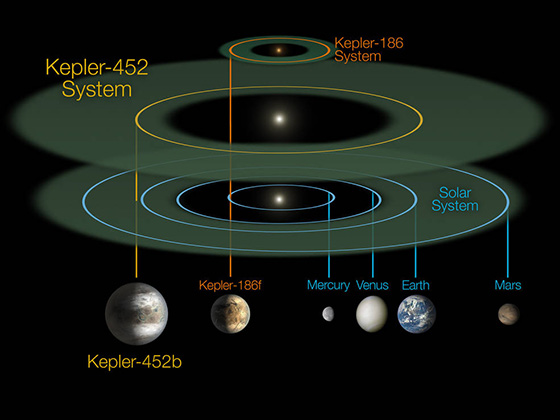 The solar system, the planetary system Kepler-452 and the planetary system Kepler-186 ("Second Land" of the April 2014 model)
And to the “inhabited zone according to the version of the conservatives” the planet does not slightly reach: it receives 10 percent more heat than the earth. Any climatologist, preoccupied with the problem of global warming, will say that all life on Earth from such an additional portion of solar energy would be welded, but we do not know anything about the ability to adapt alien ecosystems.
The “second land” is 1.63 times more than the first - although here the authors are not fully confident in numbers: maybe 1.86 times, and maybe 1.43.
And at these not quite definite figures, any certainty ends.
It is impossible to weigh the exoplanet - neither in a direct way, nor indirect. Without knowing its masses, scientists cannot say for sure, this is a firm planet - like the ground and Mars - or a gas ball that does not even have a clear surface, like Jupiter or Neptune. The probability of the second situation is from 38 to 51 percent (depending on what method to count) , and then all the conversations about the inhabitability will lose meaning: even the most daring astrobiologists do not undertake to talk about life in dense layers of gas instead of the ocean.
To get upset about this would be worth it only if the “second Earth” was something unique, as the news is presented, but this emphasis on uniqueness is beneficial only to the NASA press service. And he leads all the others from an understanding of how science works.
All exoplanets found by the Kepler telescope are concentrated in the sky area of 0.28 percent of the entire heavenly sphere. The other 99.72 percent were outside his field of view.
When physicists opened the Higgs boson in 2012, there was no specific particle that fell into a trap in the depths of a large adrone collider. The essence of the discovery was that the chain of different unlikely events cannot be explained by anything other than the existence of Bozon. The same story with exoplanets: astronomers may not open a single one that, with a 100 percent probability, would be inhabited by someone, but to conclude that the inhabited worlds are an obligatory detail of the universe.
The observations that led to the opening of the “second land” were carried out from May 2009 to May 2013. All this time, the Kepler space telescope followed, not looking up, behind the modest section of the sky between the constellations of Lebed and Lyra with an area of 0.28 percent of the heavenly sphere. There, Kepler -452 B was found, as well as the overwhelming part of the list of “second lands”.
The other 358 of the same in size of the stellar sky were not until recently affected by observations in general-but there is no reason to think that they are something worse and there exoplanets are many times less. In November 2013, a team from the University of California at Berkeley and the University of Hawaii shared its statistical calculations: on the basis of what Kepler saw, every fifth star should have exoplanets . In particular, each fifth of the 100 billion stars of our galaxy. And for sure, some of them are closer than 1,400 light years to Kepler -452 B , with which it still cannot be exchanged -from these “second earthlings” we will receive a response to any signal from the ground no earlier than after 2800 years. Search for a good reason for further-and find someone closer.