
Translated material
Vacation at your own expense
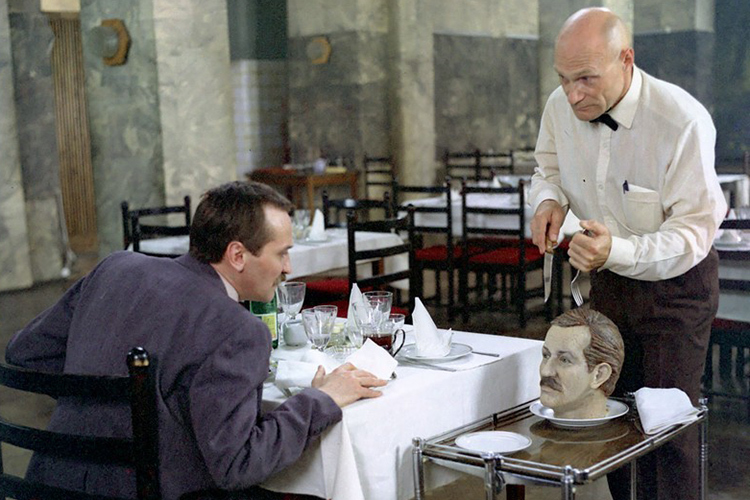
In the cinemas of the Moskino network, on May 8, a retrospective “Cinematics” is underway. Production poem. " About the genre of the Soviet production drama, its canon and numerous exceptions from it, in fact, constituting the retrospective program, says its curator Karina Karaeva.
The very first experiments in the field of production drama are partly attributed to the “exit of workers from the factory” of the Lyumier brothers-although, in fact, the hero of the genre has not yet formed here: a mass caused by the camera in a kind of non-being, a moment between work and leisure, is emerging from the doors of the factory. A documentary, pure image of a worker, which will subsequently acquire an increasing degree of convention on the Soviet screen, is set by Jiga Vertov in “enthusiasm. Symphony of Donbass ”and later in the“ Lullaby ”. Subsequently, the Soviet production drama becomes a space for sufficiently cautious statements regarding the experiences of the meaning of the meaning of intellectual and physical labor, the existential tragedy of collectivity, labor feats and reports on the achievements of a plant or factory, strangely refracted through the prism of not quite communist sensuality.
Speaking about the production drama, first of all, I would like to touch the peculiar period of the 30s, when the universal enthusiasm caused by the pace of industrialization did not allow us to say that labor is sometimes the pain, loss and tragedy of an individual, finally. If in the “Tool of Life” (1931) of Nikolai Ecka the existential conflict still passes along the production line (an unconscious homeless-lumpen resists the proletarization, refuses the right to work), then the hero of the 30s is mainly an array of films-a simple worker sees his work as an unconditional feat of the “great citizen”. In 1939, the “member of the government” Alexander Zarha and Joseph Heifitz, who demonstrates the viewer, the practical benefits of a production feat for the benefit of their homeland - the possibilities of career growth. Yes, those that the heroes of the late Soviet production procedures of the 1980s did not dream.
The production drama usually unlessly demonstrated the stages of a labor exploit (“height” of Zarha), however, the moral appearance of the worker still remained the sphere of his personal responsibility or even the choice (“Rumyantsev’s case” of Haifice).
“Pig and shepherd” Ivan Pyryev is a special case: the melodramatic genre base, on the one hand, is extremely flattened and schematized by the image of the worker, but the special epic of musical drama lies his figure, turning into an effective element of propaganda, socialist realism, exalting record productivity as the highest degree of socially useful activity.
Yuri Egorov with the “simple story” (1960) becomes a kind of opponent of Pyryev: in the life of her heroine, chairman of the collective farm, love is more important than the norms of agricultural production. This is an anomaly for a production drama, which shows an individual employee as part of the collective consciousness, emphasizing this total scenes of collective thinking (see the “premium” of Sergei Mikaelyan). The individual hero leaves the genre, dissolves in the team of sitting, voting, supporting his colleagues.
The program “Production Poem” is devoted to such anomalies, deviations from the canon: all the films collected here in one way or another have a bright, convex, often reflecting and paradoxical hero-worship-a figure that is generally completely disappearing from Soviet cinema by the end of the 80s. Here, production realities could even conflict with the ethics of the hero, moreover, he was allowed to doubt the need for a particular form of labor (such a conflict sometimes took completely unexpected forms-from the lyric-romantic in the “nine days of one year” by Mikhail Romm to the existential-accurate in the “degree of risk” by Ilya Averbach).
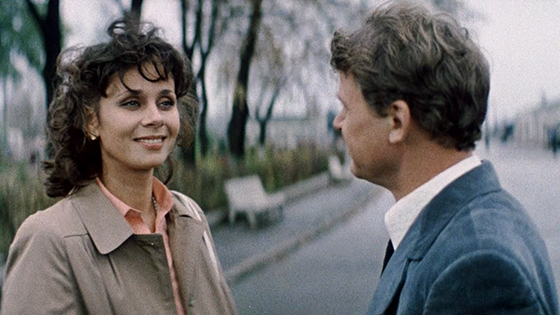 © Cinema Studio named after Alexandra Dovzhenko is a frame from the film "If you can, forgive"
The protagonist of the melodrama “if you can, forgive” literally forced to go on vacation so that he can establish his personal life. Almost forty, an excellent worker, and will not arrange a joint life! This external narrative (as a result, the wife returns to the hero, who threw him seven years ago) hides another, subversive. For a super -versed tractor driver, a trip on vacation means to sacrifice working principles, leave a collective farm without a single tractor. Further in history, another character appears-a vacationer-playwright who puts bad performances on the stage of a provincial theater (a transparent metaphor for total unprofessionalism, especially obvious in an extreme case of inaccurate, “creative” production).
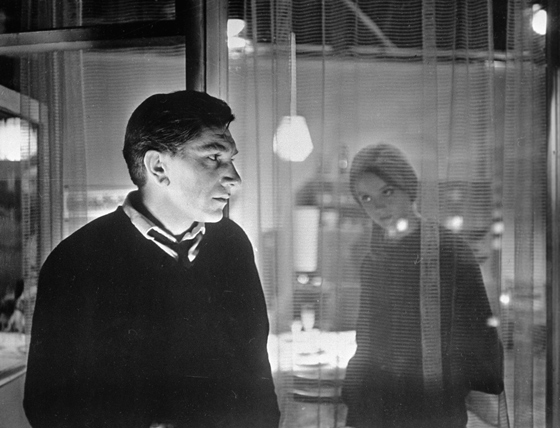 © RIA Novosti Hard from the movie "Hello, it's Me"
"Hello, it's me!" Frunze Dovlatyan takes as a basis the conflict of "nine days of one year." Two veteran physicists examine the “reaction of soft components in space rays”, while thinking about the possibility of the practical application of their discoveries. Alas, the ideas of friends for years are ahead of not only the state of the material base of the national economy, but also the mentality of the scientific community. There is no way out, except for leaving the profession - and life (in the finale one of the physicists dies, the other symbolically goes to the temple).
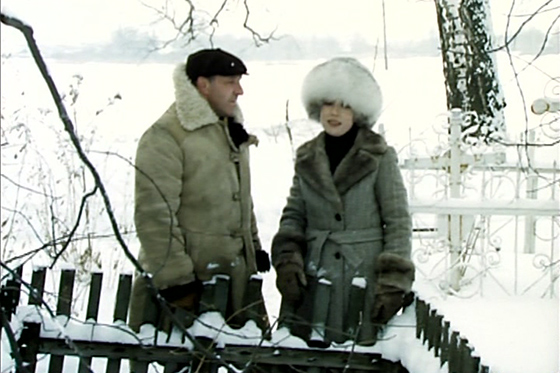 © Mosfilm Frame from the movie "Topic"
The “topic” of Gleb Panfilova is devoted to the refusal of the capital's intellectual from his convenient position of the professional “conscience of the nation”. The playwright Klim Yesenin goes to the village in search of new topics. Having met in Suzdal the idealist Sasha, an employee of the local museum, occupied by the heritage of the local poet Chizhikov, Yesenin finally realizes the futility of his works for the moral education of Soviet man (and even immorality). So the work (in any case, the work on the ideological support of the Soviet man) loses its heroic aura, it becomes alienated: the topic of the dead end, existential and professional, will become the central in Soviet cinema of the 80s. So, the hero of “Success” (1984), a young director from Moscow, comes to the provincial theater for the production of Chekhov’s “Seagull” - and faces the maximum alienation of the troupe, a misunderstanding of his interpretation of the play. A series of conflicts leads to the sudden death of one of the artists. Reconciliation with the team nevertheless happens, the hero makes a successful performance, but in the final is completely disappointed in his radicalism and in the creative team.
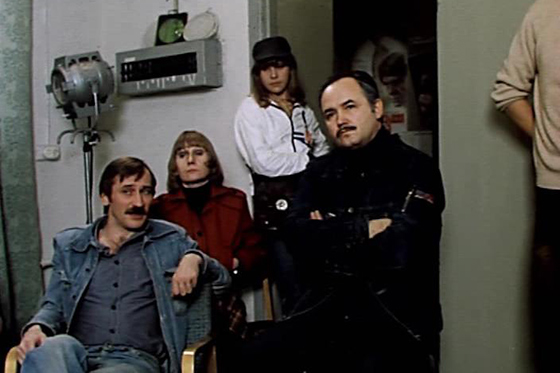 © "Lenfilm" Frame from the movie "Voice"
The “vote” of Averbach also speaks of the unjustified of sacrificial enthusiasm in the field of intangible production. In it, the filming group of the Soviet film passes through the production hell: the director is dissatisfied with the material, the operator is about to go to another project, the director of the picture escaped, the composer does not get in touch, and the leading actor is in the hospital with some serious illness and cannot finish the form of the film. So labor becomes synonymous with alienation, pain and suffering, and the excessive labor enthusiasm of a seriously ill heroine leads to her death (price obviously inadequate creative result).
The film “Several Interviews on Personal Affairs” is also a subversive statement (in an unexpected Maoist spirit). His heroine, a talented and successful journalist Sofiko, specializes in social materials. The work makes her sacrifice her leisure - and her husband Sofiko Archil from longing leads a young mistress. Treason makes Sofiko reconsider his attitude to the profession as a pure stated reality, painted with moral judgment. Again, the role of the intellectual, an ideological front, is in relation to the role of the intellectual.
And in the film “An Extraordinary Exhibition”, doubts about the advanced role of “creative workers” were already brought to a grotesque, an evil cartoon. The sculptor discovers the ability to practical and well paid activities: the production of tombstones. This business delays the character so much that at some point he begins to make tombstones to live neighbors-and is thinking about self-portrait.
“If I were a boss ...” Explits a change in powers and duties in the production context. The protagonist makes a desire - to change his place in the production chain - and suddenly changes with roles with his boss. Thus, work, labor, perseverance in achieving results and the desire for a feat degenerate into the comedy of the provisions.
The heroine of the “Key without the right to transfer” Dinara Asanova, the young teacher Marina Maksimovna, is too close to her students that her senior colleagues do not like. The mother of one of the schoolgirls finds a tape record from the gatherings of classmates discussing teachers, and brings it to school. The new director is trying to explain to the young teacher that her pedagogical methods are unethical. As a result, the main character here is the director-it is he who, forced to support the status quo and introduce modern methods, will survive the real conflict of the old and the new.
The school theme is continued by the “Jester” by Andrei Eshpai - a complex monologue of three characters: a schoolboy, his lover and teacher. The main character, a teenager-wonderkind (one of the ominous boys of late Soviet and post-Soviet cinema like a plumbum or Nietzschean Vitaly from Satan), invents his own psychotechnical system and begins to put endless provocative experiments on others. His teacher of mathematics enters a psychological duel with a schoolboy - and wins. But the price of this triumph is the betrayal of his ideals, declared as humanistic: in order to step over the jester, he has to wrap the perverted “system” of the student against himself, take advantage of the prohibited techniques.
The final breakdown of labor - and any - relations occur in the "City of Zero" Karen Shakhnazarov. This is the paraphrase of the “castle” on the late Soviet material: the main character comes from the center to the province to correct a certain error in the production of air conditioners. Subsequent absurd events and circumstances turn it into K. Shakhnazarov, the unconditional removal of labor arises, which ultimately desubalizes the hero, alienating not only his work, but also reality itself - absurd, which has lost internal logic and connectivity.
Subscribe to the COLTA.RU channel in Yandex.Zen to miss nothing