
Translated material
In a secular circle

Whit Stillman is a New York director with a very convenient, compact filmography consisting of only four films. At first there was the Golden Youth trilogy ( Metropolitan , 1990), Barcelona ( Barcelona , 1994) and the Last Disco Day Last Days of Disco , 1998), over the years, has become a cult. Thirteen years later, Stillman took off “girls in trouble” ( Damsels in Distress , 2011), almost without violating the stylistic and thematic unity of previous films, and the trilogy became a tetralogy. Stillman wanted to be a writer, was fond of Fitzgerald and Salinger, on the one hand, and Samuel Johnson and Jane Austin on the other. With literature, even something turned out, he was printed in Harper ' s . But he admits that he experienced difficulties with a letter from a third person, he wanted to write from the first and for the sake of this went to all kinds of tricks that weighted the text. I accidentally got into the cinema to his Spanish friends - directors Fernando Truebe and Fernando Colombo, and Writer ' S Block was miraculously removed. In the cinema, as it turned out, all the characters speak in the first person, and in comedies it is not necessary to observe the logic of the presentation with which it has been for so long to bother in journalism.
Stillman takes off the comedies of morals, what is called Comedy in English of Manners , that is, works in a classic comedy genre with a rich literary tradition. How to shoot a modern “comedy of manners” is not very clear, because, in fact, there is no manner left. According to the rules of the genre, the highest, “fashionable” society and an alumer-agent, observing its manners/customs, should be presented in the comedy. The stranger is not identified with them and is capable of removing, from which a comic arises.
In the purest form, this genre is represented in the first film of Stillman "Golden Youth". There are a group of Preppies , graduates of expensive private schools living in Wesides, who have fun a visit to traditional New York Balls Debutante. Tom Tausend, a poor man from Isaade, the son of the divorced parents, reading Fourier and Torstin Veblen (the author of the concept of demonstrative consumption) and, among other things) and, according to him, despising secular entertainments, accidentally fall into their circle. Tom is drawn into night home gatherings after social events, the company accepts it favorably. In addition to him, there is another outsider in the group - Audrey Roger, a girl from the same environment as everyone else, but somewhat falling out of the overall picture. For example, she is fond of Jane Austin's novels. Tom chuckles, but, as it turns out, he did not read Austin, but only retells Lionel Trilling's devastated essay. According to the laws of the genre, an outsider should eventually realize that visibility and secular formalities are not so bad and something very valuable will be lost without them. Tom reads by Roman Austin “The arguments of the mind” and abandon Fourier. In the finale, along with another member of the “gang”, intellectual Charlie, trying on the plots of classical novels, he will go to save the innocent, simple-hearted Audrey from the networks of an invented villain-molester.
In the next film “Barcelona”, both protagonists, cousins Ted and Fred, are outsiders, simple -minded Americans who do not understand how life in Europe works: neither her politics, nor the rules of sexual behavior. “Barcelona” seems to be a very confused film: it is shot from the point of view of heroes for whom the motives of the behavior of the natives are opaque and who perceive the environment extremely schematically.
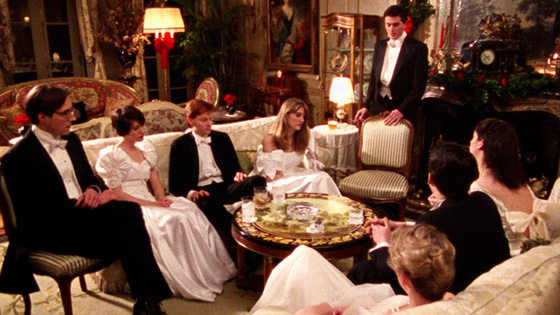 © Westerly Films Frame from the film "Golden Youth"
In the “Last Days of Disco”, the point of social attraction is a super-modified disco club, which is eager to get the whole of New York. One of the heroes, dess, even works there as a manager, but he with great difficulty manages to spend his friends, graduates of prestigious universities to the club. It seems that they belong to the elite, Yappy are considered, but their secular and social status of shake, and at the disco they are outsiders who can be expelled from there at any moment. In the "Golden Youth" the secular circle was also played, so to speak, by amateur forces. Elegant coats, tailcoats and evening dresses sat on heroes as if from someone else's shoulder. Lovely, intelligent children with a bunch of complexes undertook to play in the world of Scott Fitzgerald in the 90s.
In a sense, the heroes of Wita Stillman - Dandy, especially if you understand dendism as a slope to the right, opposed to the left bias, and not the philistine ideas about the norm, or as the romanticization of the highest classes, for which it is not necessary to belong to them - it is enough to be fascinated by formalities and ceremonies. Stillman's films resemble the comedies of John Hughes (“Breakfast Club”, “The House of Ferris Buuller”) about school and adolescents. But the heroes of Hughes from a more democratic environment, and they are often opposed by low -sympathic major. A good parallel to Stillman - the film "Cute in the Pink" ( Pretty in Pink ) , shot according to the Hughes scenario and with his beloved Molly Ringwold in the title role, where everything is built in the conflict between fashionistas from the poor, dressed up in rags from second-hand, and rich and truly stylish classmates.
Stillman takes the 80s cinema, so passionate about alternative culture and non-conformists of all stripes, and changes places and cons. In the “last days of disco”, the heroes are kicked out of the club for the fact that they are Yappy, not Bohemia. They would like to be young, ambitious professionals, but they are not them. In Barcelona, the protagonist Ted is a trade representative, sincerely passionately passionate about his own business, reading Dale Carnegie and Peter Drucker (founder of management theory) as a moral philosophy, just as Audrey from the Golden Youth was read by Jane Austin. His cousin Fred came to Barcelona to serve in the American embassy, walks around the city in which terrorist attacks are taking place in military uniform and tries to fight the inveterate anti -Americanism of the local public, mired in propaganda stereotypes. But with some ideological stereotypes you can only deal with the help of others, simply reviving them. It is necessary to take Barcelona girls on the lake and fry the real hamburger so that they realize that this is not just an ideological fiction.
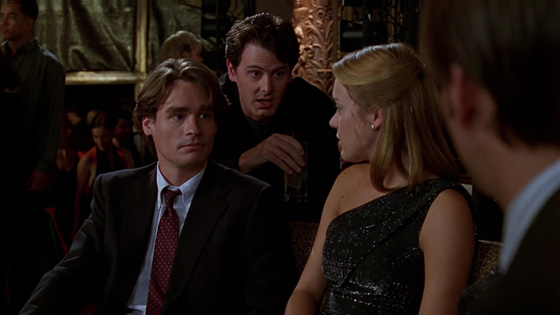 © Westerly Films Frame from the movie "Last Days of Disco"
The tie “girls in trouble” resembles another cult film of the 80s-“Deadly attraction” ( Heathers , 1988). There was a group of the most popular girls, elegant and well -groomed, who call themselves the same name - Heather. At Stillman Hizer has the name of one of the heroines of “girls in trouble”. In “deadly attraction”, Trinity Hizer invites to his company the fourth - Veronica, who turns out to be, like Lily in “girls in trouble”, a free agent confusing them to the game. If the Heiser were real bitch that terrorized the school, then Violet and its team, on the contrary, are going to save their fellow practitioners from depression and suicide, carrying them the light of civilization and hygiene. Although they are sometimes perceived almost in the same way as those heisers.
In "girls in trouble", conservatism is played even more ironically. Violet (Greta Gerwig) explains Lily (analysis of Tibton) that the main task of the college is to learn as much cliche and stereotypes as possible, in which life wisdom is laid. Violet has the same fundamentally non-ambitious program of personal life-bypass the beautiful and popular, find an equal to yourself, and even better someone worse, then to develop and raise it to yourself. Violet is the very embodiment of rationality and judgment, only its rationally chosen object is a complete moron, because of which it itself is in in Distress and on the verge of suicide. Those whom Violet was going to ennoble are college students living in an “elite” fraternity D , most advanced in a sanitary-hygienic and psychological basis for the corps. Their Stillman seemed to be written off from John Landis's comedy “Menary” ( Animal House ) .
Who is an outsider designed to judge and observe other people's morals, in “girls in trouble”? On the one hand, this is Lily, which transferred to someone else's college and fell into a strange company with specific rules. On the other hand, a Weylet with its invigared theories and reconstruction projects, if not a world, then at least a campus. The plan of the film changed along the casting. Grete Gerwig first proposed the role of Lily, the most beautiful girl in whom everyone falls in love. But she wanted to play Weylet, and this image grew into something more interesting than the script was provided. However, the main antagonist Violet is not Lily, but an episodic character from her center of suicide prevention, played by Obri Plaza from “parks and recreation areas” and “jokes”, an implacable negativeist, now and then lowering a violet to Earth. She is dressed in black, does not use perfume and is firmly sure that depression is treated with chemicals, and the one who does not have a certificate from the doctor does not have the right to privilege that the center gives, even to coffee with a donut.
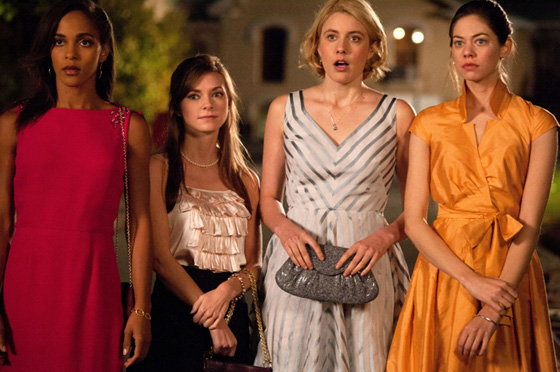 © Westerly Films Frame from the movie "Girl in Beda"
It is characteristic that in “girls in trouble” they constantly argue about letters, names and names, emphasizing the surface, external, shallow connections and combinations. This correlates with the faith of the beloved heroes of Stillman in rituals, ceremony and formalities. Therefore, depression, as Violet is sure, is treated not by pharmacology, that is, not through deep effects, but purely superficial effects - smells, for example, the aroma of soap in a motel (which kept it from a fatal step), outfits and dancing.
Stillman always knows how to open his plots with allusion to the musical genre. In the “girls in trouble” in the final Violet and all other characters arrange a dance promenade along the alleys of the campus to the music of Gershvin. They dance beautifully, although without an excessive alienating brilliance of professional dancers. The scene turns into a fantasy that refers to Stillman's favorite film “Fun Divorce” ( Gay Divorcee , 1934) with Fred Aster and Ginger Rogers. In the Last Days of Disco, the notorious disco saves the film from becoming another passing comedy about the youth group looking for themselves in New York. Suddenly, there is a sunset sunset: people with the inscriptions of “ Disco Sucks” appear on the streets, the club closes, the notes stop selling sharply and people stop going to discos - but this is exactly what the heroes' chamber history in a wide frame of nostalgia, gives the plot free breathing. And it doesn’t matter that the characters were not icons of style and they were not allowed into the club. As one of them said in conclusion, perhaps the style is over because everyone found a couple, and if there is a couple, then why go to discos? Disco is a utilitarian thing, not a romantic movement. But still, the film has a wonderful ending: Chloe in a scarlet dress, as always, slightly constrained and timid, and her boyfriend, a former prosecutor with clinical depression in the history of, dance in the subway, with them the whole car and people on the platforms, past the train. Random circumstances of personal life coincide with the end of the era. Nostalgia post -facts gives the meaning of personal history.