
Translated material
People who are not

In society
 People who are not
March 15, 2006 Alexander Cherkasov
 There is an opinion that any glory is better than at all. Especially if she is facilitated by such a brilliant publicist as Julia Latynina, who said on the Sunday broadcast of Echo of Moskva on the program “Access Code” the following words: “I feel bad about human rights activists. It is bad mainly because I believe that they occupy a certain place, showing that they are, and they are probably not, with the exception of several people.”
In an hour's program, much of the previously written was repeated. For example, that, following the dissident tradition, they are not defending those -I already tried to argue with this statement. Or fresh : that the “symbol of faith” for liberals and human rights activists was the version of the poisoning of Chechen schoolgirls by Russian special forces - with this statement, equally groundless, can also be argued.
And what to argue with when they say "there are no them"? Woland, I remember, was treating such an attempt with irony: "He tried to prove to me that I did not exist!"
Glory to God, I do not need anyone's confirmation of what I am, like in no good respect. You never know what Moscow says about us? Where Latynina to Mamontov with his stones. In general, the reaction has long been dull, the attitude is: well, what is a normal person will take it seriously? After all, physicists with occultists do not argue, and historians with Fomenko!
But Latynina further has some explanation of the reasons for their attitude to human rights activists: “... I constantly come to the computer human rights spam, the streams of letters:“ urgent ”,“ important ”,“ pay attention ”. Three grades spam:“ anti -fascist ”, in defense of“ opponents of the regime ”(they are said about them earlier and higher), and“ third is just random judicial situations with Pupkin, Mumykin. And with Vaskin, when I get a note that I must react to the fact of the detention of some kind of Pupkin, because he was detained only in the framework of the fact that he carried out human rights activities. "
Neither Latynina mentioned as the only "real human rights activist" Lyudmila Alekseev, nor I, sinful, should not seem to be offended by the last phrase.
But it is she who encourages me to answer.
It is very simple from the limits of another state, Moscow, to talk about the remaining nine tenths of Russians. Ivanoah and Akhmet, who, of course, should be defended by "as a whole." But as soon as they turn from the “object” into “subjects”, they gain not only a name, but also a surname, alas, they turn into “Pupkin, Mumkin and Vaskin”.
Here you have one specific person.
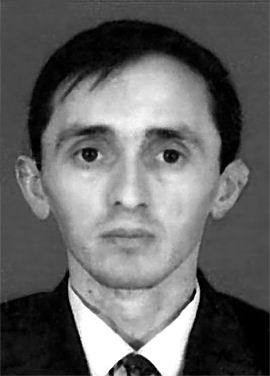 Osman Ramzanovich Boliev was born on June 20, 1967 in the city of Khasavyurt, in 1995 he graduated from the Moscow Architectural Institute, in 2003 he entered the modern humanitarian institute for the law faculty, and at present-a 4th year student of the correspondence department. Since the late nineties, Osman of Boli has been engaged in public work, at first humanitarian and educational, then by the protection of human rights.
In 2002, a group of like -minded people from Khasavyurt established a regional public organization with the peaceful name "Chamomile". Directions of the work - peacekeeping, support of the ineffective segments of the population, emergency consultative legal assistance to victims of human rights violations, assistance in the legal education of children, adolescents and youth, and so on. The chairman of the organization became Boliev.
Boliev and his colleagues sought the investigation of crimes committed by employees of law enforcement agencies. For example, they were engaged in the disappearance of the detained by the employees of the Khasavyurt, the local resident of Israilov on October 19, 2004, found out the reasons for the torture of his relatives. The complaint was filed in the European Court of Human Rights in 2005 and was recognized as a priority. Other things are on their account: about the murder of six -year -old Abdurashidova on March 14, 2005 during a “special operation” in the village of Solnechnaya; The case of the death of a four -year -old boy on April 6, 2005 in Khasavyurt during another “special operation”. In this work, the organization "Chamomile" collaborated with Russian and foreign human rights organizations ...
And on November 15, 2005, Osman Boliev was detained. The circumstances of this detention are notable for themselves.
About four hours in the afternoon, when Boliev washed his car near his house in Khasavyurt, on 34 Mira Street, traffic police officers drove up to him. They reported that his car allegedly looks like a coal listed in theft and the car should be checked on this item. The policemen asked Boliev to go to the town of internal affairs with them. Boliev went to the GOVD at the wheel of his car, accompanied by traffic cops. On the way they were stopped by OMON employees, and the traffic police car unexpectedly, without explanation, turned around and left. So Boliev got to Goroddel, accompanied by riot police. Here, when inspecting his car, they unexpectedly “found” a disassembled grenade. Boliev was detained, and later charged under Part 1 of Article 222 of the Criminal Code of the Russian Federation for storage of ammunition.
The charges contain a lot of absurdities and traces of violation of procedural norms. Firstly, if the grenade had not been tossed to Boliev, then he could easily get rid of it when he was driving after the traffic traffic police. In the documents presented by the police to the prosecutor's office, there was no description of the grenade. The searches themselves were compiled with gross violations. In the documents submitted to the prosecutor to initiate a criminal case, there were no materials of administrative detention. And so on, and the like ... Finally, the Boliev was delivered to the town of Boliev for an administrative violation expressed in disobedience to police officers, "and this, among other things, contradicts the testimony.
This event was covered in the media, but very peculiar. On November 15, 2005, the press service of the Ministry of Internal Affairs of Dagestan said that “in the Khasavyurt in the area of the village of Zarechny, an active member of the Armed Forces of the ChRI [Chechen Republic of Ichkeria] was detained during a special integrated preventive operation. <...> According to the Republican Ministry of Internal Affairs, the detained 37-year-old O. Boliev, an active participant in the forms of CRI in Chechnya, was a member of the Arslanbek Abdulshekhov detachment, who was killed during the operation to release hostages in the Nord-Ost Theater in Moscow in 2003. During a personal inspection from the detainee, a rgd grant -5 with a fuse was found and removed. ”
Immediately after the detention, Boliev was greatly beaten, then tortured. He repeatedly lost consciousness. The police who tried to “behave incorrectly” and should confess to the storage of ammunition and participation in illegal armed groups.
And this was just the case when human rights activists should protect human rights defenders. At least from an elementary sense of solidarity. Yes, I understand that individual plots about individual people - human rights activists and not human rights activists - can annoy, especially if there are many of them. As Julius Kim sang, “people only interfere, get confused under their feet, forever something, something, something, something they want ...”
But the flow of “human rights spam” is sometimes not an end in itself, but only a dusty train that accompanies a completely purposeful information exchange, a call to those who can help: “act”, and from them to power institutions: “We know, we are worried.” Sometimes this alone is a lot. Moreover, republics such as Dagestan are not yet spoiled by the attention of capitals and abroad. Both journalists and lawyers - metropolitan and foreign people - are uncomfortable people, with them it is much more difficult to perform business according to custom. From my own experience I know that the attitude towards a person sitting in a dungeon from this moment is often changing. They free those who, in a different situation, would disappear without a trace.
Since December 2005, Osman Boliev, with the assistance of the Public Verdict Foundation, has been defended by Moscow lawyer Sergey Brovchenko, whose participation allowed to turn the course of the case. On February 13, 2006, Boliev at the request of the defense was released from the custody of a recognizance not to leave before the sentence.
The consideration of the criminal case on charges of Osman Boliev did not take place in the Khasavyurt City Court of Dagestan in connection with his illness. Upon leaving the preliminary imprisonment, he was in the Khasavyurt city hospital with complaints of pain in the heart, head, spine and general malaise - simply put, he practically could not walk: a consequence of three days of “interrogation with addiction” in the city of the police. Upon admission to the hospital, the doctor told Boliev that the “case is serious”, and he must be sent to the republican hospital.
The prosecutor’s office, meanwhile, protested the liberation of Boliev from the custody. On March 16, a court session should be held, which may well return Osman to bars.
I hope that none of the readers will perceive this article as “human rights spam”.
Author - Member of the Board of the Society "Memorial"
Alexander Cherkasov
All rights to materials located on the EJ.ru website are protected in accordance with the legislation of the Russian Federation, including copyright and related rights. With any use of the site and satellite projects, hyperlink (Hyperlink) on EJ.ru is required.