
Translated material
The will to passion
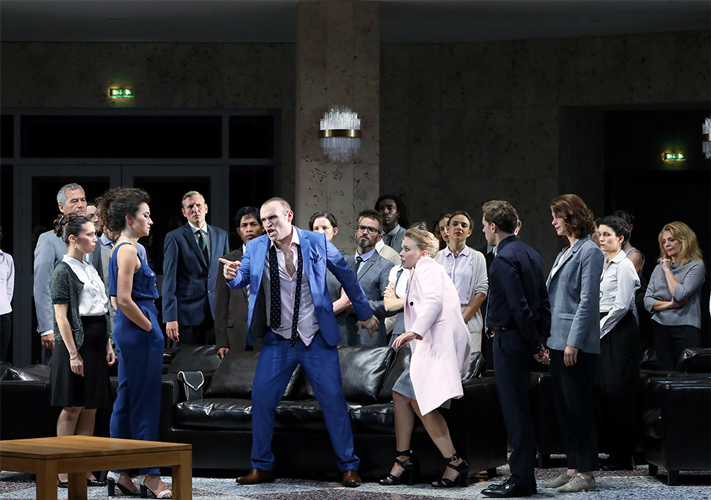
The appearance in the program of the ex-en-product "Carmen" Georges Bizet seemed a joke. The last time the festival cultivating the Gourmet opera taste allowed itself such gluttony 60 years ago. But it was precisely so unobvious for this score that the context made curiosity.
The name of the director Dmitry Chernyakov was also poorly glued in mind with the plot about everyday murder on the basis of jealousy. Not that Chernyakov is always looking for an exclusive repertoire. In his resume, a sufficient number of blockbusters - motionless, overloaded with stage traditions and audience expectations. But in them always (as in the Milan “Travate” or the Parisian “Nutcracker”) there were an abstract beginning, metaphysics, archetypal, depth that could be raised, opened, emphasized, and the connection with which the modern viewer and modern director could feel and show.
In Carmen, genre history can not be anything except that it is. Attempts to redistribute roles or find their equivalents in the modern world immediately send this story to a museum or in a tavern - equally unconvincing and artificially. And Chernyakov makes a somersault, which is fundamentally different from its other interpretations of classic operas. He does not try to justify the text of the opera and circumstances of the action that are invented by people from another time, from the point of view of a modern person. He does not try to find in a classic text (in Bizet or, God forbid, Merima), insights and futurism, allowing to identify himself with him now. And thereby leave responsibility for what is happening on the stage on the authors of the opera. No checks of canonical texts. No ethnographic curiosity. Chernyakov literally places the modern “European White Man” (“Don Hose”) inside the plot - about smugglers and gypsies, deserters and domestic murder. And further - what will happen. And everyone is responsible for himself.
 © Patrick Berger / Artcompress
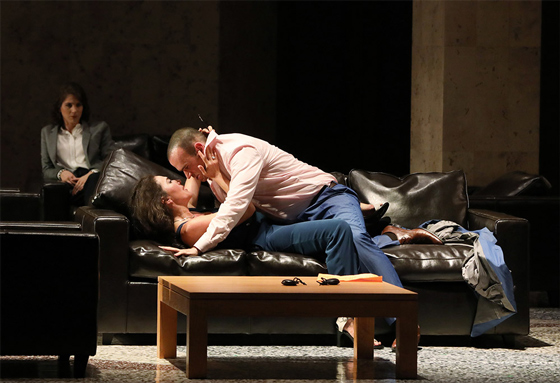
Such an immersion occurs for “Don Hose” in the process of some kind of psychological treatment to solve the emotional problems that his wife persuades him. The doctor offers to play Carmen. The choice of this plot is not justified by anything except that in it “passions boil” are very different, not only sexy. “Don Hose” does not require sexual training, his treatment is not connected with marital life. It is required to include an emotional reaction (not at all a love).
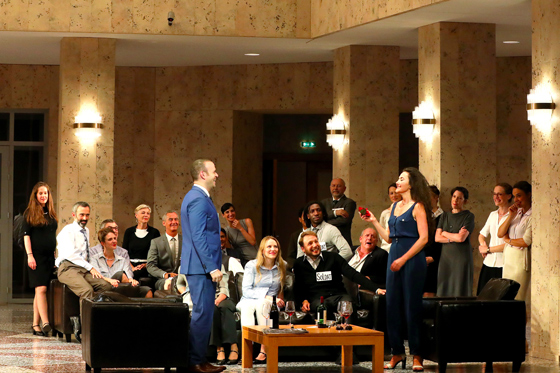
The whole story unfolds in some Luzhkovsky interior and is played out by the staff of this hospital. The word "game" is not entirely true, no one is trying to be neither dimensional nor more disinfected than it is. The requisite was purchased in the "Children's World"-pistols shooting flags with emoticons, telescopic knives-explosives, a cuckold flower. And they cope with him not so hot. Participants only indicate the plot for Don Hose. And he is free to behave the way he wants.
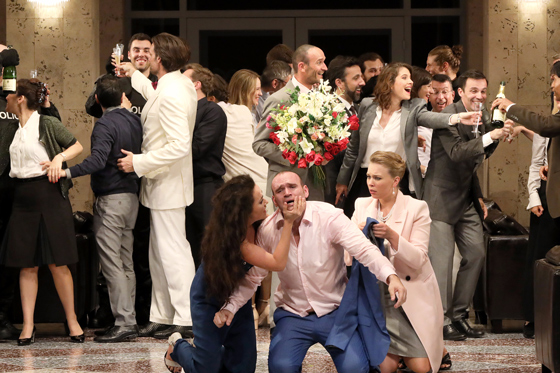
His progress in the treatment is impressive by the doctor by the end of the first act. By the end of the second, a satisfied doctor believes that treatment can be completed. But for the “Don Hose” itself, it is already turning into real passion. He requires continuation - murder. With a fake knife - by the fact that at hand - it crashes into a vertic, which depicts Carmen. She, in the course of the “game”, seems to be more and more immersed in this passion (although every time she returns from it to her “professional” duties). The hassle-burning, feeling something was wrong, also requires a character-becomes Michael, the bride of Don Hose, who brings to lead and kisses from his mother (an occasion to kiss her husband and remind of herself).
 © Patrick Berger / Artcompress
Any doubts about the effectiveness of the director's course of Chernyakov lose all meaning when Michael Fabiano (“Don Hose”) in the final of the performance turns literally into a piece of meat without strength, without will, when he almost with hatred looks at the public at applause. His nasal tenor is not afraid to be ugly or hysterical, not afraid of falsetto in “Aria with a flower”. The virtuosity with which Chernyakov removes barriers and restrictions on the path of Don Hose to passion, it seems impossible. Starting from the children's choir in the first act, in which the adult male “Soldier” is clowning, thereby weakening the suspicion of “Don Hose”. Through the habaner, which ends with a cluster of a flower, confused in the hair of Carmen. Through a series of games, in which the passion of “Don Hose” unfolds, always with some kind of items, for example, a tie, which the hero connects the hands of the “arrested” heroine. After a few throws of reality, this role -playing game (the invasion of police officers, at first similar to the present, or unexpected seriousness of the performer of the role of Carmen, informing the danger of those people who organized this treatment).
The Carmen itself - with an ideal booty emphasized by the overalls, in which she is dressed, and the mane of gypsy hair - Chernyakov’s - no “born” seducer. It also only means its role, following the behavior of Instagram-Gerl. Metzzo Stefani d'Ustrak, mobile and ironic, helps to create the image of an actress who plays this a priori for a non -gas game, maintaining a distance in relation to her work.
 © Patrick Berger / Artcompress
The dynamic performance of the Paris Symphony Orchestra led by Pablo Eras-Casado creates ideal conditions for increasing passion-but not to the detriment of articulation. The attention of the conductor to the soloists allows d'Ustrak to sing Segidil in almost a whisper. And the emphasis on folklore and socio-anthrape components Bizet works on the overall concept of the performance.
Because the “Carmen” of Chernyakov and Eras-Casado-about how the interaction of people in society occurs. When everyone has their own behavior strategy. These strategies never coincide and constantly change depending on the circumstances. Circumstances may be fear, money, and passion, and a tie, adapted instead of handcuffs. In such an interaction, will and strategies - the game and reality equally, and to distinguish, where what is often impossible. This is not to say that here a person is real, and there he portrays something. Each in turn is the victim, then the director. “Don Hose” may require the continuation of the game in which he is a patient to get into a sacrifice. “Michaela” - demand a role to run away later with the words that everything is crazy here. “Carmen” - to quarrel with the authorities when the game goes too far. And all this is the same life that happens everywhere, and not just in the role -playing game in the plot of Carmen.