
Translated material
Colta.ru
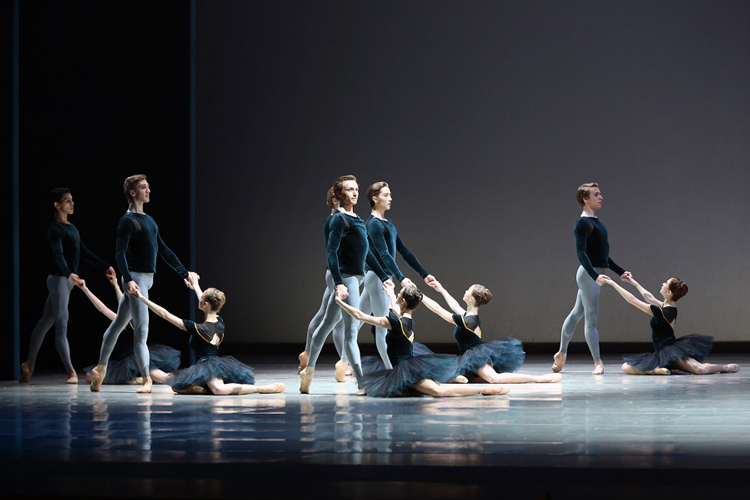
Within the framework of the Festival “The Stars of the White Nights”, the Mariinsky Theater showed a double premiere dedicated to the 125th birthday of Sergei Prokofiev-“Russian Obeck” Maxim Petrov and “Violin concert No. 2” of Anton Pimonov. The meaning of this diptych for the domestic ballet process is Sofia Dymova.
Having entrusted the full -fledged festival premieres to the inaccessible directors - both actively put only the third year - the leadership of the Mariinsky ballet was unanugobic. Young choreographers are recommended, as you know, to start small: short musical plays, a small number of performers. On the other hand, the gesture of the Mariinsky Theater is understandable: the desire to urgently grow their own writers is an attempt to overcome the non -healing “Ratmansky injury” for a year - the departure from the country of the only post -Soviet choreographer with an international renom.
This pain syndrome is a great danger for young choreographers: hurrying to the new Balanchin or the new Ratmansky, the domestic ballet observer makes incredible (and at the same time very vague) requirements for every debut. If a beginner on the first attempt does not give a masterpiece like “agon” or “Russian seasons”, he threatens to be dropped from the cliff as an underdeveloped baby in Sparta. We remember with what rapture the venerable ladies have gone two years ago by the participants of the Mariinsky “Workshop of Young Choreographers” - the benefit of the execution of beginners could be observed on the official website of the theater. Since then, public discussions of new works have completely ceased; Pupils simply refuse the right to student blots in the notebook.
On the eve of the reporting performance, the viewer was free to reason something like this: the theater calling himself the “house of Prokofiev” played all concerts and symphonies to the composer’s anniversary, but the ballet gift was not displayed, so he shut up a repertoire hole under the curtain of the season than he had to, throwing young fools at the protocol event. The latter, however, gave out two masterful, witty ballet, after which it is difficult not to notice that the children grew up. Moreover, as they say on the sidelines, the choreographers themselves showed the initiative and themselves chose specific music for their performances - they must assume, according to some personal (sorry, artistic) needs, and not from loyal love for big dates.
Prokofiev two
The novelties represent two absolutely dissimilar Prokofievs, despite the fact that the third - just the author of one -act ballets for Diaghilev’s entreprise - remained overboard. The choice of Maxim Petrov is a “Russian overture” for a large orchestra-a marginalia on the side of the official biography, not even known even to music-arches. This is the first composition of the composer after repatriation: in it, it is clearly audible in the desire of the light -winged cosmopolitan Prokofiev to remain himself, but at the same time become his own for an imaginary Soviet listener - hence the Homeless Hurry and Pseudo -Russian fringe with a fairly simple design of the play. In combination with a hard and bulky orchestral style, at that time new for Prokofiev, such a “nationality” can scare away from studying the little-known pages of the legacy of the composer-submission for a long time.
Petrov easily managed to find a balance between the abstract academic form and the souvenir "Russian" wrapper. The choreography recalls the best opuses of the Ratmansk, but the idea of mechanized functioning dancers-functions is the opposite, in essence, of the “anthropomorphism” of Ratmansky-and the overall abrisa is more likely to inherit the “wedding” of Nizhinskaya. The complex ensembles of Petrova are a small candle factory, an intricate mechanical toy. The brushes with fists, lifted mouths, a litter with a protruded hand and a stupid look at the sky-the characters resemble the Malevich peasants (costumes of Tatyana Noginova), but in the mise-en-scenes of Robert Wilson, whose work the choreographer clearly studied. Among the fifteen participants, the only living face is an nameless soloist, a universal favorite and an eternal loner, a sorrowful character of “from the author”, with amazing plastic freedom, stained Vasily Tkachenko.
Having built the change of episodes very fractionally, strictly in music - after a series of inventive evolutions of the cordebiary group, he blows from the stage alternately - Petrov caught a happy sensation of the through motor movement, which was not enough for his previous works: unless at the very beginning of the performance rhythmic lethargy and not always logical structure of combinations - but winners, as they say, are not, not the winners. judge.
A small candle factory, an intricate mechanical toy: with fists, lifted mouths, a litmotif with a protruded hand and a stupid look into the sky.
The timeless, overcofal nature of the gift of Prokofiev was most clearly manifested in his finals. He alone was able to paint the all -so -solar sunrises, since the time of the Scythian suite, knowing how to look at them without blinking, and in the late opuses, bringing his favorite trick to the scale of the nuclear disaster. On the last tacts of the “Russian overture” - where the string and wooden winds a hundred times repeat the same pattern, and the red -hot copper roars the lyrical theme - the back is poured with crimson, the groovy men sees on one combination, until everyone crumbles. Kalinka-Malinka and charming dancing are not turning too cheerful, frightening with their outcome mechanism with a denouement. The red sun, at which the peasants looked at the whole performance, gave them a fist on the head.
In the choreographic Austinato of the last minutes of the performance of Petrov, an experienced viewer will see the traverse dance of the chosen one from the “Spring Spring” and the fresh “Bronze Horseman” of the Mikhailovsky Theater, where Peter the Great fell in the fireball in the Petersburgers, and the most farsighted - Ommazh’s “Nutcracker” Dmitri Chernyakov, where in Apotheosis was destroyed by the asteroid. The whole season on ballet stages subconsciously, with manic persistence, the same catastrophic script is reproduced. So in the “Russian overture” “the sacrifice of oneself is an existential, individual act, forced by extreme circumstances, turns into a collective duty” : before us, Russia, the lusting Chelyabinsk meteorite as a desired groom.
In a narrowly craft sense, “overture” is important to an attempt to synthesize the two most important dance principles - classical and characteristic. There is an informal workshop separation: a characteristic dance, understood as a set of Spanish-Synygan-Hungarian dancing, usually stands on the side of the dancer’s career, soloists of a characteristic dance are supposedly losers from those who are not very strong in “pure classics”. Petrov, again, after the Ratmansky, understands the characteristic beginning of wider, as the sharpness of the plastic degree, the “deviation from the norm” of the structure of the basic poses, and implants the strict classics characteristic of the body (which most performers, which is characteristic, so far resists). It is here, according to your observer, that the house of the “Russian overture” is concluded-and not at all in the depiction of the Gorky Russian Propility or Apology of the Olympic-Social Spirit, as someone may measure.
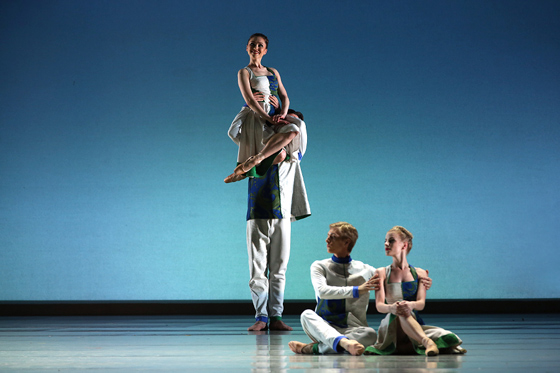 © Mariinsky Theater Scene from the ballet "Russian Oblastura"
Prokofiev is one
If the “Russian overture” denotes a catastrophe, the “violin concert No. 2” represents the utopian space “after the explosion” - the action of the ballet takes place in the beautiful anywhere. The music also has - introvertly, as if devoid of concert shine: hidden fear and anxiety of two extreme parts, a summer tea party on the veranda with Bach in Andante - all this in 1935 marked the end of the composer freedom of Cosmopolitan Prokofiev. A year later, he will return to his homeland, and then the heavy Russian overtures and the October cantata will go in a jamb.
The genre model of the choreographer Anton Pimonov - Balanchin, the main interpreter of the White Ballet in the twentieth century and the author of the great model of the Black Ballet in the later Mozartian. The performance of Pimonova is precisely the black ballet, the negativity of the traditional, festive-aged ballet spectacle. Black packs of dancers, their unblinking gaze into the hall and somnambulic port de Bras - signs of the inhabitants of the reverse side of the moon. Cosmic, paralyzing coldness is also emphasized by exemplary light - Konstantin Binkin gave another reason to recall the performances of Robert Wilson.
“Violin concert No. 2” is a strict ballet. Its signs are an appeal to the posing of Menuet (the ancestor of the classical dance), admiring the intricate ornament, the use of the simplest drawings (for example, building a corps de ballet in two columns) only in special cases. The plot of the ballet - muscle bench press, overcoming, languor: at the very first tacts, Pimonov puts Grand Pli é - a deep slow squat in a well -fed position, the movement from which the daily ballet lesson begins - and makes it try as something hitherto unheated.
Each turn of the head and eyes in the eyes are verified with homeopathic accuracy. Pauses work as a continuation of movement. The basis of the solo party - in which Victoria Tereshkin reigns - is precisely the experience of a lasting pose and precisely calculated micropauses. For 25 minutes, braking and lexical slipping are felt only occasionally - for example, in the Andante reprise. But I don’t want to find fault with the ballet: such an intellectually exquisite and stylish work in Mariinsky had not been to be seen for a very long time.
The same can be said about a pure, disciplining scenography: on both premieres-one set of hard backsters, a white screen, and even two anti-bonfires. Artists - of those who in the current Mariinsky are not particularly expected: familiar from the public "Leo Tolstoy. The secret of success ” and the site “ Batenka, you are a transformer ” Nastya Travkina and Sergey Zhdanov. The screensaver to the "violin concert" successfully imitates the canvases of abstract expressionists; The evil curtain to the “Russian overture”-Khokhloma and the Dome (lustful scrapers), the Maxim Gorky plane and the Falcon, which Stalin gave steel wings. The collage of Travkina and Zhdanov can be called Kitch, but he is absolutely adequate to Prokofiev’s music and, importantly, fixes the current cultural situation in the country: everything is mixed in the general dance and not without some fun flies to hell.
The ballets of Petrov and Pimonov can be interpreted as a kind of research work. The form of an abstract concert of their adherents in 70 years has practically exhausted its capabilities, but so far there has not been a single work in Russian that analyzes the poetics of this genre. The initiative was intercepted by the young choreographers themselves. Subject of study? The expressive power of the ornament and violation of the ornament. Pimonov has a specific ballet irony that does not imply the immediate ridiculous reaction of the viewer. In Petrov’s ballet, there is a naivety that can be attributed to the young age of the author, but which is actually a consciously chosen figurative foundation, ETC.
But the main thing here, perhaps, is this: the fundamental line of the performances of Petrov and Pimonov - their optionality. Today's viewer from each premiere subconsciously expects an act of great art - so that the equestrian monument, the great poet, and damned questions. The premieres of Mariinsky are important as part of the daily work, as a payload for the bodies of dancers: competently arranged material that gives the growth of muscle mass - in the literal and figurative sense of the word.