
Translated material
Mata Hari and Murka
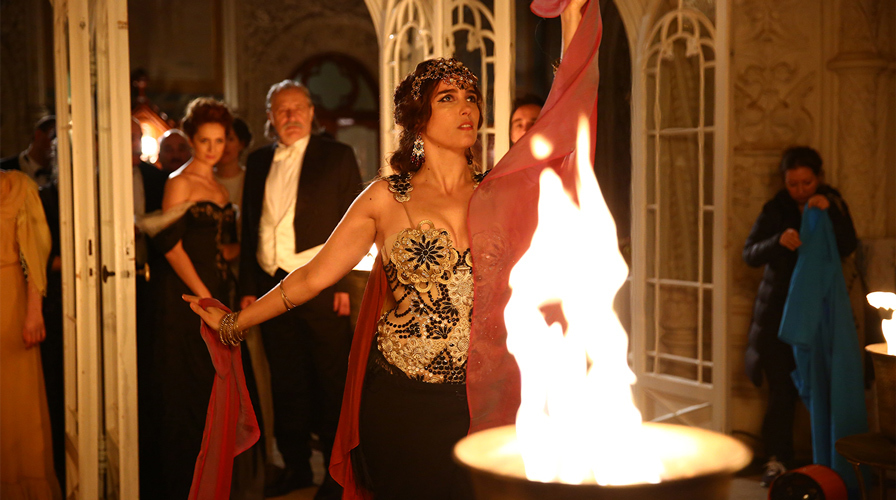
Both the song “Murka” and the myth of Mate Hari are part of the entertainment mass culture that we still take place in the category of “cheap art for millions”, despite the abundant financial injections into the mainstream cinema. Hollywood, by the way, at one time occupied this clearing precisely because he did not skimp. Domestic television also tries not to cheaply: the technical quality of filming is improving, a lot of money is spent on costumes, the situation, they take off a non -standard firmware in the studio, but a variety of nature, even go to Europe. That is, we finally thought about the fact that mass production of cheap crafts ceases to be profitable, and a competitive series for masses requires serious efforts and investments.
The result is still not happy. Even the rating does not rise above the usual one, and public opinion completely ignores the proposed stories. As if showing another "engagement ring - not a simple decoration." It turns out, as one simple -minded user of social networks wrote, “Boring Cinema. But. And the previous “Murka”, and this series is very beautiful films, bright. I like such a movie. ” Bright but boring-it looks like a sentence, even if someone “likes” it.
The new series of Channel One, not by chance, of course, set nearby, have a lot in common. Their title characters are spying under the guise with false names. Mata Hari, as a dancer, worked for foreign intelligence, Marusya Klimova, an employee of the NKVD, portrayed a bandit in the Odessa thieves world. Both did what they did, not so much of their own free will, but obeying the circumstances: in fact, everyone dreamed of simply having a husband, children, to live an ordinary female life, but fate, as they say, forced. Both reluctantly endure the boundaries of a narrow family circle, interfering in big politics.
If the lady is not so reprehensible to the lady, then taking it to enemies literally from an unheated bed is still unethical.
It is interesting that the emphasized forces of their emancipation is interesting: the series is removed for the general public, where they still consider the norm so that a good woman is engaged in a family. In order for the viewer to forgive the violation of the norm, strong motivation is needed. Motivation provides, as always in melodramas, an evil fate. In the series about Matu Hari, the heroine will be mutuated as an orphan of Oliver Twist, a saber-killer husband beats and rape, bribed justice does not protect, the bandits are despised, the bandits are robbing, in short-there is no clear woman in the life of a delicate innocent woman. And then she has to act herself. In the series about Murka in the role of an evil fate, her healer-killer-prodon-head, who substitutes her herself and her groom under the bullet, acts-and now the groom is killed, the connection with the center has been lost, and the woman has to take out the Nagan and begin to act.
Both heroines are so beautiful, so innocent that the misfortunes literally have to jump on them, like a tiger from an ambush, unexpectedly and for no particular reason. The authors need suffering in order to force the audience to sympathize with the sufferers. The problem is that in the classical melodrama, where the victim suffers the persecution until fully humiliated, it is not adopted by its virtue, for which in the end it is awaiting a reward. The real melodrama does not tolerate moral relativism. But the heroines of the new series do not retain innocence. Murka is crumbling from the gun of bandits, who, of course, are bad, but still people considered her their own. This is even according to the laws of the old thieves song is punishable: “You made all our raspberries / and get a bullet for this!”
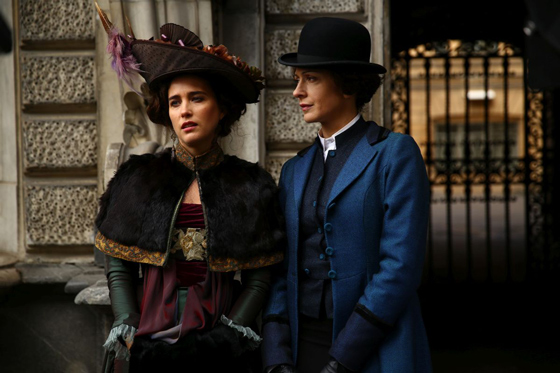 © Channel One Hard from the series "Mata Hari"
As for the lovely Margot, she is Mata Hari, then her actions cannot be justified even by class interests, and if the lady is not so reprehensible to seduce the young officer, to give it to the enemies literally from an unhealthy bed is still unethical. However, what can you do: business is business. Like real heroines of melodrama, both young ladies do not choose their own path on their own, but they are not rock or even the logic of the genre, but the playful hand of the author’s arbitrariness of the screenwriter.
The screenwriter is a problem. No matter how much they participate in writing the script (and in our cases this is a collective thing), something convincing cannot come up with. Occasionally, dialogs learned to write, but they cannot compose a plot. Perhaps that is why the plots are not the main thing in both series, the efforts and budget are not spent on the invisible slaves of the television market that compose them. And in that and in another series, the action is static, sluggishly, accidentally, in a word, does not have an internal engine. Instead, external stimuli. How to justify one or another event is not important, any reason is suitable. The desired character is in the right place by itself - the case brought. The case is an excellent assistant to weak playwrights.
Sometimes there is a sinister place, a sort of mordor surrounded by thunderstorm clouds, and then the inscription “Moscow, Lubyanka” appears on the screen.
Problems with the plot are associated with the lack of ideology - not the one about liberals and conservatives, but the one that about life and death. Why does a person live, what does it mean to die, how life is arranged, is there a soul, well, in general, all this that is now considered not worthy of attention with mutation. For any literary text, especially mass -cult, it is necessary to understand how the rules of life are arranged, who controls it. Ah, does man manage? So why don't you give him freedom then as part of the plot?
No sense from life, told by the series about Murka and Matu Hari, cannot be extracted. And from the thieves' song, by the way, it is possible: life is tragic and unreliable, but death overtakes the traitor.
Due to the lack of the main meaning, the genuine super-task of the work, the creators of the series are trying to take the beauty of the images, as they said in the twenties-with viracy.
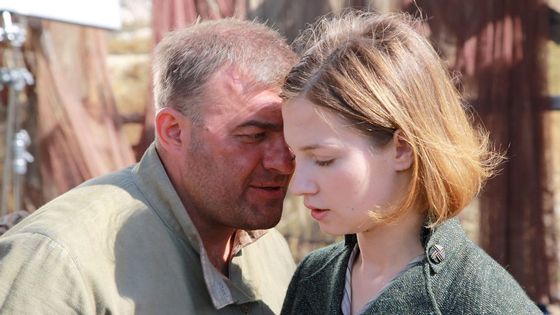 © Channel One Hard from the series "Murka"
In the series about Mata Hari, money for secondary details did not regret. True, the film was shot for a long time, so sometimes annoying discrepancies come across, but still the creators tried to build a background in the frame, it is dense, "like in a movie." But the background will never replace the main one, alas.
Less money was spent on Murka, there was no travel to Paris, I had to reduce locations. It is noticeable of some uniformity of the places of action: it seems that all the thieves of Odessa are sitting all day in one hotel, sometimes walking to a billiard room, a photo studio and a hairdresser. Yes, there is also a salon of a fashionable dress, where, by the way, the same jerk hangs that Murka will not wear. In addition to the unsteady jacket in this salon, the Murka is abducted from under the nose of the stupid groom, her new groom leads there, there she changes completely in the spirit of modern shows such as “Take it off immediately”. Well, also the building of the local police and the bank. However, sometimes there is a sinister place, a sort of mordor surrounded by thunderclouds, and then the inscription “Moscow, Lubyanka” appears on the screen.
They also painted the “Murka” - where there is “Stirlitsa” - with aniline paints, so that the Berlin azure literally floods the houses, courtyards and faces of the characters. It turns out a bright and cheerful sight, like a gang of “jumpers” with red clown noses, proving that everything in this series is a pink, not seriously, cranberry juice instead of blood.
The fabric of our culture is too thin: alas, it, with a swellfulness, is not enough strength of strength, the dilapidated stamps quickly wipe, without increasing meat. Neither Chapaev, nor Stirlitz, nor even mimino are eternal.
This attitude - “well, how to seriously believe in these nonsense” - strongly fails the authors of the series, and not only these.
Although, composing the “Murka”, its creators still thought about the genre and decided to justify the plot scheme with its help. This is something like a new Odessa comic book, where numerous types created by both the fantasy of the people and the professional efforts of culture are accumulated into the narrative. Kostya-Buhglatter hints at the well-known Moldavanka Kostyu-Moryak. Garmash plays more than once by the played -up thief, the commissar Sonya in Galife's pants also appeared more than once in Soviet cinema, like the rest - from the intellectual Kataev to the ambal of the Schiffonier axis. The problem is that the fabric of our culture is too thin: alas, she, a shame, lacks a margin of strength, the dilapidated stamps quickly wipe without increasing meat. Neither Chapaev, nor Stirlitz, nor even mimino are eternal.
And finally, the main characters. I do not want to discuss actresses here, they play as they can and are not to blame for anything, the director and playwright are responsible for the role. In the end, they chose them. The idea of a violent awakening of female consciousness, unprecedentedly active, until complete superiority over men, female nature could become an interesting spring for the plot. But the authors of the “Mata Hari” are clearly focusing (consciously or not) on the immortal “Angelica, the Marquis of Angels”, the very one that, along with the “phantom”, raised the status of French cinema in the early 70s. Apparently, they believe that this type is now needed by the audience of the European series (and the intentions of producers to make a product for the international market are obvious). And here is before us - a beauty, a sexual idol, an object of inexplicable carnal lust. Alas, they did not find the second Michelle Mercier for the role of Mata Hari. And the time of simple sex symbols is gone, to be honest.
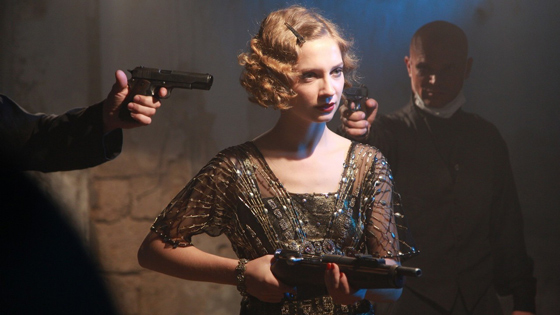 © Channel One Hard from the series "Murka"
As for Marusi Klimova, the authors played a little with her image: to realize the type of a simple -minded girl who had to become a merciless Furia of violence, while completely not changing internally, the task is arch -sized, but also curious. But again - it would be impossible to play such a role without material without a stronger actress than Maria Lugovaya. Moreover, the creators of the series are clearly fascinated by more colorful characters, such as Zakhar Cardjoglo (it was played by the general producer of the series and the script co -author Dzhanik Fayziev), Osia Schiffonier, Tsilya or Greek. Marusya is left to the arbitrariness of a whimsical plot, the main task of which, as it seems, is to hold out 12 of the intended series.
It is good that the idea of thinking about a genre that can justify any implausible, but fascinating plot, visited television heads. However, Yuri Tynyanov, who was one of the first to think about the ratio of the theme and material, plot and plot, wrote: “Ideology enters (in the cinema) not an abstract theme, but a specific material and style,” and his friend Shklovsky added: “There is a wild extermination of topics. You need to be able to <...> to turn topics into a design. " But we don’t know how to do this, because the vision of the leaders of the serial workshop is faceted, like a dragonfly.