
Translated material
Colta.ru
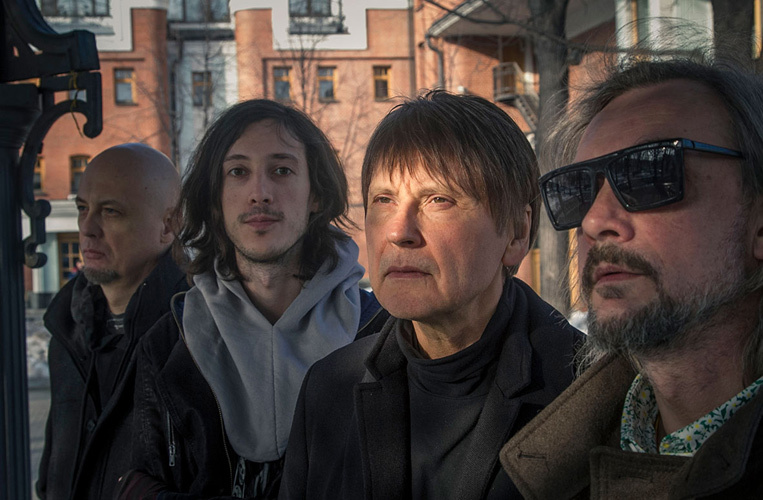
The business card of the Alliance group is “at dawn”, the most ornate rock hit of the Soviet Union, which, despite its musical sophistication, can still be heard on radio waves, and at a disco, and in a Sochi restaurant. This complex song, soaring upside down in the chorus, is still trying to pick up and, not embarrassed, to sing in chorus in public places, which is actually not very typical of the Russian nation. Such is the amazing lifting force of the synthesizer chords “at dawn”, which accelerates the elegant bass racing with a graceful foreigner.
Everyone born in the Soviet Union should know the chorus “at the dawn” and not remember the word from the verses, because the music in this song, as it should, should be self -sufficient. She expresses emotions that are not capable of words - a diad of feelings, composed of intoxication with a sharp rise and bitterness of awareness of the inevitable fall. The “at dawn” was twisted in the legendary television program “View” when it was a searchlight of perestroika. This is partly why, rather, because of the accurate sensation of the time, the victories of which turned into defeats, this song of the “Alliance” is perceived by the same musical symbol of the change of historical eras as the Tsevskaya “We are waiting for change”. Although, by all signs, its antipode is romanticism against sociality, impressionism against plasteness, individualism against the feeling of the elbow, moonlight against the burning of the red sun.
By the time of the record “at the dawn”, which many perceive as the anthem of the irrevocable youth, the “alliance” lived already his second, mature life. The fate of one of the first Moscow groups of the “New Wave” was never even: the fall followed the fall, and the fall, according to a slightly esoteric alliance philosophy, is “all my desires take off - it carries new dreams with itself”. The first life of the “Alliance”, which declared itself in 1982 at the underground rock festival in the concert hall of the MIPT in Dolgoprudny (by the way, along with other debuting the New-Viva pioneers-“Center” by Vasily Shumov), ended with the advent of Secretary General Andropov. In 1984, the authorities began to hastily close the windows, opened due to the senile weakness of the muscles of the Brezhnev regime, which pulled the air of freedom, and opened a demonstration campaign to combat rock music. The famous black list of prohibited groups , “whose works contain ideologically and morally harmful works,” “Alliance” for some reason went to the first among Moscow rock groups (the list was not compiled according to an alphabetical principle).
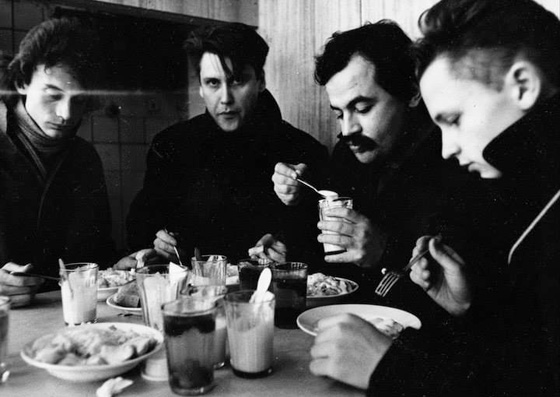 © from the archive of the Golden Composition of the Golden Assistance group: Igor Zhuravlev, Andrey Tumanov, Oleg Parastaev, Konstantin Gavrilov. 1987
“What did they hear anti -Soviet in our songs? - Igor Zhuravlev is still amazed. - In the innocent “let me in the queue” or the pacifist “full of toy house”? They could complain about the song with the words “The Park opened the attraction“ Smart head ”.” Like, what kind of head is without a body - Lenin or Brezhnev? “And just in case, they banned.” The Alliance, who worked out its “new-wave” manner of dancing for advanced MFT students, where they performed the Blondie , Police and Talking Heads songs, always aspiced with social topics, preferring metaphysics. The maximum that the hero of Zhuravlev was capable of is ironic observations of life, a sentence to a friend: "You are still a doll." But the anti -zero campaign had fruits: the “Alliance” was expelled from the Kostroma Philharmonic, which served as a cover for them, the group broke up, Zhuravlev had to work for a construction site - in an institute geodetic specialty.
The Alliance was revived in 1986, when they waved a hand on rock, and in an ultramoded electronic sound. To the founders of the group Igor Zhuravlev, Basist Andrei Tumanov and the sound engineer-Sund Produer Igor Zamaraev are joined by the keyboards Konstantin Gavrilov and Oleg Parastaev, the drummer replaces the rhythm-box. The star hour of the new “Alliance” will come at the first official Moscow rock festival “Rock-Panorama-87”, made by Stas Namin at an “foreign” level that was unprecedented then-two scenes, thanks to which the groups could act without pauses, the favor of the authorities, the Live -recording of the festival and the double vinyl record on the “melodies” of the post-Factum. At this festival, which shook the small sports arena of Luzhnikov, for the first time and sounded to the large audience “at dawn”, composed by Oleg Parastayev and spiritualized by Vocal Igor Zhuravlev, which was very incredible by the school of academic singing at the Ippolitov-Ivanov Music School (where he was in the same stream with Jeannia Aguzarova). After Rock-Panorama, the Alliance began to perform at stadiums. The desire not to miss the chances provided by the recognition by the “Alliance” to the record “Record”, which was then engaged in the future oligarch from show business Sergei Lisovsky, and in a wonderful company of pop stars Sergey Minaev, Vladimir Markin, Volodya Presnyakov and Alla Pugacheva-the rock band took part in giant teams, wrapping up worshipers. The expanses of the USSR.
Six months later, Igor Zhuravlev was bored with opening his mouth under the plywood - he parted with Oleg Parastayev, who starts in return the NRG group, returns the drummer Yuri Kistenev and guitarist Sergey Volodin, writes a new hit built on slaughter guitar riffs and a galloping bass party, “Mom, Hope.” This third composition of the “Alliance” by Zhuravlev and Tumanov is called classic-it was in this form that they heard and remembered the Moscow Pioneers of the “New Wave” then the young participants of the Bi-2 and Technologies, who consider them for their teachers. In this composition, they performed in the 1990s along with Kino (as well as “Lube”, hard-rockers “Your Day”, Joanna Stingrey and “Biosstruktruktroter”) at a historical concert at the Luzhnikov large sports arena, arranged by the Moscow Komsomolets newspaper. In the report, published after the concert, the MK correspondent Arthur Gasparyan noted: “Being recently the hero of the light neuromancy, the Alliance has recently deepened in search of something more significant and intellectual and is trying to gain new recognition along this path.”
The fourth life of the “Alliance” begins with the advent of the singer Inna is desirable in the group, and in music - the color of Russian folk songs and instruments brought by the collector Sergei Starostin. This period was recorded on the third album of the “Alliance” “Made in White” , recorded by Igor Zamaraev in 1990, is an amazingly thin and balanced work where male and female, pagan and Orthodox, Slavic and Anglo-Saxon, folk and rock and rolling principles, to give the birth of a new musical aesthetics, which no one in Russia in the 1990s is in Russia Not appreciated.
We did not assume that with the opening of borders in Russia, both the level of education and the level of culture would fall, and the taste would completely disappear.
“We wanted to raise a taste. It seemed to us that along with perestroika, with the freedom that opened, the public would become more demanding, ”Igor Zhuravlev said bitterly. - We did not assume that everything would happen exactly the opposite, that with the opening of borders in Russia, both the level of education and the level of culture would fall, and the taste would completely disappear. As a result, we were on the sidelines. ” “Made in white” really liked the foreigners-it was awarded some rewards in France, the interest in this record laid the foundation for the demand for Inna of the desired and the Farlanders group at World Music western festivals, but Russia, which was shocked by political and economic crises, was clearly not up to the lady's songs of Zhuravlev. Once facing a new reality, many participants in the Alliance left for Europe - including the permanent producer Igor Zamaraev, and Igor Zhuravlev stayed in Moscow and left his head along the third, psychedelic, path to a conscious and fundamental underground.
Now the Alliance lives a new one - either the fifth, or the seventh - life. Together with the founders of the Zhuravlev and Tumanov founding in the group, an experienced session is played, the keyboard player Vyacheslav Zinovsky and the representative of the new generation-the son of Igor Mitya Zhuravlev. Around the “Alliance” there was a small cult, only the initiates know about it - the classics that play younger than the young, occasionally give concerts and take part in festivals. As in the Andropov eighties, the leader of the Alliance Igor Zhuravlev earns a living in the first geodetic specialty and accumulates the song to the fourth album - not in a hurry, as if there is no death. Or maybe, in fact, there will be no rise in every fall.