Translated material
Baptism of Sobyaninskaya Moscow
In society
 Baptism of Sobyaninskaya Moscow
January 19, 2011 Boris Kolymagin
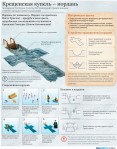
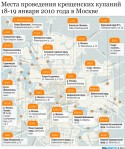
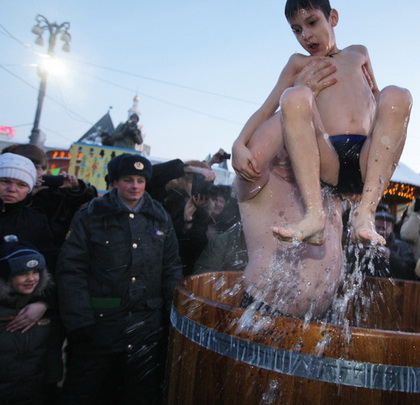 Sobyaninskaya Moscow celebrates baptism. Lyudmila Shevtsova, deputy mayor of the capital on social policy, held a meeting with officials and representatives of the church. She said that about 70 fonts were arranged in the city in almost 60 places. All of them are equipped with comfortable gatherings, an ambulance and police, rescue services will be on duty near the ponds. The font will be installed even in the very center of Moscow, on the Square of the Revolution, and everyone will be able to plunge in it after the water prayer. This year, according to the prefecture of the Central District, bathing will take place under the bell charge and performances of folklore groups.
Probably, there is nothing wrong with the fact that secular authorities take part in a confessional festival. Last year, more than 330 thousand Muscovites participated in the Epiphany events, and the state, with such a number of participants, could not let the matter on its own. Another thing is that the holiday itself has turned into a certain demonstration of the “Russian world”, which is not tired of reminding the Orthodox media, and was far from the spiritual foundations of life.
Patriarch Kirill felt the danger of baptism reduction, and in the Epiphany Christmas Eve opposed the folklorization of this twelve holiday.
In ancient times, Christmas and Baptism were celebrated on one day, and this holiday was called the Epiphany. By tradition, on this day, new members of the Church were baptized, who had been preparing for the sacrament before, read the Holy Scriptures, and thought about their moral landmarks.
Actually, the consecrated baptismal water was intended for them. But then, when the missionary efforts of the Church weakened, and prolonged catechesis became history, various legends about the miracle of baptismal water appeared, in no way connected with the realities of the ancient Church. Epiphany water, they say, is stored for years and does not deteriorate, and the baptismal dipping helps to strengthen health.
Practicing Christians moan because this twelve holiday cannot be parted: the clergy are mainly engaged in the distribution of holy water. And this situation has existed for decades. In the post -war reports of the authorized council for the Russian Orthodox Church, numbers are given that after Easter the baptism was the most popular holiday of the Soviet church people and people exposed long lines in the cold to get a can or a bottle of cherished fluid.
Last year I saw the light of the two -volume of Fr. Alexander Shmeman “Conversations on Radio“ Freedom ”” (PSTGU, 2010), thinking about this phenomenon. His performances on the air, collecting from the receiver those who, in the most deaf Soviet times, excited issues of faith and Christian culture, for many years remained for many the most important source of knowledge about Orthodoxy. Of course, you can complain that far from everyone did not reach the Soviet “muffles” of the priest. But even if there were no muffles, he would be heard by everyone and correctly understood about. Alexander at home?
Schmeman devoted several conversations at Freedom to the miracle and superstitions associated with him. Now we see that “miracles” for church administrators are one of the ways to revive church life. “These are the miracles of baptismal water, fertile fire, the relics of saints - come and use,” as if they call.
Shmeman categorically opposes such a utilitarian approach. If there were so many visible miracles in the world, he says, it is simply incomprehensible how unbelievers still exist. The gospel denies a miracle as a “cause of faith”, as a proof of God's being. Christ remained primarily in the image of a poor, persecuted, homeless person. And when he rose from the dead, neither students nor women who came to the coffin recognized him otherwise than faith, some kind of internal, mysterious, and not our “objective” knowledge.
And at the same time, continues Fr. Alexander, Scripture is full of miracles: healing, visions and the like. How to coordinate this undoubted “miraculous” of the Christian faith with its denial of a miracle as a simple evidence? 
Answering this question, Shmeman notes that the world itself, life itself is a miracle that will never get tired of delving into, which a person will never cease to be surprised and admired. Christ worked miracles because he loved, spared, compassion.
“Miracles without love are deception and self -deception, and they really need and can be rejected. But love is a miracle, and this miracle reveals to us wonderful possibilities, not to see and not recognize which means not to see and not understand anything on earth, ” - maybe a little pathetic about. Alexander.
Shmemann is not touched by the baptismal fun of the Russians, all this Shmelevsk-Zaytsev Orthodox patho. Yes, he loves Russian culture, literature, but not as an identification sign of the “Russian world”, but as an assistant on the ways of collecting an inner person.
Unfortunately, people's scale about. Alexandra is always not enough, and they are still “muffled”, not in the same way. People of the system broadcast, and those who touch the last things are silent, they are almost inaudible.
Therefore, I would like to break through the new “jammers” of Shmeman's voice today. At least so, in the context of baptismal thoughts. Indeed, thanks to this wonderful theologian, much falls into place.
Photos and infographics RIA Novosti