
Translated material
Two accidents?
Around Russia
 Two accidents?
March 18, 2010 Alexey Makarkin
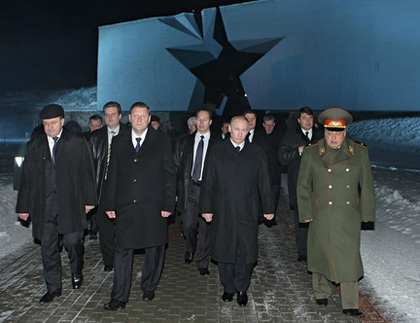
In the relationship between Russia and its two eastern neighbors, two small events took place. The Belarusian President Alexander Lukashenko did not find time to meet with Russian Prime Minister Vladimir Putin. And the deputy head of the administration of the head of the Ukrainian state Anna German made it clear that her chief Viktor Yanukovych would not deprive Stepan Bandera posthumously awarded to him the title of Hero of Ukraine.
Two accidents in one week? It is unlikely. Although they can be explained by formal reasons. Indeed, Lukashenko was on a visit to Venezuela by Hugo Chavez, and it is impossible to be in Karakas and Brest at the same time. In addition, Putin is not a president, but only the prime minister, so he should meet with the Belarusian "man number two." As for the story with Bandera, being on a visit in Moscow this month, Yanukovych promised to consider the cancellation of the decree on the assignment of the title of Hero of Ukraine to the leader of the organization of Ukrainian nationalists Stepan Bandera until the day of the victory of May 9 of this year. But to consider does not mean canceling. After all, you can consider, think and save the status quo.
In fact, such explanations cannot mislead anyone. It is clear that Lukashenko does not have such a large selection of priority foreign partners so that he could not agree that he first meet with Putin, and then go to Chavez - or vice versa. And that in modern Russia there is a ruling diarchy, in which Putin’s influence is at least no less than Medvedev. Obama and Sarkozy are de facto recognized, and only Lukashenko is an exception, acting strictly according to the protocol, as if there are fibers or Zubkov at the head of the Russian office. As for Yanukovych, his statement at the Moscow press conference cannot be interpreted otherwise than the promise to make a political decision on the painful issue of Bandera’s awarding painful for Moscow (and, for Warsaw). Moreover, the promise given in the presence of President Medvedev.
The real motives of such iconic actions of neighboring presidents are understandable. Lukashenko leads a long and tense oil dispute with Russia (regarding Russian oil re -exported from Belarus to Europe) - and the agreement reached during his course can only be considered as intermediate. Russia would like to privatize the Belarusian refineries, which is unacceptable for the "Old Man", used to keeping the economy of its country under its own vigilant control.
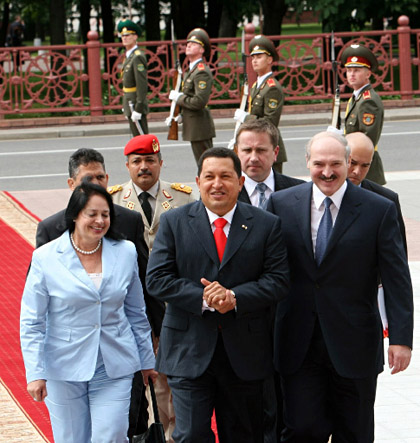 While in Venezuela, he agreed on the supply of oil from Venezuela, which does not put forward such conditions. Moreover, she allowed Belarus to participate in oil production in its territory (Minsk owns 40% in the mining joint venture of Petroler Belvenesolan). True, Venezuelan oil can cost Belarus much more expensive - it must be transported on tankers through the Atlantic. Perhaps the Belarusian president is blackmailing Russia, and does it very sweeping and not without the excitement of him? It seems that not only - after all, we are talking about specific agreements on the supply of 80 thousand barrels of oil per day, which Lukashenko will be able to sell to the West. If we take into account that the country receives oillessly from Russia for Belarusian needs itself (and will receive - otherwise the project of the Customs Union will collapse for Moscow), it is an attempt to classical diversification.
It is also possible that Lukashenko did not want to meet with Putin for another reason. He has nothing to tell the Russian prime minister on the recognition of Abkhazia and South Ossetia, which Moscow has unsuccessfully achieved from Minsk for a year and a half. Putin’s words that Russia has always advocated the normalization of Belarusian relations with the West, and if it occurs on the basis of non -recognition of the republics, then it seems to be even good, you cannot consider simple irony. This is a pronounced sarcasm, to which the Russian prime minister resorts infrequently.
Yanukovych has a different situation. He had a strong conflict with a significant part of the Ukrainian intelligentsia, displeased by the appointment of the famous Russophile Dmitry Tabachnik to the post of Minister of Education and Science. Yanukovych wanted to soften this decision by appointing this policy “only” by the Minister, and not the Deputy Prime Minister (as the Tabachik himself was counting on), but did not achieve the expected result. Lviv and Kyiv professors and students were already deeply offended by the election of President Yanukovych - they were just waiting for the reason to start protest actions. In addition, in the Party of Regions itself there is no one attitude to the truly very controversial figure of the tobacco. True, the latter is supported by scientists and teachers of the East of Ukraine, but they have a problem with - how it is now fashionable to say - passionarity during all recent years. It is not surprising that Yanukovych seeks not to annoy the Ukrainian West even more, depriving the “regional hero” to Bandera of official national recognition. And, accordingly, calling new protest promotions.
All these arguments are clear. But a logical question arises - how do you really relate to your CIS partner in order to go to such demonstrations? It seems that both in Ukraine and in Belarus are considered by Russia only as a resource that must be used if necessary - but not only to act exclusively in their own interests (you can just understand this!), But also not to think about not offending the eastern neighbor. In turn, Moscow is often in a hurry, inertially not perceiving its neighbors as full -fledged independent states, when it is harshly insisting on the implementation of its own priorities. This, of course, even more complicates the already difficult interstate relationship.
Author - First Vice President of the Center for Political Technology